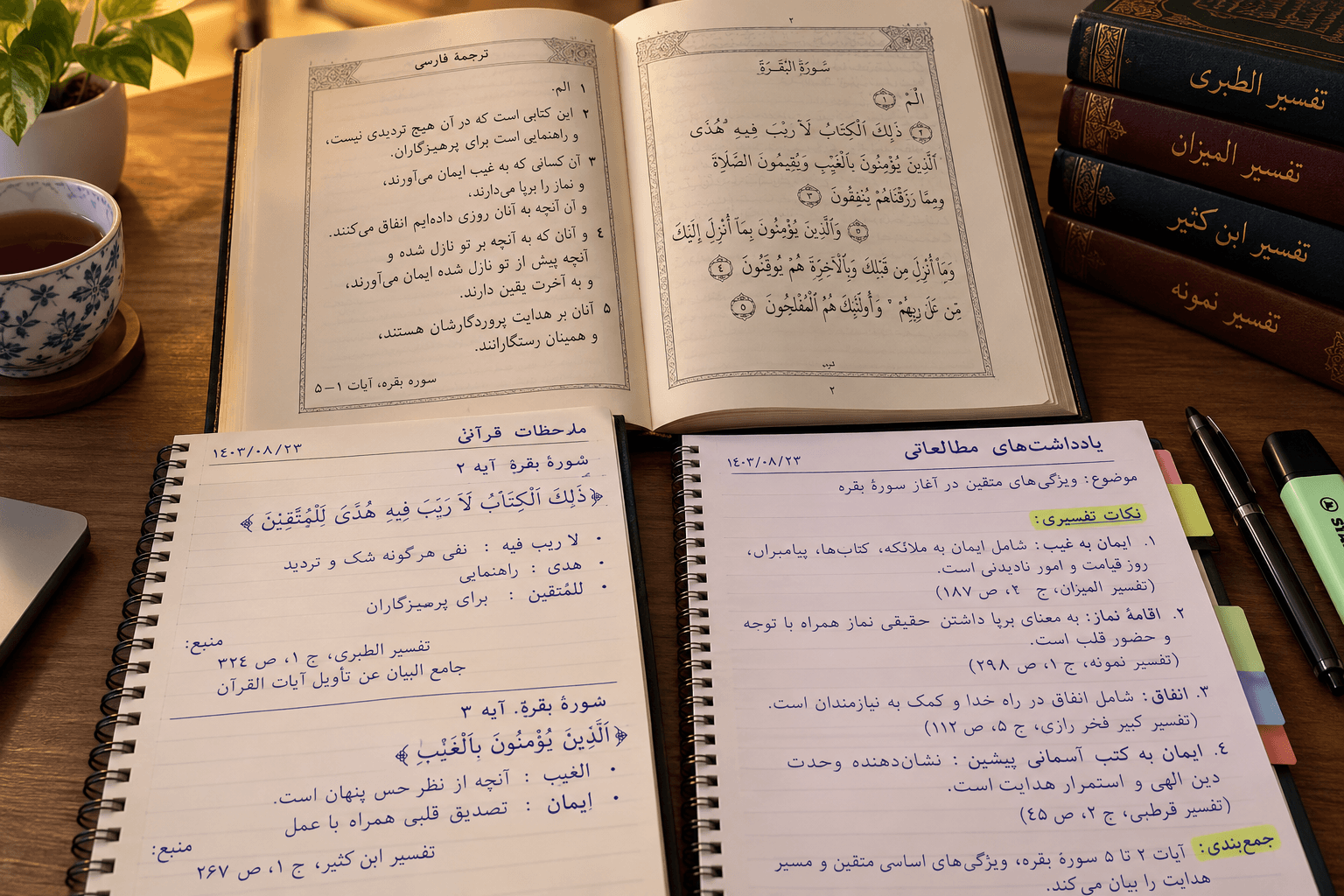
The Hidden Words of Bahá’u’lláh is a collection of brief religious passages revealed in Arabic and Persian in 1857–58, during Bahá’u’lláh’s exile in Baghdad. The standard English arrangement contains 71 Arabic passages and 82 Persian passages, translated by Shoghi Effendi. For Bahá’ís it is scripture; for any reader, understanding it begins with its two parts, its distinctive voice, and the exact edition being read.
In brief: Read The Hidden Words as a complete two-part work, not as a loose anthology of inspirational quotations. Record the Arabic or Persian section, passage number, translator, addressee, image, and ethical demand. Then distinguish what the passage says from the interpretation you bring to it.
Bahá’u’lláh composed The Hidden Words, also known by the Persian title Kalimát-i-Maknúnih, as a series of compact addresses. The Bahá’í Reference Library dates the work to 1857–58 in Baghdad and identifies Shoghi Effendi as the translator of its current English text.
The work’s Arabic preface presents the passages as a concise expression of truths revealed through earlier prophets. That is a theological claim made by the text, not a neutral finding that all religions teach the same thing. Readers comparing traditions should study each earlier source in its own setting rather than using The Hidden Words as a substitute for them.
|
Feature |
Source-grounded description |
Reading caution |
|---|---|---|
|
Date and setting |
Revealed in 1857–58 during Bahá’u’lláh’s Baghdad exile |
The often-repeated account of composition beside the Tigris comes through Bahá’í historical memory and later reporting |
|
Form |
A preface, 71 Arabic passages, 82 Persian passages, and a Persian conclusion in the standard English arrangement |
Some Persian editions number or order a passage differently; always name the edition |
|
Voice |
Most passages present divine speech directed to a named human addressee |
A devotional voice should not be silently converted into the author’s detached historical commentary |
|
English text |
Translation by Shoghi Effendi, refined across early twentieth-century editions |
Archaic English belongs to the translation; it is not the grammar of the Arabic or Persian originals |
|
Religious status |
An authoritative work of Bahá’u’lláh for Bahá’ís |
Historical and literary study can describe that status but cannot assign belief to every reader |
The independent Encyclopaedia Iranica entry describes the work as spiritual and moral aphorisms and documents its manuscript, numbering, and translation history. It also reports that the passages were set down over time and later organized in their present sequence under Bahá’u’lláh’s direction. “Aphorism” is useful for describing brevity, but it does not mean that each passage is self-contained or interchangeable.
Both parts repeatedly begin with a direct call such as “O Son of Spirit,” “O Son of Man,” or another named address. The addressee matters. It positions the passage as an encounter and can shift the tone before any counsel, warning, image, or promise appears.
The Arabic part often states counsel in compressed, direct sentences. Its opening passages move through the heart, justice, love, self-knowledge, detachment, moral accountability, and relations with other people. The Persian part often uses a denser field of images: the beloved, nightingale, rose, garden, bird, candle, dust, and journey.
That contrast is a tendency, not a rule. The Arabic passages also use rich imagery, and the Persian passages include sharp ethical instruction. Literary scholar Amin Banani argues that the Persian section cannot be reduced to one genre: it moves among advice, mystical vision, symbolic narrative, song-like expression, and admonition. A careful reader therefore asks what a particular passage is doing rather than assigning one fixed style to an entire language section. Banani, “The Hidden Words of Bahá’u’lláh”
The following route does not claim to summarize all 153 passages. It gives a beginner four places to observe how voice, image, and action work together.
|
Reading window |
Start with |
Notice |
Ask |
|---|---|---|---|
|
Heart and justice |
Arabic 1–2 |
Counsel about the heart is followed immediately by justice and independent seeing |
How does inward character become a way of judging and acting? |
|
Speech and accountability |
Arabic 25–31 |
Pride, fault-finding, inconsistent speech, refusal, and daily self-accounting form an ethical sequence |
Which passage concerns my own conduct before it concerns someone else’s? |
|
Shared origin and oneness |
Arabic 68 |
Common origin is connected to refusing superiority and making oneness visible through action |
What action does the passage require beyond agreeing with an ideal? |
|
Image and conduct |
Persian 1–7 |
Birds, gardens, love, companionship, envy, and “deeds, not words” appear close together |
How do poetic images lead into concrete moral demands? |
Arabic 1 begins with the condition of the heart. Arabic 2 then places justice at the center of seeing and knowing without simply borrowing another person’s judgment. Read together, they resist two reductions: spirituality as private feeling and justice as a slogan detached from character.
This does not turn Arabic 2 into a modern theory of courts, elections, or research methods. It does provide a textual reason to connect justice with responsible perception. State the modest claim first; broader applications need their own argument and evidence.
Arabic 25–31 addresses arrogance toward the poor, attention to other people’s faults, speech about others, mismatch between commands and conduct, reciprocity, response to need, and self-accounting. The sequence makes quotation-as-accusation a poor reading habit. Before applying a warning to an opponent, ask what it exposes in the reader.
Persian 5 supplies the compact phrase “deeds, not words.” Its surrounding passages bring love, companionship, envy, and movement toward the beloved into view. The ethical command is therefore not an isolated productivity motto. It belongs within the work’s relationship between divine love and transformed conduct.
Arabic 68 connects a shared origin with the refusal to exalt one person over another. It then moves into coordinated images of living and acting as one. Within the passage’s religious frame, oneness is not merely an idea about human sameness; it is to become recognizable in deeds.
A comparative reader should not use this passage to claim that every religion grounds equality in the same way. Our guide to comparing religions without flattening their differences explains why a similar ethical conclusion does not prove an identical theology, history, or practice.
The Persian opening’s nightingale, rose garden, Solomon, Sheba, phoenix, and journey are not ornamental synonyms that can be replaced without loss. Banani connects these motifs with Persian literary and Islamic inheritances. A reader without that background can still follow the passage, but should mark the images as research questions rather than inventing a universal code for each symbol.
Start with description: identify the image, its movement, and the action requested. Then consult a qualified commentary or literary study. This sequence keeps the image available for interpretation without pretending that the first association in English exhausts it.
Use one note for one passage or a short, clearly bounded sequence:
For Arabic 68, for example, the location and translator make the citation recoverable; the shared-dust image supports a claim about refusing superiority; the requested action supports a claim that unity must be enacted. The passage alone does not provide a complete history of Bahá’í teachings on race, government, economics, or community life.
If an AI tool helped locate the passage, follow the religious-citation verification checklist. Confirm that the words occur in the stated section and number, that the quotation belongs to the named translator, and that the surrounding text supports the claim.
The official online English text identifies Shoghi Effendi as translator, with assistance from English friends. Encyclopaedia Iranica records an initial 1923 publication and a refined 1929 translation, as well as earlier English efforts by other translators. Those versions can be useful for translation history, but they should not be blended into one quotation.
Three details belong in every precise citation:
This matters because some Persian editions split or reorder material differently. In the standard English arrangement there are 82 Persian passages; an edition with 83 is not automatically missing or adding a teaching. Check how it divides and numbers the text before declaring a contradiction.
Translation also changes a reader’s first associations. Words such as “soul,” “spirit,” “heart,” “self,” and “detachment” can carry large arguments. Use our sacred-text translation worksheet to keep wording, context, translator, and interpretation in separate fields.
Plurilore’s Bahai corpus guide describes a bounded public-domain source collection. It does not claim to contain every authoritative edition, original-language text, historical document, or current institutional statement. Use the Bahá’í Reference Library for the authoritative online English text and disclose the edition behind any retrieved passage.
The standard English arrangement has 153 numbered passages: 71 in the Arabic part and 82 in the Persian part. Some Persian editions count 83 because of how one passage is divided or ordered. Cite the section, number, and edition so another reader can find the same text.
Its Arabic preface presents the work as a concise expression of the inner essence of earlier revelation. That is the work’s own theological framing. It should not be turned into the historical claim that every tradition or scripture can be reduced to these passages. Comparative study still requires each tradition’s own sources and interpreters.
The online English text is Shoghi Effendi’s translation, refined during the 1920s, and uses forms such as “thou,” “thee,” and “hath.” Those choices shape the English register; they are not evidence that Arabic or Persian has the same grammar or that another translation may be quoted as if it were identical.
You may begin with one numbered passage, but read enough around it to see recurring addresses, images, and ethical movements. Encyclopaedia Iranica reports that Shoghi Effendi did not assign doctrinal significance to the order. Reading each part from beginning to end still helps prevent a favorite quotation from standing in for the whole work.
They are Bahá’í scripture and carry a devotional and authoritative status for Bahá’ís. Other readers can study their language, history, ethics, and reception without claiming that devotional authority for themselves. State which perspective—participant, historical, literary, or comparative—guides the question you are asking.
Choose Arabic 1, Arabic 2, or Persian 5 in the official edition. Record its section, number, translator, and opening address. Paraphrase the movement of the passage, name one image or demand, and write one limit on your conclusion. That small note turns a memorable sentence into a source you can revisit, verify, and understand more carefully.
Follow the Kojiki from the first kami through land birth, Izanami's death, Yomi, and purification, with translation and source limits visible.