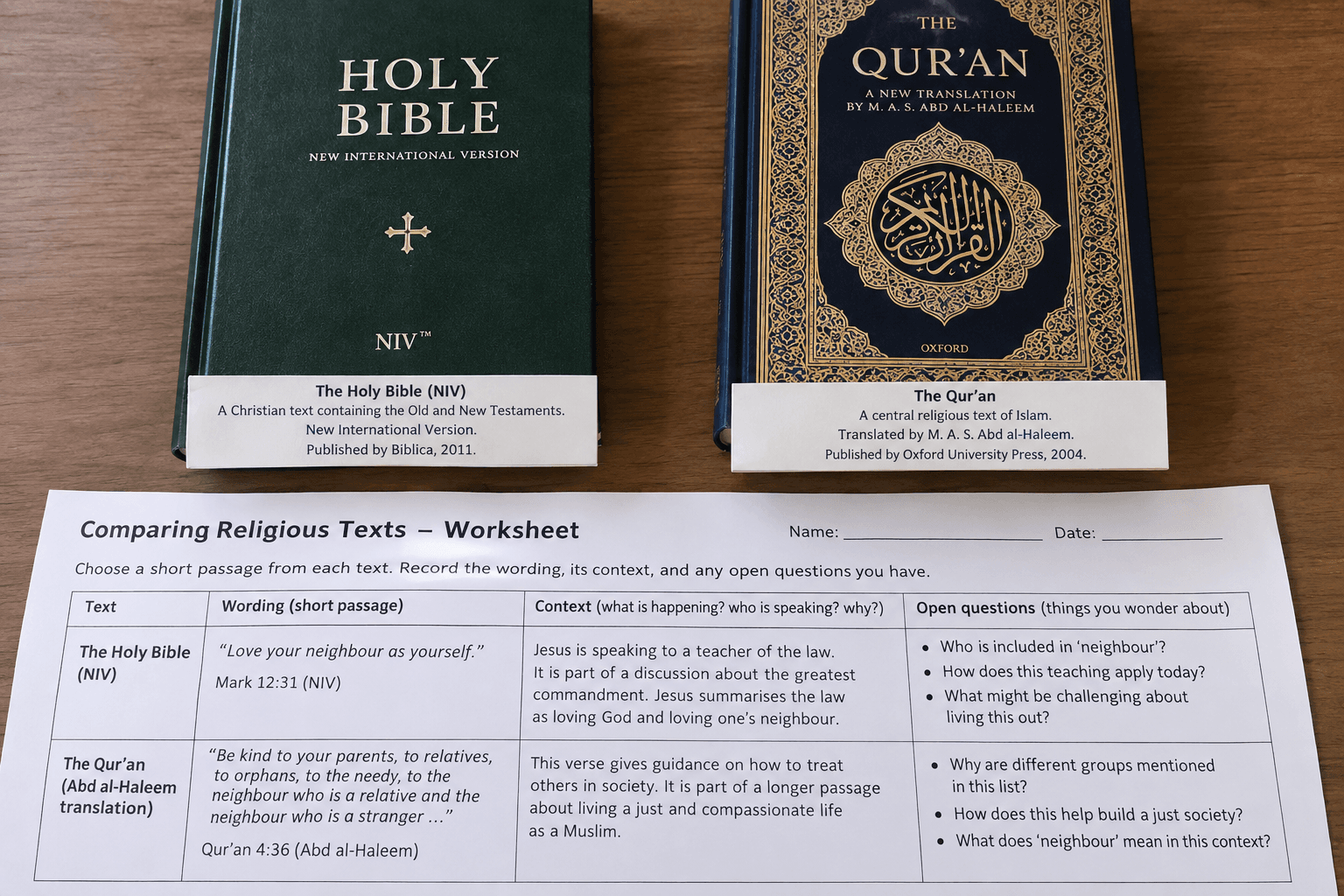
To compare sacred-text translations, identify both editions, locate the same passage, and record the differences you can see before explaining what they mean. Read the surrounding text and the translators' notes. Different English words give you a question to investigate; they do not, by themselves, establish different doctrines.
This guide is for students, independent readers, and study groups working with translations rather than claiming expertise in the source language. Its worksheet helps you make a bounded comparison and keep the unanswered questions visible.
In brief: Keep three things separate: the words printed in each edition, the translator's stated explanation, and your own interpretation. Start with one passage. A useful comparison names its sources and limits, even when it cannot decide which translation is better.
A quotation attributed only to “the Dhammapada” leaves another reader with work to do. Record the translator, edition, publisher and year where available, passage locator, and the page or URL you used.
Keep publication dates and website dates separate. For example, Acharya Buddharakkhita's Dhammapada text on Access to Insight identifies a 1985 Buddhist Publication Society edition, a later transcription, and a website revision date. Those dates describe different stages in the text's publication.
Check that your two sources translate the passage you mean to compare. Record any stated difference in the underlying text or textual version. If you cannot establish that information, write “Not yet established.” Similar English titles do not settle the question.
If a quotation came from an AI answer, use the citation-verification checklist first. Comparing two unverified quotations only gives the errors a more orderly layout.
A translation renders a source text into another language. Commentary explains or interprets that text. Both involve judgments, but they do different jobs on the page. A sentence in an introduction is not automatically part of the work being translated.
Before comparing two editions, identify what each presents:
|
What you are reading |
What to record |
|---|---|
|
Translated passage |
The translator's wording and the passage number |
|
Translator's note |
The explanation, its author, and the note's location |
|
Commentary or teaching about the passage |
Who is interpreting it and which source they discuss |
|
Editorial heading or introduction |
Whether it belongs to the edition rather than the source text |
|
Your own paraphrase |
Your authorship and the editions you consulted |
For instance, a chapter heading may help you find a theme without being a sentence spoken by the figure to whom the verses are attributed. Keep that heading in your navigation notes; do not silently include it in a quotation from the verse.
This distinction also helps when choosing an edition. For a first comparison, look for a named translator, clear passage numbering, an explanation of the text being translated, and accessible notes. Those features make the edition easier to investigate. They do not certify that every choice is correct.
“Which translation is true?” asks more than a worksheet can establish. Try a narrower question: “How do these editions describe the response to hostility in this verse?” You can investigate the wording, the surrounding argument, and any explanation each translator supplies.
Keep the passage short enough to read in context. Match the units of comparison rather than assuming a verse number, paragraph break, or heading occupies the same role in both editions.
Write the smallest excerpt needed to show the difference. Name its edition beside it. Then describe the observation in ordinary language: one version uses a different noun, supplies an explanatory phrase, or arranges the sentence differently.
“Version A uses this word” is an observation. “The translator chose it because of a particular doctrine” is an explanation requiring further evidence. Leave space between those two statements in your notes.
Read the surrounding passage in both editions. Check introductions, footnotes, and endnotes, keeping commentary distinct from translated text.
In his introduction to the Dhammapada, Ṭhānissaro Bhikkhu discusses poetic form, meaning, and the reader's response. That is evidence about his stated approach. It does not automatically explain his choice of a particular word in a particular verse.
When a note does address your passage, record what it says and where. When no explanation is found, keep the reason for the difference unresolved.
You may be able to show a wording difference without deciding its linguistic cause or theological significance. That is a usable finding.
Try: “In the editions consulted, this passage is rendered with different English terms. The difference raises this question; the sources read so far do not resolve it.” If later evidence changes that account, revise the record.
Our guide to comparing religions applies the same discipline at a wider scale: describe the things being compared before drawing a conclusion about their relationship.
Open Buddharakkhita's edition linked above and Ṭhānissaro Bhikkhu's chapter 1 at dhammatalks.org. The latter groups verses 3–6, so locate the relevant sentence within that group rather than expecting a separate heading for verse 5.
|
Question |
What the two editions let us record |
|---|---|
|
What wording differs? |
Buddharakkhita uses “non-hatred”; Ṭhānissaro uses “non-hostility.” |
|
What is the shared immediate subject? |
The passage addresses the ending of hatred or hostility. |
|
What can we conclude? |
The named English versions differ in wording at this point. |
|
What remains open? |
The reasons for that wording and its implications need further investigation. |
This observation does not establish a doctrinal disagreement between Buddhist schools. It also does not establish that the words are interchangeable in every context. We have compared English renderings of a selected passage; we have not adjudicated the Pāli or surveyed Buddhist interpretation.
That boundary helps you choose the next step. If the distinction matters to your argument, look for passage-specific commentary or ask a reader qualified in the relevant language and tradition. If your argument requires only a careful citation, use the edition you actually read and identify it.
Notice how a claim can become stronger than its evidence. “These editions use different English nouns” follows from reading them. “These translators represent opposing Buddhist doctrines” requires a separate argument. A third rendering would add another observation, not settle that argument by a vote.
Start a separate record for each passage. You can put the fields in a document, notebook, or spreadsheet; no account or particular study tool is required.
|
Field |
Translation A |
Translation B |
|---|---|---|
|
Work and passage locator |
|
|
|
Translator or editor |
|
|
|
Edition, publisher, year if known |
|
|
|
Readable URL or catalog reference |
|
|
|
Underlying text/version, if identified |
|
|
|
Short wording being compared |
|
|
|
Surrounding context read |
|
|
|
Translator's explanation and its location |
|
|
|
Date checked |
|
|
Under those records, add:
If your project expands to several sources or different traditions, carry the edition records into the comparative religion research matrix. The translation worksheet asks about renderings of a passage; the matrix organizes a broader question without collapsing all the sources into one row per religion.
You can do the comparison with the two source pages and a notebook. If you already use Plurilore, its local notes give you a place to keep the same record:
This is a way to organize your own reading. The example does not assume that both translations are available inside Plurilore or that an AI response reproduces either one exactly. Keep the named editions as the evidence for their wording. The Library guide explains how to find and read material in the workspace.
Pause a strong conclusion when it depends on a word in a language you cannot assess, an alleged manuscript difference you cannot document, or a claim about what an entire tradition believes.
An additional translation may show another possible rendering. It does not settle the issue by majority vote. Identify what evidence would resolve the particular question: the translator's note, an edition's account of its source text, relevant scholarship, or a qualified specialist's explanation.
| If your proposed claim is… | Look for… |
| --- | --- |
| These English versions differ | The identified passages themselves |
| The translator explains the choice this way | A passage-specific note or statement by that translator |
| The editions use different underlying texts | Each edition's source description and relevant textual scholarship |
| The difference changes a doctrinal argument | Evidence from the wider argument and qualified interpretation |
AI can help you organize observations or suggest further reading. Read any suggested source yourself before using it as the reason a translator made a choice. Preserve the research steps in a verifiable study trail.
No. A documented difference can help you ask a more precise question. Identify the editions and explain what remains uncertain instead of removing whichever wording complicates your argument.
You can write your own paraphrase, clearly identified as such. Do not place combined wording inside quotation marks and attribute it to one translator. Keep a record of both sources that informed the paraphrase.
Yes, at the level of the English wording, structure, and explanations you can read. State that limit. Claims about the source language or the superiority of a rendering require evidence beyond the English difference alone.
Record the edition or revision information and your access date. Where permitted, preserve a research copy or a catalog reference that lets you identify the version consulted. Check the current text again before quoting it in a new publication.
Choose one passage, identify two editions, and fill one worksheet. End with a supported observation and a specific next question. A small comparison another reader can check is a useful foundation for a larger argument.

Understand nirvana, bodhi, and awakening through early Buddhist texts. Compare English translations and see why liberation is not simply an afterlife.