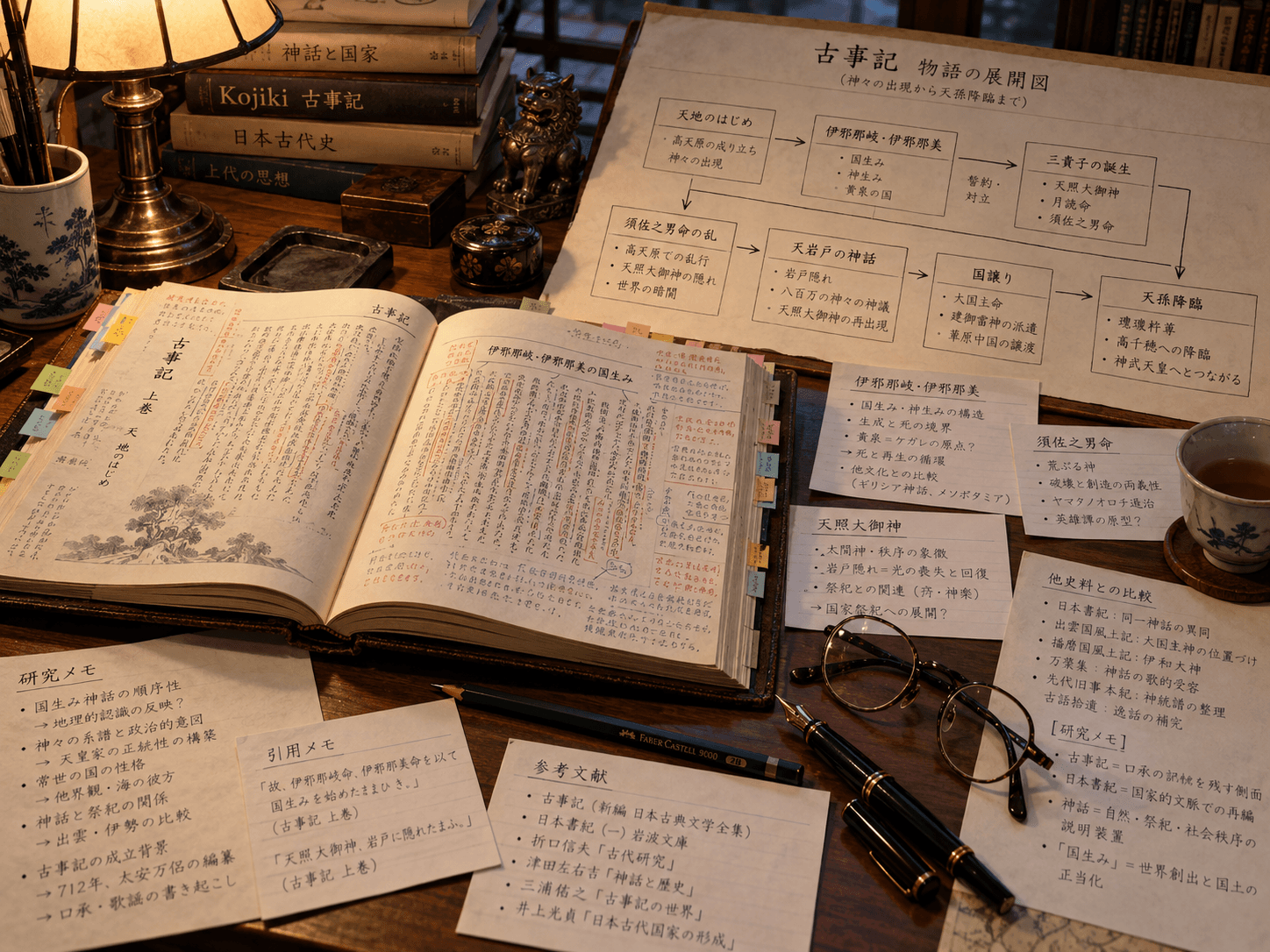
The Kojiki does not tell one simple story in which a lone creator makes the universe. Its opening sequence moves through kami coming into existence, a still-unformed land, the divine pair Izanaki and Izanami consolidating and giving birth to islands, the birth of further kami, death, Yomi, and purification. Each movement changes what the English word “creation” can mean.
Read the sequence before extracting a doctrine from one episode. The text's genealogies, place names, repetitions, and bodily imagery are part of its work, not clutter around a single origin claim.
In brief: In the Kojiki, the earliest kami emerge; Izanaki and Izanami are commissioned to consolidate the drifting land; islands and kami are born; Izanami dies after giving birth to the fire deity; Izanaki enters and escapes Yomi; and his later purification brings forth Amaterasu, Tsukuyomi, and Susanoo. “Creation” here includes emergence, ordering, birth, death, and transformation—not one creation-from-nothing event.
In this guide:
The Kojiki, or Records of Ancient Matters, was presented to the Japanese court in 712. Its three books combine divine-age narratives, genealogies, songs, and accounts associated with imperial succession. That makes it a major source for early Japanese literature, myth, court history, and later religious interpretation. It is not an eyewitness transcript of primordial events or a neutral catalog of everything practiced as Shinto. Kokugakuin's guide to the Japanese classics
The text also reaches English readers through editions. Basil Hall Chamberlain's 1882 translation is historically important and now public domain, but its Victorian vocabulary and romanization can steer interpretation. It calls Yomi “Hades,” for example, importing a comparison that is not the Japanese name. Kokugakuin University's current annotated English Kojiki project offers a chapter-based translation with linguistic and textual notes. Use the named edition in your citation; do not blend wording from several translations into an imaginary original.
Names vary too. This guide follows the project's spelling Izanaki; many English editions write Izanagi. The spelling difference does not identify a different figure.
Even “creation” is an English organizing label. The opening chapters use different kinds of action. Deities come into existence. Land is described as not yet consolidated. Izanaki and Izanami receive a task, stir the sea, and later give birth. Other beings arise from bodies, blood, discarded objects, and purification. A responsible summary keeps those verbs distinct.
The familiar story is a chain of episodes rather than a single scene.
|
Movement |
What the text narrates |
Reading caution |
|---|---|---|
|
First kami |
A succession of solitary kami comes into existence as heaven and earth begin |
The first kami are not described performing one total act of creation |
|
Divine generations |
Paired generations culminate in Izanaki and Izanami |
A genealogy is not yet an account of human origins |
|
Land consolidation |
The pair use a jeweled spear and form Onogoro |
“Form,” “order,” and “create from nothing” are different claims |
|
Union and land birth |
The pair circle a pillar, repeat their encounter, and give birth to islands |
The episode contains gendered and disability-related imagery that needs historical care |
|
Birth of kami |
Natural features and many kami emerge through bodily generation |
A list of births does not map every later shrine or cult |
|
Fire and death |
The fire deity's birth leads to Izanami's death and further transformations |
Creation and destruction are intertwined |
|
Yomi |
Izanaki seeks Izanami, sees her changed condition, flees, and seals the boundary |
Yomi is not automatically identical to every English idea of hell or afterlife |
|
Purification |
Izanaki washes after Yomi; further kami arise, including Amaterasu, Tsukuyomi, and Susanoo |
A mythic sequence is not a complete history of present purification rites |
This map prevents two common compressions. First, it does not turn the earliest kami into a single supreme maker when the text does not narrate that act. Second, it does not stop at the islands: the sequence continues through mortality, separation, cleansing, and the assignment of divine realms.
The opening begins when heaven and earth first become active. Three kami appear in the Plain of High Heaven—Amenominakanushi, Takamimusubi, and Kamimusubi—followed by two more solitary kami. They are hidden after coming into existence. Later paired generations culminate in Izanaki and Izanami.
The precise verb matters. Kokugakuin's annotated study of the opening chapter discusses the difficulty of the wording and distinguishes divine emergence from the later verb used for giving birth. An English paraphrase such as “the gods created the world” erases that difference and assigns an action the first passage does not describe.
The land below is still drifting. The heavenly kami command Izanaki and Izanami to bring it into order and give them a jeweled spear. From the Floating Bridge of Heaven, the pair stir the brine; drops from the spear form Onogoro, where they descend. Kokugakuin's chapter on consolidating the land translates the commission as putting the drifting land in order, solidifying it, and completing it. The passage does not narrate an act of creation from nothing.
That observation does not solve the myth into geology. It simply respects the sequence and its verbs.
On Onogoro, Izanaki and Izanami see a heavenly pillar and a broad-spanned hall. They circle the pillar in opposite directions and meet. Izanami speaks first. Their first offspring, Hiruko, is set adrift, and Awashima is not counted among the successful births. The pair consult the heavenly kami, repeat the rite with Izanaki speaking first, and then give birth to the major islands and more places.
Kokugakuin's annotated chapters on the union and the birth of the land help separate the passage's order from later conclusions readers may impose on it.
The text's own narrative links the first result to reversed speech order. Reporting that logic is not the same as endorsing it as a timeless rule about women, marriage, disability, or ritual correctness. Hiruko's treatment is also ethically difficult for modern readers. A careful guide neither hides the episode nor converts its imagery into a judgment about disabled people. Record what happens, identify the source's ancient court setting, and keep modern moral claims distinct from textual description.
Once the sequence succeeds, the narrative expands from islands to the birth of kami associated with sea, wind, trees, mountains, and other features. This is generation through a divine pair, not a list of modern shrine jurisdictions.
The birth of the fire deity Kagutsuchi burns Izanami, and she dies after bringing forth further kami through her suffering. Izanaki mourns and kills the fire deity; new kami emerge from the blood, body, and sword. The narrative's generative pattern therefore continues through injury and death rather than ending with the successful birth of land.
Izanaki then follows Izanami to Yomi. She says that she has eaten its food and asks him not to look while she consults the kami there. He looks, sees her transformed body, and flees. After a pursuit, the two face one another across a great boulder that closes the pass. Their final exchange connects death and birth in a stark numerical pattern before they separate.
Do not make “Yomi” silently equal “hell” or treat it as identical to the Greek-derived category suggested by Chamberlain's heading “Land of Hades.” Kokugakuin's annotated chapters on entering, fleeing, and leaving Yomi treats even its reading, etymology, and location with care. Kōnoshi Takamitsu's study of Yomi in the Kojiki argues that the episode belongs to the distinctive mythical world constructed by this work.
After escaping, Izanaki purifies himself. Kami arise as he discards garments and washes. Amaterasu emerges from his left eye, Tsukuyomi from his right, and Susanoo from his nose; they then receive their respective realms. Kokugakuin's annotated chapters on the first and second parts of the ablutions preserve the birth sequence and explain difficult wording.
Purification here does several things at once: it follows contact with Yomi, marks a transition, and generates kami central to later narratives. It can illuminate why purification carries narrative weight in Shinto traditions. It does not prove that every present shrine procedure is an unchanged reenactment of this passage.
Use a five-column note before you interpret an episode:
|
Field |
Question to answer |
|---|---|
|
Passage |
Which chapter, edition, and translator are you reading? |
|
Sequence |
What happens immediately before and after this event? |
|
Key wording |
Does the translation say emerge, consolidate, give birth, transform, or purify? |
|
Textual observation |
What can another reader verify in the passage? |
|
Interpretation and limit |
What do you think it means, and what does this passage alone not establish? |
For example, “Amaterasu appears during Izanaki's purification” is an observation about this Kojiki sequence. “All purification rituals are performed to create solar deities” plainly does not follow. “Purification mediates a transition from pollution associated with contact with Yomi and death to renewed order” is an interpretation worth testing against language, ritual sources, and scholarship—not a line to attribute directly to the text.
Our guide to comparing sacred-text translations explains how to record edition differences. If you compare this narrative with another tradition, compare religions without flattening their differences: put source type beside source type, not an ancient myth beside a modern creed without explaining the mismatch.
The Kojiki is evidence for its own narrative world and for the history of its interpretation. By itself, it cannot tell you:
Plurilore's Shinto coverage guide identifies its current Kojiki as Chamberlain's 1882 public-domain translation. The local text has normalized formatting and removed some footnote markers, so use it for discovery with the named edition visible, then verify high-stakes wording against a stable scan or annotated source.
It contains foundational narratives used in the study and interpretation of Shinto, including divine emergence and land birth. The singular label “creation myth” is convenient but incomplete: the sequence includes several kinds of origin and transformation, and the work also serves literary, genealogical, and court-historical purposes.
Its preface presents Ō no Yasumaro as the compiler who recorded material associated with Hieda no Are and submitted the work in 712. That account belongs to the text's transmission history; it does not turn every episode into a contemporary eyewitness report.
Amenominakanushi, Takamimusubi, and Kamimusubi are the first named kami. The narrative then unfolds through other solitary and paired kami before Izanaki and Izanami. The sequence establishes distinctions and genealogical order; it should not be shortened to “one creator plus assistants.”
No. The works share names and episodes, but their openings, order, framing, and placement of alternatives differ. The Nihon Shoki frequently preserves a main account followed by other versions. Compare exact passages rather than constructing one blended Japanese creation story.
Return to one movement: emergence, consolidation, birth, transformation, or purification. Write down the exact verb in your edition and what it allows you to claim. Then compare a second translation or the corresponding Nihon Shoki account without erasing the differences. A source-grounded reading begins with sequence and wording, not with the doctrine we expected to find.
Begin reading the Analects with a guide to its twenty books, key terms, translation differences, and two passages that show why context matters.