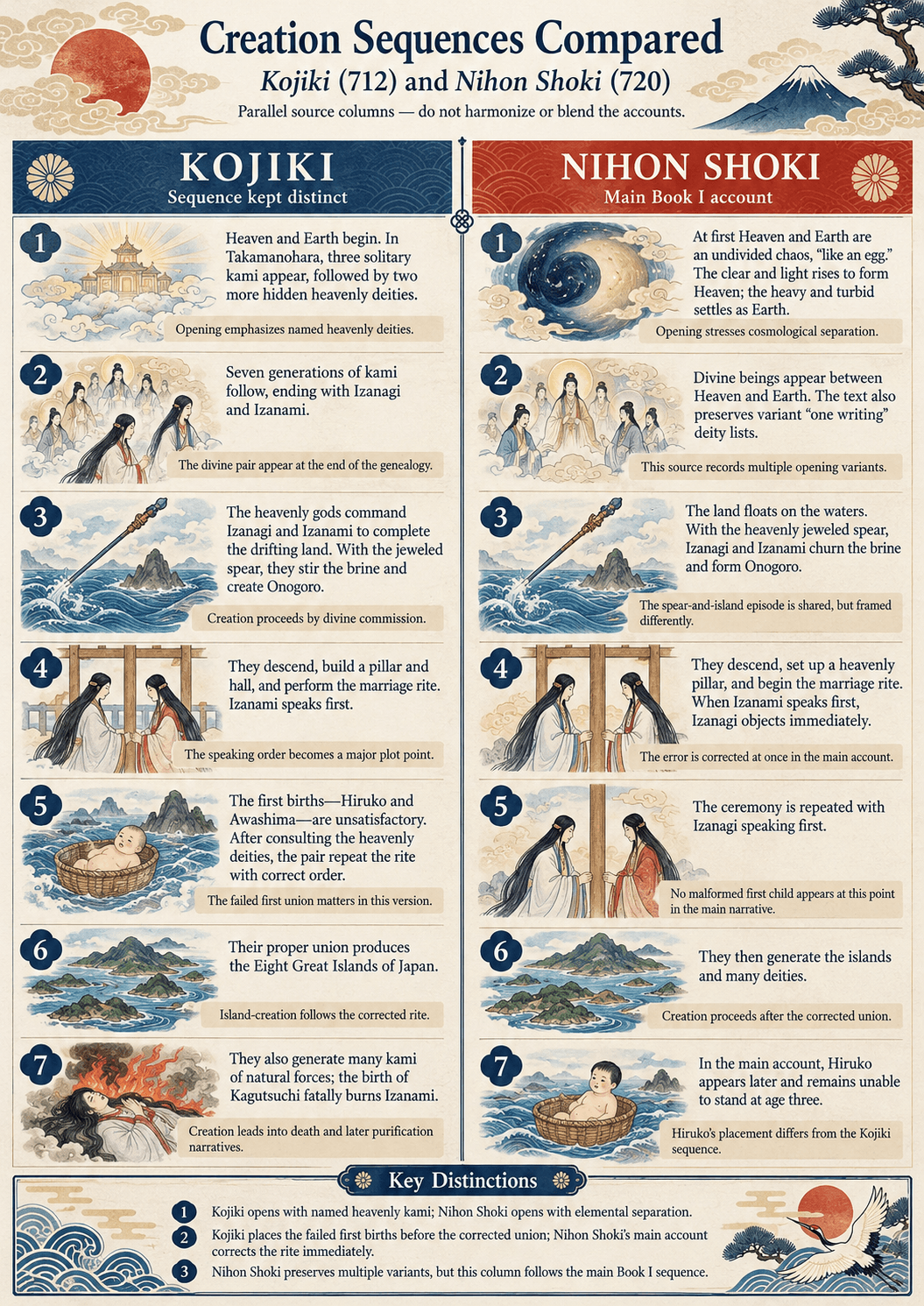
The Kojiki and Nihon Shoki share divine names and origin episodes, but they do not tell one identical creation story. They organize the material differently, begin with different principal sequences, assign different initiative to Izanaki and Izanami, place Amaterasu's birth differently, and give Yomi a different role. The Nihon Shoki also preserves alternative accounts beside its main narrative.
Those differences are not debris to remove before discovering the “real” myth. They are evidence about how each work constructs a narrative world.
In brief: The Kojiki offers a comparatively continuous sequence from the first kami through land birth, Yomi, and Izanaki's purification. The Nihon Shoki presents a main account plus numerous alternatives: its principal opening starts with Kunitokotachi, its main narrative has Izanaki and Izanami initiate land formation, and it makes Amaterasu their deliberately produced child. Some alternatives share details with the Kojiki. Always name the work and version you mean.
In this comparison:
The Kojiki was presented in 712; the Nihon Shoki was completed in 720. Both are early court compilations containing mythic and genealogical material, but their forms are not interchangeable. The Kojiki moves through a main narrative sequence. The Nihon Shoki repeatedly gives a principal account and then introduces other versions with a formula often translated as “in one writing.” Kokugakuin's guide to the Japanese classics
Nihongi is an alternative title commonly found in older English-language scholarship for the work now usually romanized as Nihon Shoki. W. G. Aston's 1896 translation uses Nihongi. Plurilore's local file is named Nihonigi.txt; that filename is not a separate title or romanization. The file is an abridged anthology and its edition metadata is unverified, so it must not be mistaken for a complete primary edition.
For this comparison, the Kojiki sequence is checked against Kokugakuin University's annotated English project. The Nihon Shoki main account and variants are checked against Aston's complete Book I, with scholarly guidance from Kokugakuin and Kōnoshi Takamitsu. Aston's Victorian English is evidence from a named translation, not timeless terminology.
This guide follows Kokugakuin's spelling Izanaki; many English editions use Izanagi for the same figure. It otherwise modernizes romanization where possible while keeping each cited edition identifiable.
|
Question |
Kojiki |
Nihon Shoki |
Why it matters |
|---|---|---|---|
|
How is the work arranged? |
A more continuous principal sequence |
Main accounts followed by multiple alternative writings |
“The Nihon Shoki says” may hide which layer is being cited |
|
Which kami appear first? |
Amenominakanushi, Takamimusubi, and Kamimusubi lead the opening sequence |
The main account begins with Kunitokotachi; the fourth alternative also names the same trio |
Shared names do not mean shared placement |
|
Who begins land formation? |
Heavenly kami command Izanaki and Izanami to consolidate the land |
In the main account, the pair confer and act; the first alternative in this section gives a heavenly command |
Agency and hierarchy shift |
|
How is Amaterasu born? |
From Izanaki's left eye during purification after Yomi |
The main account has the pair deliberately produce the sun deity; the sixth alternative includes Yomi and purification, with three kami emerging from Izanaki's eyes and nose |
Her birth belongs to different narrative problems |
|
What role does Yomi play? |
Central bridge between Izanami's death and Izanaki's purification |
Absent from the main account; Yomi-related episodes appear in the sixth and tenth alternatives |
The route to purification is reorganized |
|
Is there one creation version? |
One main sequence still contains complexity and later interpretation |
The work displays alternatives rather than fully harmonizing them |
Variation is part of the source, not an editorial accident |
This table compares narrative placement, not which account is older, truer, or more religious. Those require different evidence.
The Kojiki begins as heaven and earth become active. Amenominakanushi, Takamimusubi, and Kamimusubi come into existence in the Plain of High Heaven, followed by other solitary kami. The still-young land is described through fluid, drifting imagery. Kokugakuin's annotated opening chapter
The Nihon Shoki's principal account begins differently. Heaven and earth separate from an undifferentiated condition; a reed-shoot-like form becomes Kunitokotachi, followed by other kami. Its appended alternatives change the order again. The fourth alternative also names Amenominakanushi, Takamimusubi, and Kamimusubi in the Plain of High Heaven—the trio familiar from the _Kojiki_—but does not thereby turn that trio into the main account's opening.
Kokugakuin's study of the complexity of the Nihon Shoki emphasizes that the alternatives differ not only from the main account but also from one another. A comparison should therefore use labels such as main account, first alternative, or fourth alternative. Combining every first deity into one sequence manufactures a text neither work contains.
In the Kojiki, the heavenly kami command Izanaki and Izanami to order and consolidate the drifting land, giving them a jeweled spear. The pair stir the brine from the Floating Bridge of Heaven; drops from the spear form Onogoro. The action begins as a commission within a divine hierarchy. Kokugakuin, “Consolidation of the Land”
In the Nihon Shoki's main account, Izanaki and Izanami stand on the bridge, ask whether there is a country below, and act after conferring with one another. The nearby alternatives then supply several other formulations. The first alternative in this land-making section has heavenly kami order the pair to bring the land into order, resembling the Kojiki at this point. Others have the pair search for or form a country on their own initiative. Aston, Nihongi, Book I
The point is not that the spear “really” belonged to one version. The contrast concerns narrative agency: who authorizes the task, who recognizes the need, and how the source places the pair within a larger divine order.
In the Kojiki, Izanami has already died, Izanaki has fled Yomi, and he purifies himself. Amaterasu arises from his left eye, Tsukuyomi from his right eye, and Susanoo from his nose. Her birth therefore belongs to a sequence of pollution associated with Yomi, cleansing, renewed generation, and the assignment of realms. Kokugakuin's annotated ablutions chapter
The Nihon Shoki's principal account places the event elsewhere. After producing islands and natural features, Izanaki and Izanami consult and deliberately produce the sun deity to rule. They then produce the moon deity and Susanoo within the same broader family sequence. A following alternative has Izanaki produce the three through mirrors and a sideways glance. The sixth alternative instead includes the Yomi-and-purification sequence and has Amaterasu, Tsukuyomi, and Susanoo emerge from Izanaki's eyes and nose. Aston, Nihongi, Book I
The shared figure is Amaterasu, but the narrative function changes. In one work, her emergence follows the Yomi crisis and purification. In the other's main account, her production is a joint decision associated with rulership. Quoting only “Amaterasu was born from Izanaki” or “Amaterasu was born from Izanaki and Izanami” without a source label turns textual difference into apparent factual contradiction.
The Kojiki connects Izanami's death to Izanaki's journey to Yomi, his forbidden look, flight, final separation from Izanami, and subsequent purification. Remove Yomi and the passage into purification loses its immediate narrative cause.
The Nihon Shoki main account does not include the Yomi journey. Kōnoshi identifies Yomi-related episodes in the sixth and tenth alternatives, and even those do not simply reproduce the Kojiki. His study of the Land of Yomi uses this difference to argue that each work constructs its own mythical world. The comparison is not just a hunt for matching plot points; placement changes meaning.
This is also a translation warning. Chamberlain's old Kojiki translation uses “Hades,” while Aston's Nihongi uses English labels shaped by his period. Keep Yomi visible and explain the particular passage before importing a complete Greek-derived or generic “underworld” model.
Use one row per textual layer:
|
Field |
What to record |
|---|---|
|
Work |
Kojiki or Nihon Shoki |
|
Account layer |
Main sequence or a numbered/described alternative |
|
Episode boundary |
Opening, land formation, union, death, Yomi, purification, or divine assignment |
|
Edition |
Translator/editor, date, book or chapter, and stable link/page |
|
Observation |
The actors, order, and exact type of action in this version |
|
Interpretation |
What the placement may accomplish, clearly labeled as analysis |
|
Limit |
What this passage cannot prove about other versions or living practice |
Suppose you compare Amaterasu's birth. Make one row for the Kojiki purification sequence, one for the Nihon Shoki main account, and one for the specific alternative you need. Only then ask how the source positions solar rule, kinship, death, or purification. Do not replace the rows with a merged sentence.
Our guide to comparing sacred-text translations helps track wording across editions. The broader method in how to compare religions without flattening their differences also applies within a tradition: text type, date, compiler, and later authority still matter.
Textual variation does not, by itself, prove that one source is corrupt, that one preserves a pure original, or that ancient compilers were careless. Nor does similarity prove that every episode carried the same meaning in both works.
The comparison also cannot tell us what all Shinto practitioners believe now. These are early court compilations with long histories of interpretation. Present shrine ritual, local tradition, institutional teaching, and personal devotion have other sources of authority.
Plurilore's Shinto coverage guide is transparent about its historical English corpus. Its Chamberlain Kojiki can support source discovery with edition warnings.
Yes. Nihongi is an alternative title commonly found in older English-language scholarship and in Aston's 1896 translation; Nihon Shoki is now the more common romanized title. Always record the title used by your edition so another reader can find it.
Its Divine Age books repeatedly preserve a principal account alongside alternative writings. Scholars debate the sources and compilation process behind them, but the immediate reading rule is simple: alternatives remain identifiable parts of the work. Do not silently choose details from several and call the result its main story.
That question assumes a single creed and textual authority that the evidence does not supply. The works have been influential in Shinto interpretation, but textual status, shrine ritual authority, institutional teaching, and personal belief are not the same category.
Begin with an annotated modern translation of one work and keep its sequence intact. The Kojiki is often easier to follow as a continuous narrative; the Nihon Shoki becomes especially valuable when you deliberately track its main account and variants. Whichever you choose, name the edition.
Choose one episode and build two or three separate rows: Kojiki, Nihon Shoki main account, and one relevant alternative. Record who acts, what comes before, and what follows. Only after that should you propose why the change matters. Comparison becomes more illuminating when it resists the urge to make the sources agree.
Explore filial piety in the Analects through care, disagreement, and a stolen sheep. Read three passages without turning family duty into a simple rule.