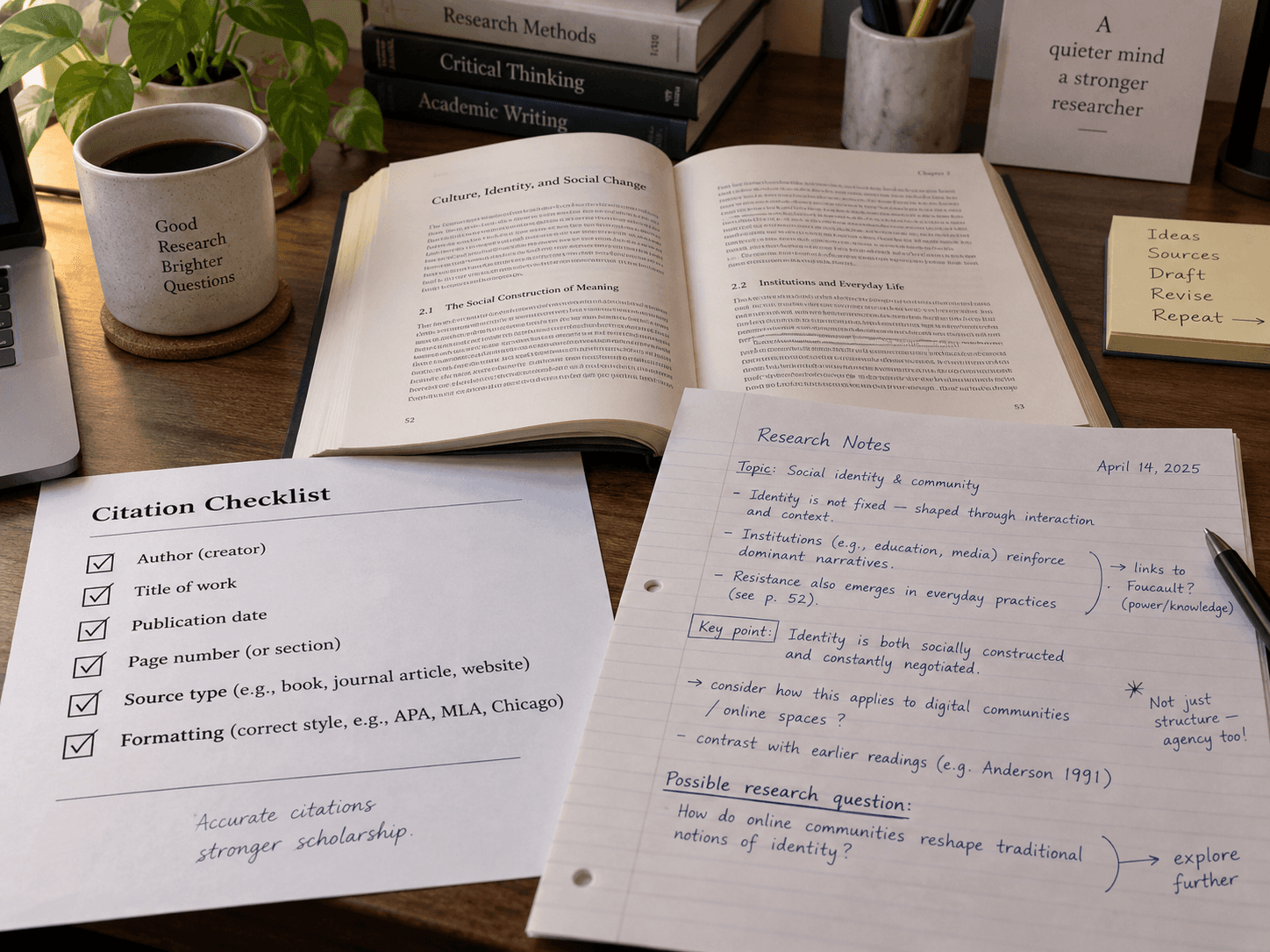
To verify AI-generated religious citations, open the source independently, identify the exact text and translation, read the surrounding passage, and check whether it supports the claim attached to it. A reference can be real and still be used incorrectly.
For students, independent readers, and study groups, the useful question is specific: could another reader follow this reference and see why you reached this conclusion?
In brief: Check five things before using an AI citation: the source exists, the location is correct, the translation is identifiable, the context fits, and the passage supports your sentence. Record any unresolved problem. A working link passes only the first part of that process.
There are two separate objects on your desk: a reference and a claim. Verify both.
The reference might name a scripture, a commentary, a translation, or a scholarly article. The claim is the sentence the AI asks you to accept on that source's authority. You need to know whether the source can be found and whether it actually does the work the sentence requires.
The University of Utah's guide to evaluating AI information recommends independently checking facts and citations, including looking up references through scholarly search or a library catalog. Religious research adds a further question: which version of the text did you find?
This article checks individual citations. If you are deciding whether to use a product at all, start with the broader AI sacred-text tool evaluation scorecard. A tool can perform well in a trial and still return a citation that needs correction in your next session.
Copy one sentence and the reference attached to it. Split compound sentences when they make several assertions.
“This passage encourages forgiveness, rejects punishment, and represents every school in the tradition” contains three claims. A passage supporting the first does not automatically support the other two.
Mark whether the sentence presents a quotation, a paraphrase, a historical statement, or an interpretation. Each needs a different check: exact wording for a quotation, faithful meaning for a paraphrase, and appropriate evidence for the historical or interpretive conclusion.
Follow the supplied link, then confirm the identity of the page you reached. A homepage, search result, or discussion quoting an unnamed translation is only a lead.
For scripture, look for the named work and passage in an identifiable edition. For scholarship, search the title and author in a library catalog, the publisher's site, or a scholarly index. The University of Hawaiʻi's responsible AI guide likewise recommends searching AI-provided citations independently to confirm that the sources exist.
If a reference includes a DOI, compare the destination's title and authors with the citation. Even a correct bibliographic match leaves the claim itself to be checked in the text.
Write down the work, chapter or section, passage range, translator or editor, and edition information available on the source. Distinguish a print publication date from a later website revision date.
A page number alone is fragile because it identifies a location within an edition. A numbered verse is more portable, but you should still confirm the numbering in the edition you will cite. Do not assume an AI-generated locator transfers unchanged between translations or collections.
If the source omits its translator, look for a title page, introduction, catalog entry, or publisher record. Leave the field unresolved if those do not establish it. An AI answer naming a translator is a suggestion to investigate, not bibliographic evidence.
Compare quotations word for word. If the wording cannot be located, remove the quotation marks until you can establish whether it is a paraphrase, a different translation, or an unsupported attribution.
Then read enough surrounding text to understand who speaks, whom they address, and what question is being answered. Sometimes that means several verses; sometimes it means a whole argument. A fixed number of sentences is no substitute for finding the relevant unit.
Keep translation and commentary separate in your notes. An editor's explanation beneath a passage may be helpful, but it should be attributed to that editor rather than silently presented as the scripture itself.
Write a short verdict beside the sentence:
|
Finding |
What to do |
|---|---|
|
The passage directly supports the sentence |
Keep it with the exact reference and edition |
|
The passage supports a narrower statement |
Rewrite the sentence to match its scope |
|
The sentence is a possible interpretation |
Identify it as an interpretation and find appropriate commentary |
|
The passage contradicts the sentence |
Correct or remove the sentence |
|
The source or wording cannot be checked |
Keep it out of the research conclusion until resolved |
This is an editorial decision aid, not a probability score. A claim does not become reliable because enough unrelated citations passed.
For statements about a whole tradition, ask what would justify moving from one passage to that larger conclusion. Our comparison-method guide explains why source selection and internal differences belong in that decision.
Consider this deliberately invented example of an AI error: “Dhammapada 5 says that forgiving an enemy guarantees reconciliation.” This is a teaching example, not a recorded output from a tested product.
Open Dhammapada 5 in Acharya Buddharakkhita's translation. The page identifies the translator and the underlying 1985 Buddhist Publication Society edition. Verse 5 says that hatred is settled through non-hatred; verses 3–4 provide a nearby setting of dwelling on mistreatment.
The citation exists. The invented sentence nevertheless adds a guarantee about how an enemy will respond. That is not established by the cited verse.
A defensible correction is: “Dhammapada 5 presents non-hatred as the response that ends hatred.” Keep broader questions about reconciliation separate. If you want to compare English wording, the page also links Ṭhānissaro Bhikkhu's translation, which uses “non-hostility” in verse 5. Record the translation you actually use.
The result of the check is useful precisely because it is modest: a real reference, an identified translation, and a smaller claim.
Use one copy for each material claim. These are tasks for the reader; the empty boxes do not represent completed verification.
Under the checklist, add three lines: Claim I can retain, Claim I must revise, and Next source to read. Those lines turn checking into an improvement to the draft instead of an exercise in collecting ticks.
In Plurilore, expand Sources consulted under the answer. Open the relevant source in the Library, read the surrounding passages, and connect each important claim to the text yourself.
The panel records the sources returned for the response. A source appearing there does not establish that every sentence in the answer follows from it. If a claim has no clear supporting passage, apply the same unresolved status you would use with any other tool.
Bibliographic detail varies by the texts included. Check the agent source guides and, where needed, an external edition before citing a translator or publication year. A Library passage identifier tells you where to read within Plurilore; it does not necessarily supply the full academic reference.
Preserve the original claim in your working notes so you can see what changed. In the article or assignment, use only the corrected statement and its supporting source.
A missing page means access is unresolved. It does not prove that the work was invented. Search by title, translator, and passage; try a catalog or ask a librarian. If you find a replacement edition, record that you changed editions and check the wording again.
A source that exists but does not support the claim needs a different repair. Narrow the claim, find evidence that does support it, or remove it. Asking the same model “Are you sure?” may produce a new lead, but it does not replace reading the source.
Yes. It can point to the wrong passage, use a translation without naming it, attribute a commentator's view to the scripture, or attach a broad claim to a narrow statement. Checking existence and checking support are separate steps.
Verify every citation you intend to rely on in your research, and every material claim you retain. You need not investigate every discarded suggestion. When time is limited, reduce the claims you use rather than presenting unchecked references as evidence.
Cite the source you actually read for the textual claim. Separately follow your institution's rules for acknowledging AI assistance. Recording the tool, date, prompt, and role it played will help you make an accurate disclosure; it does not substitute for the source citation.
Record the form of evidence you actually have: an attributed oral teaching, documented ritual, interview, commentary, or historical account, with its relevant context and permissions. Do not invent scriptural numbering or assume that one published account can stand for a whole community.
Choose one citation from your current reading and complete the checklist. Keep the source open while you rewrite the sentence it supports. You have finished when another reader can find the passage, identify the edition, and distinguish the text from your conclusion.
Compare karma in Hindu, Buddhist, and Jain sources through action, intention, selfhood, rebirth, bondage, and liberation in one source matrix.