Filial piety in the Analects gives parents serious moral claims on their children and makes room for correction whose limits remain contested. It involves care, respect, and family loyalty; the text leaves difficult questions about what happens when those duties conflict.
The Chinese term xiao is often translated as filial piety. Passage 2.7 makes respect part of serving parents, beyond the provision of food or other support. The quality of attention within an ordinary act of help becomes part of the question.
This guide is for readers beginning a close study of the text. It follows passages 2.7, 4.18, and 13.18, while separating their ancient claims from questions we might bring to them today.
In brief: Filial piety in the Analects requires more than material support. It allows a child to challenge a parent, although translations disagree about what follows rejected advice. The stolen-sheep exchange puts family loyalty in tension with public accountability. None of these passages supplies a complete modern rule for family life.
Read the three passages, examine a worked reading record, or try the reflection exercise.
The Analects, or Lunyu, is a collection of sayings and conversations associated with Confucius and his followers. Its short exchanges require interpretation; they do not arrive as a single, fully explained moral system. The Stanford Encyclopedia of Philosophy's article on Confucius places filial piety within both family relationships and the wider question of political responsibility.
For the English text, we use James Legge's nineteenth-century translation and compare it with Robert Eno's An Online Teaching Translation, 2015, version 2.21. Eno's notes also flag an important historical boundary: these teachings were addressed chiefly to sons within the social assumptions of their time. Applying them to present-day families of different forms is a further interpretive step. See Eno's translation and commentary, especially printed page 6.
Passage numbers identify book and section: 2.7 means book 2, section 7. Keep those references with your notes.
Ziyou asks about filial piety. The reply challenges the idea that supporting one's parents is sufficient, using dogs and horses as a pointed comparison. What distinguishes filial service is respect. Legge uses “reverence”; Eno uses “respectful vigilance.” Read Legge's Analects, book 2, section 7, alongside Eno's printed page 6.
For a modern reader, this invites a useful question: what is the difference between completing a task for someone and paying attention to the person receiving it?
Imagine bringing a parent groceries while talking over every answer they give. The practical help is real. Yet the exchange might still leave them feeling unheard. A different visit could involve the same groceries and a few minutes asking what they actually need.
That example is our illustration, rather than a scene from the text. It helps make the distinction concrete without turning respect into a demand for a particular feeling on command. The question concerns the quality of attention within an act of care.
This passage concerns correcting a parent. Legge renders its opening as gentle remonstrance: a respectful attempt to point out something wrong. His subsequent wording says the son “does not abandon his purpose,” whereas Eno renders the corresponding injunction “do not disobey.” Compare Legge, book 4, section 18, with Eno, printed page 16.
The difference matters. Does the child remain respectful while continuing to press the moral concern, or remain respectful while yielding? A slogan about speaking truth gently cannot settle that question.
Philosopher Yong Huang explains that the Chinese phrase at issue leaves its object unstated. His reading favors preserving the intention to remonstrate. Philosopher Hagop Sarkissian emphasizes a different difficulty: gentle correction may offer little protection when a parent refuses to listen, and many interpreters understand 4.18 as requiring compliance after failed remonstrance. See Huang's analysis, pages 24–26, and Sarkissian's discussion, especially note 6.
A careful reading can therefore affirm that the passage makes room for disagreement while acknowledging how constrained that room is. It cannot present 4.18 as an unequivocal statement of modern autonomy or equality between parent and child.
When comparing editions, write down the point where they diverge. Our guide to comparing sacred-text translations offers a way to keep that difference visible instead of silently choosing the wording you prefer.
The Lord of She praises a man who testified after his father stole a sheep. Confucius responds that, among the upright people he knows, fathers conceal their sons' wrongdoing and sons conceal their fathers' wrongdoing. Read book 13, section 18, in Legge's translation; Eno's corresponding passage is on printed page 70.
The reply is troubling because the contrast concerns what counts as upright conduct. It gives family loyalty weight precisely where the family member has acted wrongly. The Stanford discussion of family and state treats the exchange as a conflict between responsibilities to relatives and responsibilities beyond them.
Huang offers a defense: keeping the wrongdoing within the relationship can preserve an opportunity to correct the father, rather than merely expose him. His fuller account also distinguishes non-disclosure from obstructing public investigation. That is a developed interpretation, not a sequence of events explicitly narrated in 13.18. See Huang, “Why an Upright Son Does Not Disclose His Father Stealing a Sheep,” especially pages 31–35.
For our reading, an unresolved question remains: where is the person whose sheep was stolen? A family relationship may deserve special consideration, but that consideration does not by itself account for the harmed outsider.
Do not remove this difficulty by paraphrasing the exchange as ordinary affection. Nor does the short passage explain restitution, a court's duties, or every circumstance in which disclosure might arise. Its moral tension deserves to remain in view. Reading it sympathetically can include asking what its defense leaves unanswered.
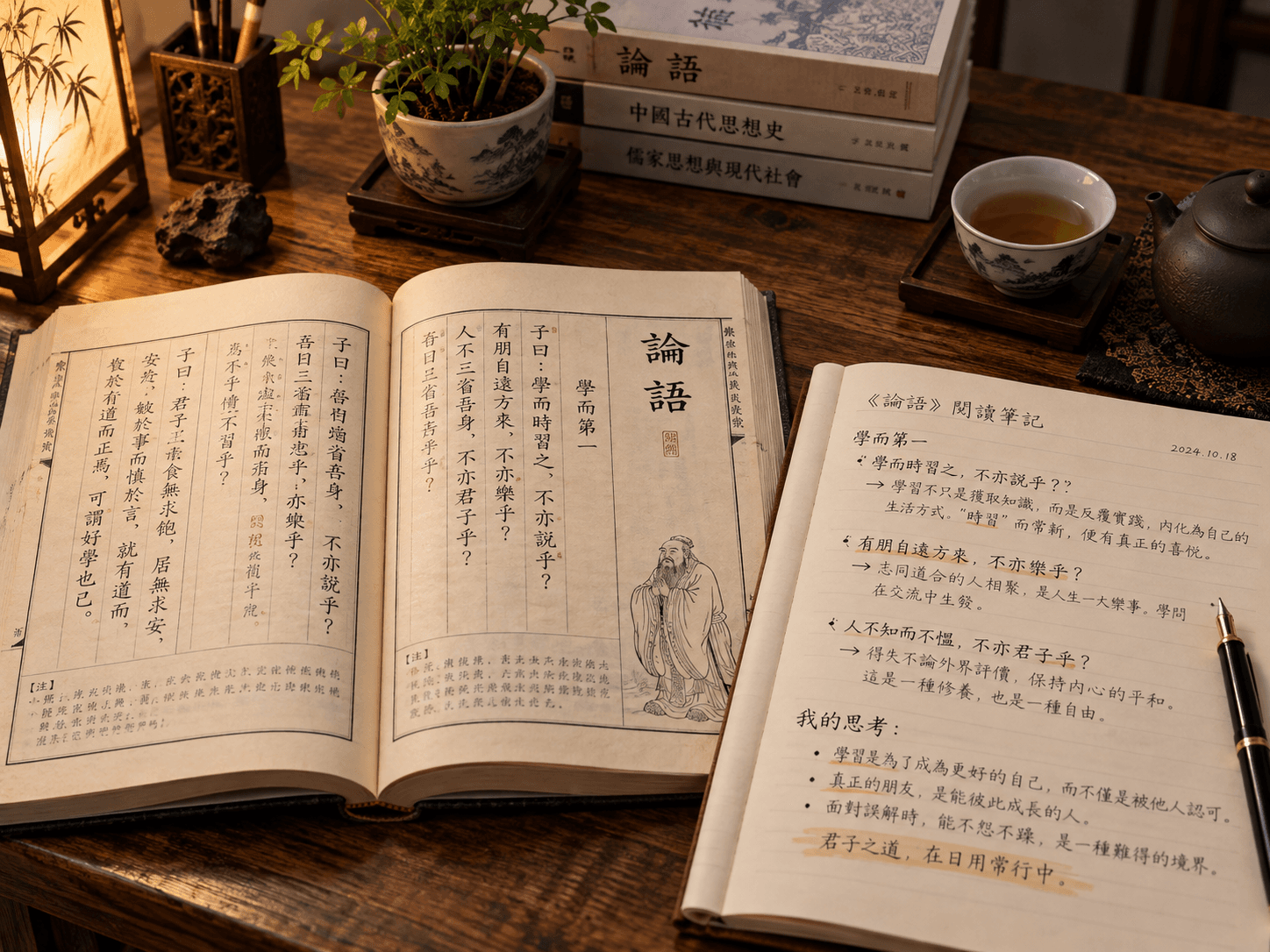
Here is a worked example of a reading notebook. The final column records our questions; it does not attribute modern conclusions to Confucius.
|
Passage |
What to record from the text |
What to examine next |
|---|---|---|
|
2.7 |
The contrast between providing support and showing respect; Legge's wording beside Eno's |
How might a routine act of help include more attention to the person? |
|
4.18 |
The correction of a parent; the point where the two translations diverge |
Which reading does the edition's commentary support, and what happens if advice fails? |
|
13.18 |
The theft, testimony, and reply about family concealment |
How does a proposed interpretation account for both the relative and the person harmed? |
To make your own record, add four lines beneath each reference:
If a note jumps straight from an ancient sentence to a rule for your family, return to the middle two lines. An interpretation should show its work. A personal application should be named as your own.
The following exercise is an editorial suggestion for an ordinary, low-stakes disagreement. It is not a reconstructed ancient practice, or guidance for abuse, safety, or legal decisions.
Suppose you and a parent disagree about plans for a family gathering. You think the proposed timetable will exclude a relative who works late. Your parent thinks changing it will inconvenience everyone else.
Before replying, write three short notes:
This separates the substance of disagreement from the impulse to dismiss the person. You might decide that a different response is better. The exercise offers a question to try, not a promise that considerate wording will produce agreement.
Then ask a second question: what would remain unresolved if the answer were no? This is where the comparison of translations in 4.18 becomes useful. It interrupts the easy assumption that respectful disagreement always leads to a satisfactory outcome.
The sheep passage adds another check. In this invented gathering example, the absent relative also has a stake. Are you describing the dispute only through the wishes of the two people speaking? Make room in your notes for someone whose interests the conversation could overlook.
These are modern questions prompted by reading. They should remain distinguishable from the historical teaching and from judgments about anyone's real family circumstances.
That description misses the correction of a parent discussed in 4.18. Yet the passage does not clearly grant an unrestricted right to refuse. The translations and interpretations above show why the answer requires more care than either “always obey” or “the text rejects obedience.”
No. The Analects and the Classic of Filial Piety, or Xiaojing, are distinct works. They can inform a wider study of family duties, but a passage from one should not be cited as though it belongs to the other. Keep the work's title beside every reference.
The response in 13.18 endorses concealment within the family, and that claim should be faced directly. Applying it today is a separate moral and legal question. This reading does not establish anyone's current reporting duties or settle how a harmed person's interests should be protected.
Filial piety in the Analects becomes clearer when care, disagreement, and loyalty are studied together. Keeping the difficult parts visible is part of reading well.
Choose one of the three passages, open both translations, and complete the four-line reading record. If you later compare family duties across traditions, our method for comparing religions can help keep each text's setting and claims distinct.
For study with Plurilore, check the Confucianism source overview first. Its current catalog lists Legge's The Sacred Books of China, Part I, which includes the separate Classic of Filial Piety. This article's Analects readings come from the external editions linked above; the catalog does not establish that the complete Analects is available in Plurilore.

Read Matthew 5:38-48 closely: where “hate your enemy” comes from, what the command actually asks for, and how Christians have disagreed about it since.