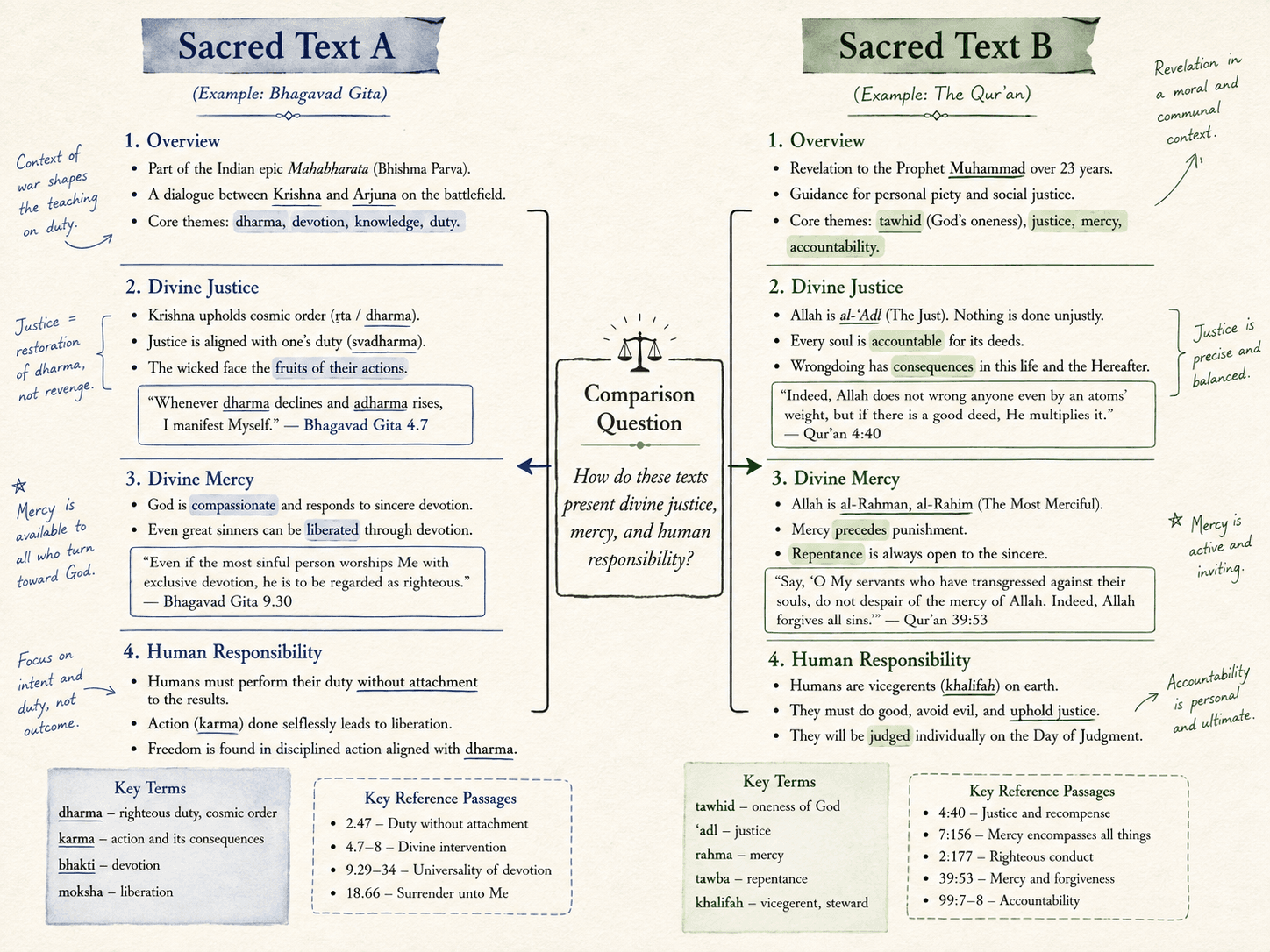
Comparing religions well is less about covering everything and more about asking a smaller, better question.
Instead of asking, “What do Christianity and Buddhism believe?”, compare two named texts, practices, communities, or ideas. Read each one in its own setting first. Then look at where they meet, where they differ, and where the comparison stops being useful.
In brief: Start with a focused question. Name the exact texts, communities, periods, and translations you are using. Compare the same kind of material on both sides, make room for disagreement within each tradition, and do not force a neat answer when the sources do not support one.
A good comparison helps you understand both sides more clearly. It does not need to prove that two traditions agree, disagree, or share one hidden teaching.
It also helps to know what kind of work you are doing:
These activities can overlap, but they are not the same. A personal belief should not be presented as a neutral conclusion about an entire religion.
Christianity, Buddhism, Islam, Hindu traditions, Judaism, Sikhism, Daoism, Jainism, and other traditions contain different schools, languages, communities, texts, rituals, and histories.
Take the sentence “Buddhism teaches detachment.” Which Buddhist tradition? Which text? Which language and translation? What does “detachment” mean in that setting?
The question is not pedantic. Without those details, one teacher or passage can be made to speak for millions of people across centuries.
Words such as salvation, liberation, soul, compassion, sin, sacrifice, meditation, heaven, and law can look familiar across traditions. Yet the ideas behind them may have different histories, purposes, and relationships to other teachings.
A shared word is a good reason to look closer. It is not proof that two traditions mean the same thing.
The broad guide to what major traditions say about suffering and the closer look at Christian, Buddhist, and Stoic approaches show how the size of the question changes the kind of answer you can responsibly give.
One side may quote scripture while the other describes what people do today. One may use a legal text while the other uses devotional poetry. One tradition may have a central institution; another may not.
Those differences are sometimes part of the answer. The important thing is to name them instead of hiding them inside a tidy table.
“Compare Christianity and Buddhism” is too large to answer well.
Better questions include:
Scholar Oliver Freiberger argues that comparison should make its purpose, scale, and subject clear. His work on comparative method also asks researchers to name the exact point around which the comparison is being made.
In plain language: decide what you are comparing and why.
Are you trying to explain a difference, find a limited similarity, support dialogue, or decide what to study next? A clear purpose keeps the article from wandering into claims it cannot support.
Give the reader enough detail to find the same material.
Record:
“The Christian view of forgiveness” is too broad. A question about forgiveness in Matthew 6:14–15, read alongside two named modern commentaries, is much clearer. It still does not represent every Christian view.
Making the subject smaller does not make religion less important. It keeps a small sample from pretending to be the whole.
Before building a comparison table, read each source independently.
Ask the same basic questions:
Do not search only for lines that fit a “similarities” column you have already written. That turns research into confirmation.
Who is doing the reading also matters. A practitioner may notice meanings and habits an outsider misses. An outsider may ask useful historical or comparative questions. George D. Chryssides' discussion of insider and outsider perspectives explains why neither position guarantees a complete view.
Different sources answer different questions.
|
Source |
What it can help show |
What it cannot show by itself |
|---|---|---|
|
Sacred or primary text |
What a named text says in a chosen edition |
How every community understands or follows it |
|
Commentary |
How a named interpreter reads the text |
The only accepted reading |
|
Official teaching or law |
A stated position within a defined body |
What every member believes or does |
|
Ritual or observed practice |
What people do in a particular setting |
A complete explanation of why they do it |
|
Historical research |
How ideas and communities changed |
What all present-day practitioners believe |
|
Survey or fieldwork |
What a particular group reported or did |
A timeless teaching for the whole tradition |
|
Modern scholarship |
A researched argument |
The tradition's own voice in every case |
|
AI answer |
A possible starting point |
Independent proof or final authority |
Not every tradition is built around a single scripture. Oral teaching, ritual, community memory, art, law, and lived practice may be central. Use the kinds of sources that fit the tradition instead of forcing everything into a book-and-verse model.
Now place the material side by side.
Ask the same question of both sources. If one side begins with a sacred text, try to begin with a comparable source on the other. If you move into commentary, history, or present-day practice, make that move clear for both sides.
The sources do not need to be identical. Sometimes one tradition gives authority to a text in a way the other does not. That difference is useful information, not a flaw to cover up.
For every important point, record three things:
A sentence such as “Both passages tell their audiences not to retaliate” is more useful than “Both religions believe the same thing about enemies.”
The first sentence stays close to the passages. The second turns two pieces of writing into a claim about entire religions.
Good research sometimes shows that the first question was poorly chosen.
After the first comparison, ask:
Freiberger describes comparison as a process in which researchers select, describe, place side by side, and then describe again in light of what they found. His book Considering Comparison develops that approach in greater depth.
Changing the question is not failure. It often means the sources have corrected your first assumption.
No comparison comes from nowhere. Tell readers who selected the material and what that person could or could not check.
For a public article, include:
Disclosure does not guarantee fairness. It simply gives readers the information they need to judge the work.
Suppose you begin with this question:
Do Matthew 5:44 and Dhammapada 5 teach the same response to hostility?
There is a real reason to compare them. Both passages are often mentioned in conversations about enemies and hatred. But “the same” goes too far before either passage has been studied.
A better question is:
How does each passage respond to hostility, and what differences in setting, language, and later interpretation should we keep in view?
Then gather the same basic information for each passage:
|
Question |
Matthew 5:44 |
Dhammapada 5 |
|---|---|---|
|
Which edition and translation? |
Record before writing |
Record before writing |
|
What comes before and after it? |
Read the surrounding teaching |
Read the surrounding verses |
|
Who is speaking, and to whom? |
Establish from the Gospel and scholarship |
Establish from the text and scholarship |
|
Which key words need checking? |
Note translation choices |
Note the Pali term and translation choices |
|
How has it been interpreted? |
Name a community, interpreter, and period |
Name a community, interpreter, and period |
|
What looks similar? |
Complete after reading both |
Complete after reading both |
|
What remains different? |
Complete after reading both |
Complete after reading both |
|
What still needs expert help? |
Record it |
Record it |
The table does not give the conclusion. It shows what you need before reaching one. A qualified reviewer should check the finished example before publication.
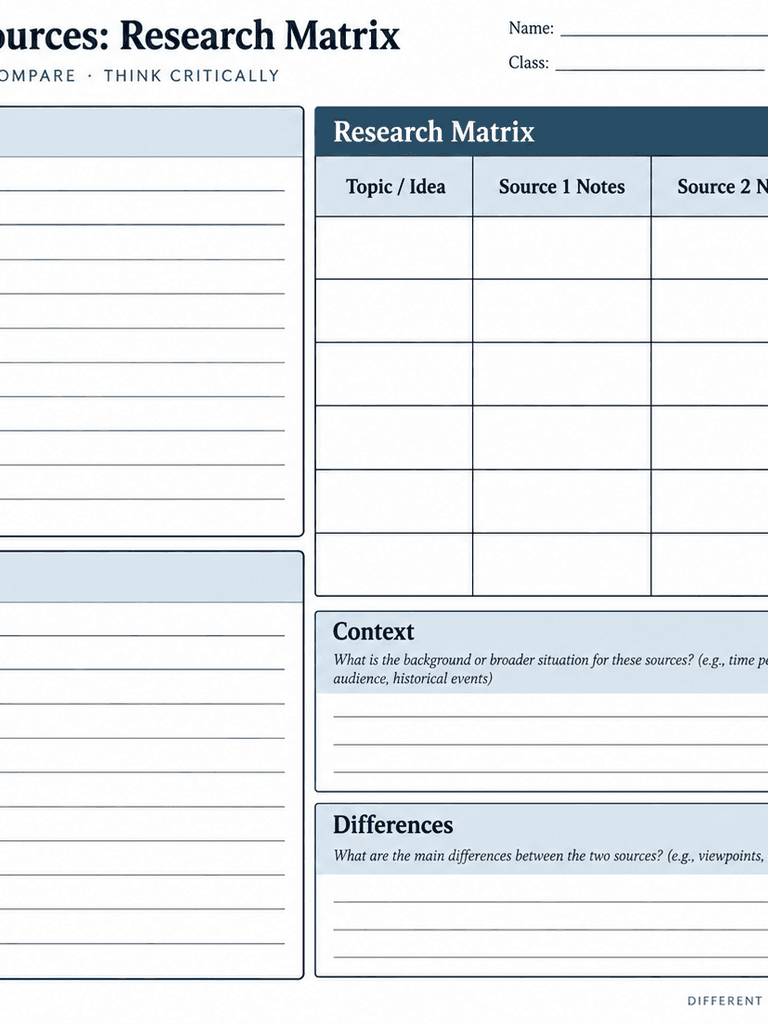
Use this worksheet before writing a comparative answer or article.
|
Question |
Item A |
Item B |
Notes |
|---|---|---|---|
|
Why am I comparing these? |
|
|
|
|
What exact question am I asking? |
|
|
Use the same question for both |
|
Which tradition and community? |
|
|
|
|
Which text, practice, or institution? |
|
|
|
|
Which period and place? |
|
|
|
|
Which language, edition, or translation? |
|
|
|
|
What kind of source is this? |
|
|
Text, commentary, practice, scholarship, other |
|
What does each source say on its own? |
|
|
Complete before comparing |
|
Where is there disagreement within the tradition? |
|
|
Name communities or interpretations |
|
What is genuinely similar? |
|
|
Keep the statement narrow |
|
What is materially different? |
|
|
Meaning, purpose, authority, or setting |
|
What is missing or uncertain? |
|
|
|
|
How did the question change? |
|
|
|
|
Who wrote or reviewed this? |
|
|
Include relevant experience and limits |
The worksheet is not a complete academic method. It is a practical way to slow down, notice assumptions, and keep the limits visible.
AI can help you find possible passages, organize notes, explain unfamiliar terms, and suggest follow-up questions. It can also invent citations, hide disagreement, or make two teachings sound more alike than they are.
A safer order is:
Plurilore is designed to support that kind of study through questions, source links, selected-tradition comparison, the Library, the Atlas, and notes. It remains a study aid. The method should still work if you use another tool or no AI at all.
No comparison is completely free from a point of view. It can still be careful and open to correction. State the question, sources, translations, author, and limits. Study each side independently, compare similar kinds of material, and show readers where interpretation begins.
The biggest mistake is treating a whole religion as one timeless opinion. A passage, teacher, school, or present-day practice may be important without representing every community and century. Narrow the question before drawing a broad conclusion.
Name the exact texts, editions, translations, and passages. Read each one in context before placing them side by side. Compare the same feature in both, then explain any difference in genre, authority, interpretation, or historical setting.
No. Two teachings may resemble one another in wording or practice while resting on different ideas about God, the self, authority, or the final goal. State what is similar and what limits that similarity.
Practitioners can notice language, lived meaning, and internal disagreement that an outsider may miss. Their review is valuable, but no individual speaks for an entire tradition. When possible, combine practitioner insight with historical and scholarly review.
You do not need to compare every religion at once. You need a clear question, well-chosen sources, room for disagreement, and conclusions that stay close to what you actually found.
If the sources change the question, let them. If two things cannot be fairly compared in the way you first imagined, say so. A good comparison does not make traditions look alike. It helps readers see each one more clearly.