Shinto is better approached through relationships among kami, places, communities, and repeated practices than through a single creed. Shrine visits, purification, offerings, prayers, and festivals make those relationships visible. Old narratives name kami and situate them in stories, but they do not function as one exhaustive rulebook for every form of Shinto.
That is the point of saying that Shinto “begins with ritual.” It is a reading method, not a claim that belief is absent, texts are irrelevant, or every shrine follows an identical pattern.
In brief: Start with what people do, where they do it, and which kami a community venerates. Then ask what kind of authority a source has: a shrine's current guidance can explain its practice, while the Kojiki and Nihon Shoki illuminate early narratives and court history. Neither source alone defines all living Shinto.
In this guide:
A creed normally condenses beliefs into statements that adherents affirm. Shinto has no single creed that performs that role for every shrine, practitioner, historical period, or local community. Starting with a hunt for a universal list of propositions can therefore make the tradition look empty or inconsistent when the problem is the question itself.
Ritual directs attention elsewhere. It asks how people approach a sacred place, prepare to meet a kami, make offerings, speak formal words, celebrate a festival, or maintain a relationship over time. Kokugakuin University's overview of ancient Shinto treats _matsuri_—ritual worship—as central while also warning that ancient practice must be reconstructed from sources written in later settings.
“Ritual first” should not become another absolute. Shinto has changed across centuries and includes institutional, local, household, and individual settings. Modern explanations may also reflect the perspective of a particular organization. Jinja Honcho, for example, describes the work and etiquette of shrines from the standpoint of Shrine Shinto; its guidance is useful for that setting, not a charter for every phenomenon ever called Shinto.
The history is not a story of one untouched essence. Mark Teeuwen and Bernhard Scheid's study of kami worship and the category “Shinto” distinguishes long histories of shrine and kami practice from later efforts to organize those practices as a unified tradition, including centuries of interaction with Buddhism. Old practices, changing institutions, and modern labels all belong in the picture.
Kami is often translated as “god” or “deity,” but neither English word is a perfect container. The category is plural and context-dependent. Classical sources speak of heavenly and earthly kami; shrines venerate particular kami; later accounts also use the term for beings, ancestors, places, and forces regarded with exceptional power or awe.
Kokugakuin's Encyclopedia of Shinto entry on kami makes two cautions especially useful for beginners: the term cannot be settled by a simple etymology, and no short definition captures every historical use. Even a famous definition from the scholar Motoori Norinaga belongs to a particular interpreter and period.
So translate with a pencil, not a stamp. In one passage, “deity” may help an English reader follow a genealogy. At a shrine, the more important questions may be: Which kami is enshrined here? What relationship does the community maintain? What occasion has brought people to this place?
This also explains why “Shinto believes in nature gods” is too small. Mountains, trees, seas, winds, and other features can be associated with kami, but the category is not limited to personified pieces of nature. Nor does calling something a kami tell you that every community understands or approaches it in the same way.
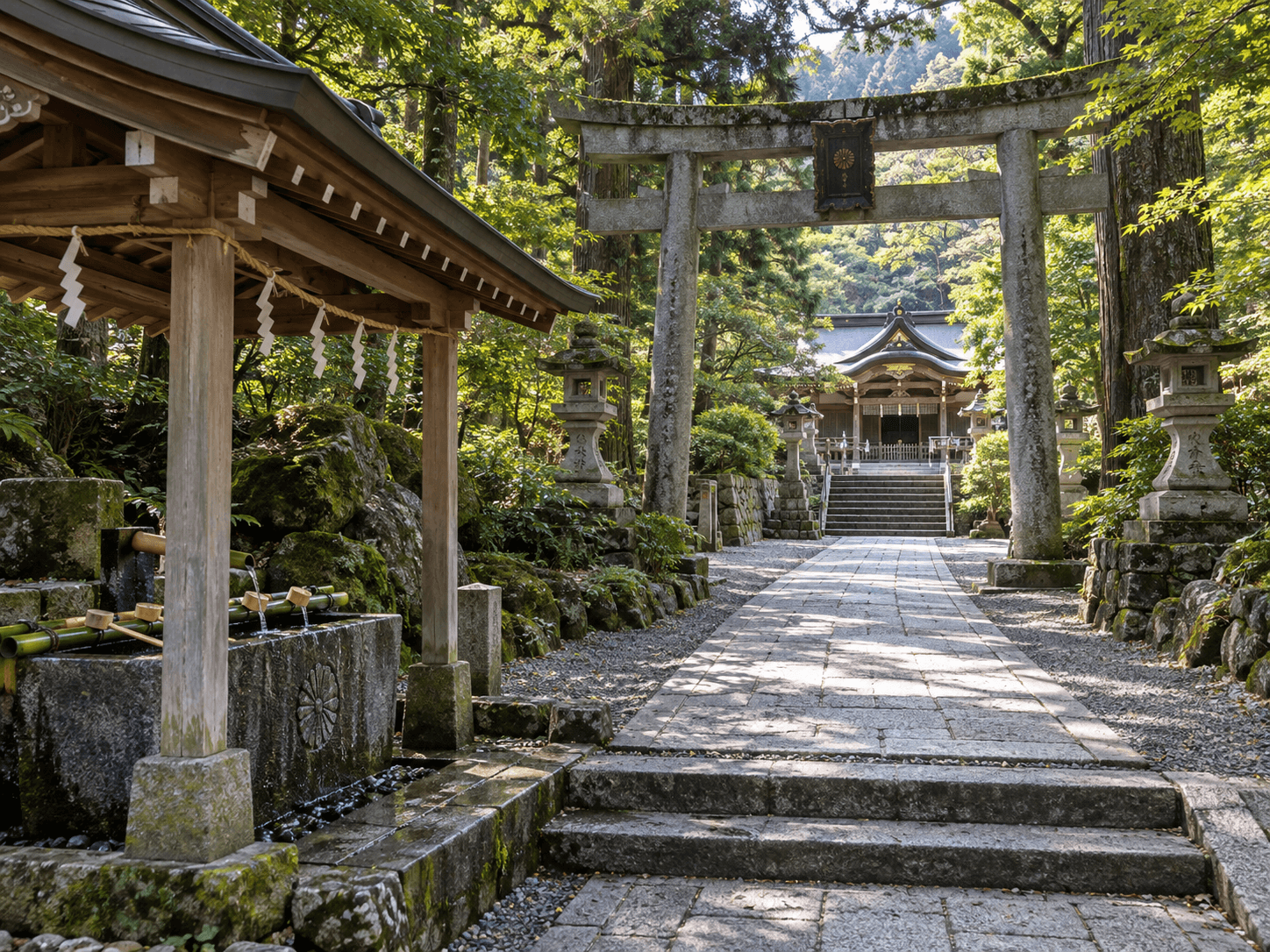
A visitor may first notice a torii marking an approach, a place to rinse hands and mouth, an offering box, bows and claps, or a festival procession. Formal shrine rites involve more than visitor etiquette. They may include purification, offerings, the recitation of norito, and acts of worship by priests and participants.
|
Element |
What it helps a reader notice |
What not to infer |
|---|---|---|
|
Jinja, or shrine |
A maintained place where one or more kami are enshrined and venerated |
That a building alone explains the community's full history |
|
Harae, or purification |
Preparation and the removal of ritual impurity in particular rites |
A universal doctrine that maps neatly onto moral guilt |
|
Shinsen, or offerings |
Food, drink, and other offerings presented in a ritual relationship |
A mechanical exchange guaranteed to produce a result |
|
Norito |
Formal liturgical language addressed in ceremonies |
One fixed prayer book used identically everywhere |
|
Matsuri |
A rite or festival connecting kami, shrine, season, and community |
Only a public spectacle detached from worship |
Jinja Honcho's descriptions of entering a shrine and daily shrine work explain cleansing, offerings, prayer, and maintenance in contemporary Shrine Shinto. Kokugakuin's account of basic matsuri places offerings and norito within a larger ritual sequence and notes that communal festivities may follow the central rite.
These sources answer different questions. Visitor guidance tells you what a particular institution recommends now. Historical scholarship can show how rites were organized, standardized, interrupted, or revived. Observation at one shrine cannot prove a rule for every shrine.
The Kojiki, presented to the court in 712, and the Nihon Shoki, completed in 720, preserve early accounts of divine emergence, the formation of the land, Izanaki and Izanami, Amaterasu, Susanoo, and other figures. They are indispensable for studying early Japanese myth and the ways the court narrated origins and lineage. They are not identical books, and the Nihon Shoki often places alternative versions beside a main account. Kokugakuin's guide to the Japanese classics
Calling them “foundational narratives” does not make them a Shinto Bible. The analogy hides too much:
Jinja Honcho's Shinto overview notes that many venerated kami do not appear in the oldest surviving narratives. Kokugakuin's introduction to kami likewise cautions against treating classical mythic figures as an exhaustive map of actual veneration.
The narratives still matter. They provide names, relationships, sequences, and images that later interpreters have read in religious, literary, political, and historical ways. A careful reader asks what a passage does inside its own work before turning it into a timeless doctrine or an instruction for present-day practice.
Confusion often comes from asking a good source to answer the wrong kind of question.
|
Your question |
Start with |
Why |
|---|---|---|
|
What does this shrine ask visitors to do? |
The shrine's current first-party guidance |
Practice can vary by place and occasion |
|
How does contemporary Shrine Shinto explain a rite? |
A named Shrine Shinto institution, with its perspective disclosed |
Institutional guidance is current but not universal |
|
What happens in a Kojiki episode? |
A named edition or translation of the Kojiki |
The claim concerns a particular text |
|
How does the Nihon Shoki differ? |
Its main account and the relevant alternative versions |
Merging variants erases the work's structure |
|
How did a practice develop? |
Historical scholarship using dated sources |
An origin story is not a complete ritual history |
|
What does a community consider authoritative? |
That community and qualified scholarship about it |
Outsiders should not assign authority on its behalf |
The same discipline helps with translation. Record the work, translator, passage or chapter, and publication details. If “kami,” “purification,” or “creation” carries a large argument, compare how another edition handles it. Our guide to comparing sacred-text translations provides a reusable worksheet.
Try a four-part note for one shrine, rite, or narrative:
This is a tradition-specific version of a broader rule: compare like with like before building parallels. How to compare religions without flattening their differences explains how to separate text, ritual, institution, and lived practice.
Plurilore's Shinto coverage guide describes a historical English-language corpus that includes the Kojiki and selected Shinto classics.
Shinto has important old texts, including the Kojiki and Nihon Shoki, but “scripture” can suggest one closed, uniformly authoritative canon. It is safer to name the work and the claim you are making. The chronicles are central sources for early narratives; they do not alone prescribe every current rite or belief.
“God” or “deity” can be a workable translation in some sentences, but not an exact equivalence. Kami has a wider and historically variable range. Keep the Japanese term when the English label would decide the interpretation too early, then explain which kami and context you mean.
There is no single test of literal assent that defines every Shinto participant. People and institutions can relate to narratives through ritual, place, lineage, culture, devotion, interpretation, or combinations of these. Ask a narrower question about a named community rather than assigning one belief to everyone.
No universal online checklist can replace local guidance. Commonly described actions include approaching respectfully, cleansing at a water basin where one is provided, making an offering, and bowing and clapping in a customary sequence. Follow the instructions of the shrine you visit and recognize that special rites can have their own procedures.
Choose one shrine or one short narrative. Identify the kami, the setting, the actions, and the source's kind of authority. Then write one sentence about what remains outside your evidence. That small discipline keeps ritual, story, and living community connected without pretending they are interchangeable.
Is Confucianism a religion or a philosophy? Explore ritual, Heaven, ancestor rites, and ethical formation through primary texts and careful scholarship.