Confucianism has religious dimensions as well as philosophical, ethical, and political ones. Whether it is called a religion depends on the definition being used and the community or period being described. A single yes or no leaves too much out.
For a reader encountering the tradition for the first time, the useful starting point is the relationship between ritual and character. Confucian sources join the cultivation of humane conduct to inherited practices, relationships, and reverence. Teachings about Heaven and rites for ancestors belong to that picture too. They deserve attention alongside the familiar advice about family and good government.
In brief: Confucianism can be studied as a religious tradition, but that description does not exhaust its meaning. Early texts combine ethical formation, ritual, and references to Heaven and spirits. Later thinkers and modern participants interpret those connections differently. Begin with a particular text or practice, then ask what the label “religion” helps explain.
In this article
Both descriptions can be useful, provided their limits are clear.
If religion is defined chiefly through an exclusive membership, a revealed creed, or a separate religious institution, much Confucian life will be difficult to classify. A definition that pays attention to sacred relationships, ritual, and the connection between human life and a larger order will bring other aspects into view.
Sociologist Anna Sun examines this problem in Confucianism as a World Religion. Her introduction traces disagreement partly to the history of the category “world religion” and partly to ways of studying religious life that privilege formal affiliation. The question has a history of its own; it is more than a neutral label attached to an unchanged tradition.
The word Confucianism also gathers together materials that were never one simple package. Stephen F. Teiser's overview for Columbia University's Asia for Educators distinguishes classical books, ritual institutions, and different intellectual lineages. Terms such as Ru, often rendered as scholars or Confucians, and later names for particular schools cannot all be reduced to a doctrine invented by one founder.
That is a useful starting rule for comparison: identify which source, practice, or community you mean. Our guide to comparing religions without flattening their differences develops that habit more fully.
Li (禮) is commonly explained as ritual or ritual propriety. It includes formal ceremonies and appropriate conduct in human relationships. Ren (仁), often rendered as humaneness or benevolence, concerns the quality of being humane toward others. Irene Bloom discusses both terms in Columbia's Confucian teaching transcripts.
The connection appears in Analects 12.1. Yan Yuan asks about ren; the response ties it to overcoming oneself and returning to li. The exchange then becomes concrete: attention to what one looks at, listens to, says, and does. Ethical cultivation reaches into repeated conduct.
James Legge translates ren here as “perfect virtue” and li as “propriety.” Those English choices can make the passage sound more abstract or more concerned with manners than a reading organized around humaneness and ritual. Keep the Chinese terms in view, and compare the explanation as well as the wording. Our translation-comparison guide offers a practical method.
Consider the difference between reciting a condolence automatically and attending carefully to someone who is grieving. This is a modern illustration, rather than a Confucian prescription: a familiar form can either conceal inattention or help a person express care. It shows why evaluating a practice only by its visible movements can miss what the participant is learning to notice.
Tian (天), usually translated as Heaven, should be read in its particular passage. It cannot safely be assigned one English theological meaning in advance.
In Analects 3.13, offending against Heaven is connected with having nowhere to direct prayer. In Analects 17.19, Heaven is evoked through the movement of the seasons and the emergence of living things, without speech. These passages offer different emphases: prayer and moral accountability in one, the world’s ongoing processes in the other.
Our reading is that this range makes both an automatic equation with a creator God and a complete removal of religious significance too quick. The text gives a reader reasons to ask further questions.
Ancestral rites provide another reason. In Analects 3.12, Legge describes sacrifice to the dead and spirits “as if they were present.” The passage also stresses the participant's own presence at the sacrifice.
That wording does not settle every question about what the speaker believes spirits to be. It does establish that sacrifice and a serious attitude toward those addressed are part of the text. Treating these practices as irrelevant to an account of Confucianism would narrow the evidence before the classification begins.
Two passages often used to support a secular reading deserve careful attention.
In Analects 6.22, Confucius connects wisdom with attending to human duties while respecting spirits and keeping them at a distance. The linked Legge edition numbers this passage VI.20. Its restraint includes respect; the two elements should be read together.
In Analects 11.12, numbered XI.11 in that edition, Ji Lu asks about serving spirits and then about death. Confucius redirects him toward serving people and understanding life.
We read this as a statement about the order of attention: the questioner has responsibilities and understanding to develop among the living. The exchange supplies no detailed account of an afterlife. It also contains no explicit denial that spirits exist. A claim stronger than either of those observations needs additional evidence.
Human concern, ritual participation, and reserve about unseen matters can coexist in these passages. Letting one isolated saying decide the classification of a whole tradition loses that combination.
The Analects itself needs historical care. It preserves sayings and dialogues attributed to Confucius and his circle; its composition and authority remain subjects of scholarly debate. Mark Csikszentmihalyi's Stanford Encyclopedia of Philosophy entry on Confucius explains why it should be read alongside a wider body of early sources. A passage is evidence for the received text; treating every line as a securely dated transcript goes beyond that evidence.
Later thought adds further differences. Xunzi retained a central role for ritual while rejecting the idea that a rain sacrifice causes rain. Paul R. Goldin's account of Xunzi, discussing the text's chapter 17, explains the importance of regular natural processes and human action in his view. Participation in ritual therefore need not imply one uniform account of its supernatural effects.
Song-Ming thinkers developed more systematic accounts of the cosmos, human nature, and moral cultivation. Zhu Xi and Wang Yangming are major figures, but they do not represent identical positions. Justin Tiwald's introduction to Song-Ming Confucianism also shows how disagreement with Buddhism and Daoism existed alongside intellectual interaction. These later developments should be distinguished from the early dialogues.
Modern lived practice poses a different question again. In her published fieldwork on ritual life in urban China, Anna Sun describes participation in ancestral rites and visits to temples across different traditions, sometimes without a single institutional religious identity. Her observations help explain why a survey asking only about membership can miss meaningful practices.
They do not authorize calling every participant a Confucian against that person's own account. Ask what people do, how they explain it, and which identities they claim. A scholarly classification and a person's self-description answer related but different questions.
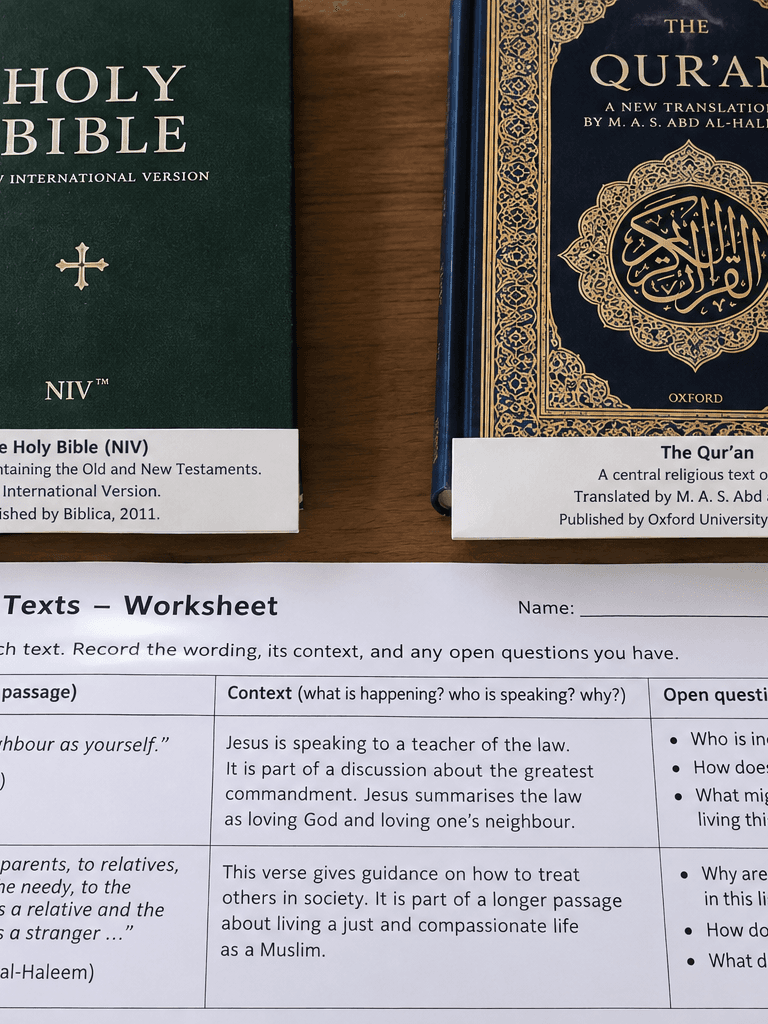
For a first reading, keep three columns in your notes:
|
What the source says |
What your interpretation adds |
What remains open |
|---|---|---|
|
Record the exact passage and translation. |
Explain why it supports a religious, ethical, or other reading. |
Name the question the passage does not resolve. |
For example, Analects 3.12 describes participation in sacrifice. You might infer that disciplined presence matters to the rite. Whether it supplies a complete theory of spirits remains a separate question. This small separation makes disagreements easier to discuss without assigning more certainty to the text than it offers.
If you study alongside Plurilore, check the Confucianism source page for the collection included. The Analects readings in this article use the external translations linked above; a selected collection should not stand in for the whole tradition.
That is not a safe definition of the whole tradition. References to Heaven deserve their own reading, and thinkers differ about natural order and ritual efficacy. Begin with the particular account being discussed rather than assuming that every Confucian source teaches the same theology.
The passages discussed here do not support that claim. Analects 3.12 describes sacrifice, while 6.22 joins respect for spirits with distance from them. His emphasis on human responsibilities helps establish priorities; it does not erase the ritual practices found in the same text.
Yes. Reading its texts as philosophy is a legitimate approach, and modern ritual participation does not always correspond to exclusive membership. Keep that study choice distinct from a claim that religious interpretations or practitioners are mistaken. The specific source and community still matter.
The question “Is Confucianism a religion?” becomes more useful when it leads into the tradition's sources. Read Analects 3.12, 6.22, and 11.12 together, noting the numbering differences in Legge. Compare what they say about ritual presence, human responsibility, and restraint toward spirits. Then explain what your chosen label reveals—and which questions it leaves open.