The Analects is a collection of brief sayings, conversations, and portraits associated with Confucius and his disciples. Its familiar form has twenty books. Read it as a series of encounters: someone asks a question, a teacher responds, and a few words invite further thought.
For a first-time reader, the difficulty is often knowing what surrounds a sentence. Who is speaking? What does “virtue” mean here? Is this instruction general or directed to one person? This Analects beginner guide helps you start answering those questions.
In brief: Begin with an annotated translation, keep passage references in your notes, and compare another translation when wording changes the meaning. Read whole exchanges before extracting advice. The Analects preserves a teaching tradition; it is not a book Confucius wrote or a verified transcript of his speech.
In this guide:
The Chinese title is Lunyu. Its statements, conversations, and accounts of conduct do not unfold as one continuous argument.
The twenty large divisions are commonly called books, although some sources call them chapters. Each book contains smaller passages, also sometimes called chapters. In a reference such as Analects 1.1, the first number means Book 1 and the second means its first passage. 11.22 means Book 11, passage 22. The book titles generally come from their opening Chinese words rather than a summary of their subject. Moss Roberts, introductory remarks to The Analects
A book title may not tell you what every passage discusses, and neighboring entries may not answer one another. Read the surroundings, then look for related passages elsewhere.
Numbering varies between editions: Eno's 11.22 appears as Book XI, Chapter XXI in the Legge text below. If a reference lands on the wrong sentence, check the opening words and people before deciding a quotation is missing. Eno, 11.22; Legge, Book XI
Confucius, or Kong Qiu, is traditionally dated to 551–479 BCE. He lived as Zhou royal authority weakened and regional rulers competed for power. Questions about learning, proper conduct, and government therefore concern more than private manners: they ask how people might live together when authority and trust are unstable. Mark Csikszentmihalyi, “Confucius,” Stanford Encyclopedia of Philosophy
The Analects was assembled after Confucius's death. Tradition credits his disciples and later disciples; scholars debate how the books developed and how directly particular sayings reflect the historical teacher. Distinguish the age of a saying from the later formation of the collection. There is no single agreed compilation date. Stanford, section 2; Roberts, introductory remarks
For your notes, ask “What teaching does this passage present?” rather than assuming you can recover Confucius's speech word for word.
Some words carry more than a single English equivalent can hold. Use this glossary as a starting point to test against each passage.
|
Chinese term |
Useful starting meaning |
What to watch for |
|---|---|---|
|
Ren 仁 |
Humaneness or benevolence |
A demanding ethical quality expressed in relationships and conduct, rather than occasional friendliness |
|
Li 禮 |
Rites or ritual propriety |
Forms of appropriate conduct, including ceremonies and everyday social behavior |
|
Junzi 君子 |
A noble or exemplary person |
An ideal of cultivated character in many passages, while the word can also retain associations with social position |
Eno leaves these terms untranslated and explains the breadth of their meanings. Eno, introduction, “Key Terms and Translation Issues”
The terms interact. In 12.1, the answer to a question about humaneness turns toward self-command and ritual conduct. In 4.5, maintaining humaneness belongs to the life of the noble person even under pressure. These are relationships to investigate, not a formula in which three terms become interchangeable. Columbia University, Sources of Chinese Tradition selections, 12.1 and 4.5
When you encounter li, ask what conduct is involved: greeting, governing, mourning, or making an offering? The setting helps you understand the word.
Choose an edition whose notes explain unfamiliar people and terms.
Three useful kinds of source are:
Compare editions when a passage is difficult or its wording will support an important claim. Our guide to comparing sacred-text translations explains how to record differences without assuming that the smoothest English is closest to the source.
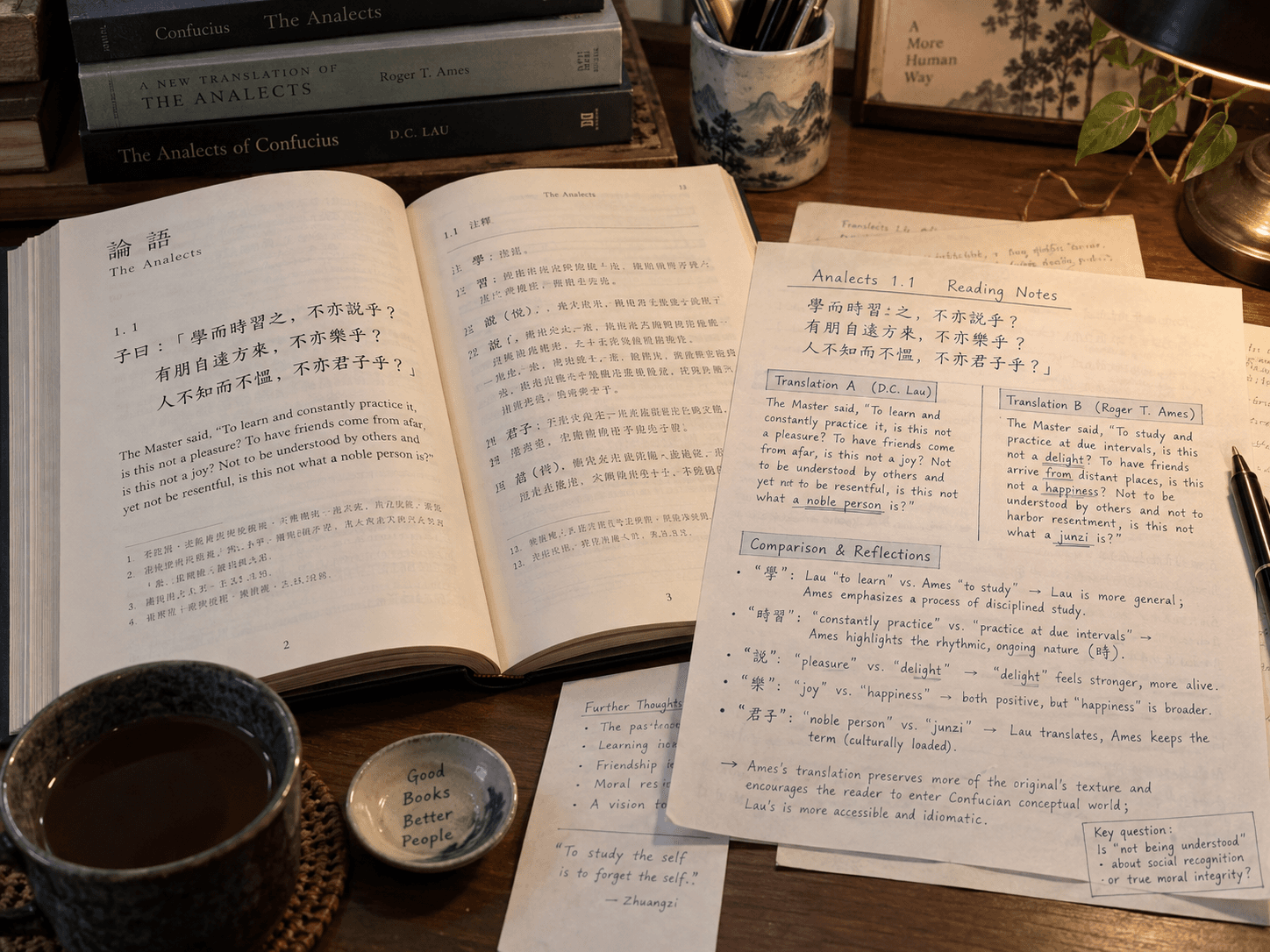
The opening passage brings together pleasure in learning, joy when friends arrive, and composure when one's worth goes unrecognized. Read all three movements before extracting the first as a saying about education. Legge, Book I, Chapter I
A small comparison shows how translation affects the emphasis:
|
Part of 1.1 |
James Legge |
Sources of Chinese Tradition, second edition, 1999 |
|---|---|---|
|
Learning and practice: selected wording |
“constant perseverance and application” |
“at due times to practice” |
|
The person described at the end |
“man of complete virtue” |
“noble person” |
These are selected excerpts. The Columbia edition was compiled by Wm. Theodore de Bary and Irene Bloom; see its teaching selections for the complete passage.
Legge foregrounds persistence; Columbia makes the timing of practice more visible. The final labels also affect how a beginner imagines the character being described.
How do the three parts connect? Perhaps learning is enjoyed and shared without depending on public approval. That is a reading to test against the passage and notes, not proof that the text dismisses ambition.
Zilu and Ran You ask whether they should put what they hear into practice immediately. Confucius restrains Zilu by referring to his father and elder brothers, but encourages Ran You. A third disciple notices the difference and asks why. The explanation concerns their dispositions: Ran You needs encouragement, while Zilu needs restraint. Eno, 11.22, printed page 55
Keep only one answer and you get a slogan about acting or waiting. The exchange asks you to consider the learner.
Before treating two statements as a contradiction, identify their speakers, listeners, and circumstances. Here the difference is explained inside the text. Elsewhere, the reason may remain uncertain.
Try this workflow with one short passage. It is a study suggestion, not a traditional rule.
A reusable note can be as simple as this:
|
Field |
Your note |
|---|---|
|
Passage and edition |
Which text can another reader find? |
|
Speaker and listener |
Who is addressing whom? |
|
Textual observation |
What happens or is stated? |
|
Translation difference |
Which wording changes your reading? |
|
Proposed interpretation |
What do you think follows, and why? |
|
Open question |
What still needs checking? |
If you later compare this teaching with another tradition, keep these notes intact. Begin with each source's own setting before placing similar English words beside one another. How to compare religions without flattening their differences offers a broader method for that step.
Plurilore's Confucianism coverage guide describes its listed source collection, The Sacred Books of China, Part I. That is a different work from the complete Analects editions linked here. Use the external texts for this article's passages; do not assume that those passages are included in Plurilore's Library.
The Analects is a later collection associated with his teachings and disciples, rather than a book he authored. Its exact formation remains debated. It is more careful to say that a passage attributes a statement to Confucius than to present every sentence as a verified record of his spoken words. Stanford, section 2
You can begin with a short passage and its notes, then read more widely. Reading in order helps you encounter material you might otherwise skip; reading by a question helps you compare relevant passages. Keep references in either case so that a thematic selection does not become your picture of the entire book.
One annotated edition is enough for a first reading. A second becomes useful when a key term is unclear or when you want to quote a passage accurately. Record whose wording you are using. Translation differences are a reason to investigate the source and notes, rather than to choose whichever version supports your first impression.
Begin with 1.1 or 11.22 in a complete edition. Write down one observation, one translation choice, and one question. Then read another passage and return to the first: the next encounter may change what you thought you understood.