
Jainism is an independent Indian religious tradition centered on freeing the soul from karma through right understanding, disciplined conduct, and radical care toward living beings. It is not a branch of Hinduism or Buddhism, even though all three traditions developed in South Asia and share some vocabulary.
Four concepts offer a useful first map: ahimsa limits harm, anekantavada resists one-sided claims, karma binds the soul, and liberation releases the soul from rebirth. None of the four stands alone.
In brief: Jainism teaches that every living being has an individual soul capable of liberation. Actions and passions draw karmic matter to the soul, obscuring its knowledge and freedom. The path therefore combines nonviolence, many-sided reasoning, restraint, and the “three jewels” of right worldview, right knowledge, and right conduct.
Jainism is an ancient Indian tradition whose name comes from Jina, “conqueror.” A Jina has conquered attachment, aversion, and the karmic bondage that keeps living beings within samsara, the cycle of birth and death. A Tirthankara, or “ford-maker,” teaches a passage across that cycle and establishes a community around the path.
Jains understand the present cosmic era through a lineage of 24 Tirthankaras. Mahavira is the 24th, not the first person ever to teach the path. The Stanford Encyclopedia of Philosophy's overview of Jain philosophy places him in ancient northern India as an older contemporary of the Buddha, while Jain tradition locates him within a much longer succession of teachers.
Mahavira should therefore not be described simply as the founder of Jainism. He is the most recent Tirthankara of this era and the central teacher for the historical Jain community that survives today.
Jainism does not depend on a creator god who makes the universe or grants liberation. Jain cosmology includes heavenly beings, and Jain devotional life includes reverence for the Jinas, but the Jinas are perfected teachers and models rather than creators who erase another soul's karma.
The tradition asks each person to understand reality, restrain harmful activity, weaken the passions, and follow a path by which the soul can become free.
It is possible to learn the four terms as separate definitions:
That list is accurate but incomplete. Jain philosophy connects knowledge, ethics, and liberation more tightly than a glossary can show.
If living beings possess souls, careless activity toward them matters. If karma obstructs the soul's capacities, restraint is more than social politeness. If ordinary knowers see reality partially, intellectual pride can become another form of attachment. If liberation requires the removal of karma, how one sees, speaks, moves, eats, works, and possesses things becomes part of one path.
The Tattvartha Sutra, a foundational Sanskrit summary respected across the two major Jain sectarian traditions, begins by joining right worldview, right knowledge, and right conduct as the path to liberation. Its seven basic categories then move from soul and non-soul through karmic inflow, bondage, stoppage, shedding, and liberation. Jainpedia's guide to the Tattvartha Sutra shows how the text builds this complete progression.
Ahimsa is often translated as “nonviolence,” but the English word can sound narrower than the Jain discipline. Jain sources examine harm caused by body, speech, and mind; harm performed directly, commissioned, or approved; and harm produced intentionally or through carelessness.
The early Acaranga Sutra instructs its ascetic audience not to slay, abuse, torment, or drive away living beings. Its rules repeatedly train attention on forms of life that ordinary movement and consumption can injure. The public-domain Hermann Jacobi translation of the relevant passage is historically important, though its 19th-century language should be checked against current scholarship.
Jain accounts classify living beings by their senses and include forms of life in plants, earth, water, fire, and air. That wide field of life explains the care associated with Jain food, movement, water, possessions, and occupations. It also prevents ahimsa from being reduced to a rule against assault.
There are different disciplines for mendicants and householders.
Jainpedia's account of the five vows explains this difference between the great vows and the lay vows. The distinction matters: presenting the most demanding monastic discipline as the daily practice of every Jain turns respect into caricature.
Ahimsa also has a positive direction. Careful action can offer safety, protection, food, and support. Nonviolence is not merely the absence of a blow; it trains a person to notice the lives that appetite and convenience usually leave outside the moral frame.
Anekantavada can be translated as “many-sidedness” or “non-one-sidedness.” It teaches that real things have multiple aspects and that ordinary human statements grasp them from limited standpoints.
The doctrine does not say that reality is whatever someone wants it to be. It does not make every opinion equally accurate. Jain thinkers are realists: they hold that things exist and that claims can be more or less adequate to them. The problem is that a finite speaker can mistake one true aspect for the whole truth.
A classical example concerns permanence and change. A thing can persist with respect to its substance while changing with respect to its modes. Saying only “it is permanent” hides change; saying only “it is impermanent” hides continuity. The Stanford Encyclopedia of Philosophy's account of Jain many-sidedness traces how Jain philosophers make the standpoint explicit rather than forcing one sentence to carry every qualification.
Two related terms help:
These ideas are sometimes turned into a simple slogan about tolerance. They can encourage intellectual humility, but their original work is more precise. Anekantavada is an account of complex objects, limited knowers, and responsible assertion. It asks, “From what standpoint is this true?” before it asks everyone to agree.
The doctrine also fits the wider path. Anger and attachment can narrow attention around a preferred view. A less possessive form of reasoning loosens the demand that one perspective must exhaust reality.
In everyday English, karma often means payback: someone behaves badly and soon receives an embarrassing result. Jain karma is not that joke, an outside judge, or mere good and bad luck.
Jain philosophy understands karma as extremely subtle material that becomes associated with an individual soul, or jiva. Activity creates an inflow of karmic matter, while passions such as anger, pride, deceit, and greed intensify bondage. Karma can obscure knowledge and perception, shape experience, and condition embodiment within samsara.
This account has a technical sequence:
The metaphor of passions as glue can make the relation easier to picture, but Jain authors treat karmic matter as more than a metaphor. Jainpedia's overview of karma describes its material character and its many classifications; the Stanford Encyclopedia entry connects karma to knowledge, conduct, and the structure of the soul.
Karma is not fatalism. Past activity conditions a life, but present restraint and insight are meaningful because new bondage can be stopped and old karma can be removed. Nor does the doctrine permit a reader to identify the exact past cause of another person's suffering. A technical theory of karma is not evidence for blaming a particular person.
Even beneficial karma does not equal final freedom. Better conditions within samsara remain conditions within samsara. The ultimate aim is not to accumulate an endless store of cosmic rewards but to end the bondage that keeps the soul cycling through embodied lives.
Liberation in Jainism is the completion of a long process, not absorption into a creator or a declaration that the individual soul never existed.
The soul is understood as an enduring, conscious reality whose capacities are obstructed by karma. As the relevant karmas are destroyed, unobstructed knowledge becomes possible. Kevala-jnana is perfect or absolute knowledge. Final liberation, moksha, occurs when all karmic bondage has ended and the soul is no longer reborn.
The path is commonly summarized by the three jewels:
These are not three competing routes. The opening of the Tattvartha Sutra presents them together. Conduct without understanding can become mechanical; knowledge without conduct leaves bondage intact; conviction without either remains incomplete.
Liberated souls remain distinct. Jain liberation is therefore different from Buddhist accounts that reject a permanent self and from Hindu schools that describe the liberated self's relation to ultimate reality in several different ways. Shared words such as karma, moksha, and nirvana do not establish a shared doctrine.
There are also Jain disagreements that a brief introduction cannot settle. Digambara and Svetambara traditions differ over parts of the path, scripture, mendicant practice, and whether liberation is possible from a female body. A responsible foundation should name those differences rather than silently make one sectarian account universal.
For a fuller map of the soul's movement through karmic bondage, omniscience, and final release, see Jainpedia's introduction to liberation.
| Concept | The question it answers | Role in the path | Common misunderstanding |
| ------------ | -------------------------------------------------------------- | ---------------------------------------------------------------- | -------------------------------------------- |
| Ahimsa | How should a person act among living beings? | Restrains harm and reduces karmic bondage | It is only a rule against physical violence |
| Anekantavada | How should a limited knower make claims about complex reality? | Checks one-sidedness and intellectual attachment | Every opinion is equally true |
| Karma | Why is the soul obstructed and reborn? | Explains inflow, bondage, experience, and the need for restraint | It means instant payback or fixed fate |
| Liberation | What is the final aim? | Completes the stopping and shedding of all karma | The soul merges into a creator or disappears |
The connections can be read in both directions.
Ahimsa makes sense within a world filled with living souls. Karma explains why carelessness and passion affect the agent as well as the harmed being. Anekantavada disciplines claims made by a knower whose cognition is still obstructed. Liberation gives nonviolence, knowledge, and restraint their final direction.
This is why “Jainism means nonviolence” is true but insufficient. It names the tradition's best-known practice while leaving out the account of life, knowledge, karma, and freedom that gives the practice its depth.
Any beginner's definition selects. Jainism includes long histories of debate, commentary, ritual, pilgrimage, devotion, renunciation, lay life, art, commerce, community, and reform.
Three distinctions should remain visible:
The two large sectarian families do not accept exactly the same canon, interpret every teaching in the same way, or follow the same mendicant practices. The Tattvartha Sutra is especially useful because both accord it authority, but even its versions and commentaries differ.
A rule written for a monk or nun cannot be transferred to a householder without checking its audience. The great vows and the limited vows share a direction while recognizing different conditions of life.
Plurilore's current Jain corpus includes the public-domain Jaina Sutras, Parts I and II in Hermann Jacobi's 19th-century translation. These texts are useful, but they do not contain every Jain scripture, commentary, sectarian perspective, or modern translation. The Jainism source guide states that boundary before readers use the agent or Library.
Use a source-first sequence rather than collecting definitions from unrelated pages.
No. Jainism is an independent Indian tradition with its own teachers, communities, scriptures, practices, and philosophical systems. It shares terms such as karma, samsara, and liberation with Hindu and Buddhist traditions, but gives those terms distinct meanings—especially through its teachings about individual souls and material karma.
Jains do not understand Mahavira as the first founder of their path. He is the 24th Tirthankara of the present cosmic era, preceded most recently by Parshvanatha. Historians focus on Mahavira and the ancient community around him, while Jain tradition places both within a much longer succession of ford-makers.
A concise map includes individual living souls, an eternal uncreated cosmos, karmic matter, rebirth, nonviolence, many-sided reality, disciplined vows, and liberation. The three jewels—right worldview, right knowledge, and right conduct—join belief and practice as one path rather than a list of unrelated doctrines.
No. Anekantavada holds that reality is complex and ordinary claims are made from limited standpoints. A perspective may disclose a real aspect without describing the whole. Jain thinkers still distinguish knowledge from error; the doctrine asks for qualified, properly situated claims rather than unlimited relativism.
Popular speech often uses karma for quick payback. Jain philosophy treats karma as subtle matter that becomes bound to an individual soul, obscures its capacities, and conditions rebirth. The path aims to stop new karmic inflow and shed existing karma, not simply collect favorable outcomes.
Ahimsa follows from the reality and spiritual potential of living beings. Harming them also involves the agent in karmic bondage. Jain practice therefore extends care beyond intentional physical violence to speech, thought, indirect participation, careless activity, diet, possessions, work, and the minute forms of life affected by ordinary action.
No. Mendicants and laypeople undertake different levels of vows, and Digambara and Svetambara traditions differ on scripture, practice, and some teachings about liberation. Family, sect, region, occupation, and contemporary interpretation also shape practice. A monastic rule should not be presented as a description of every Jain household.
Jainism becomes clearer when ahimsa, anekantavada, karma, and liberation are allowed to explain one another.
Nonviolence trains attention toward living beings. Many-sided reasoning trains attention toward the limits of one's claims. Karma explains why passions and actions obstruct the soul. Liberation names the freedom sought through right worldview, knowledge, and conduct.
Begin with the concepts, then return to a named text and its audience. From there, compare only after each source has been allowed to define its own terms. This comparison method is especially important when the same Sanskrit or Pali word appears in more than one tradition.
Use Plurilore's Jainism source guide to see the texts currently included, search the bounded Jain corpus, and follow citations into the Library. Treat the historical translation as a starting point, not as a complete representation of Jain teaching.
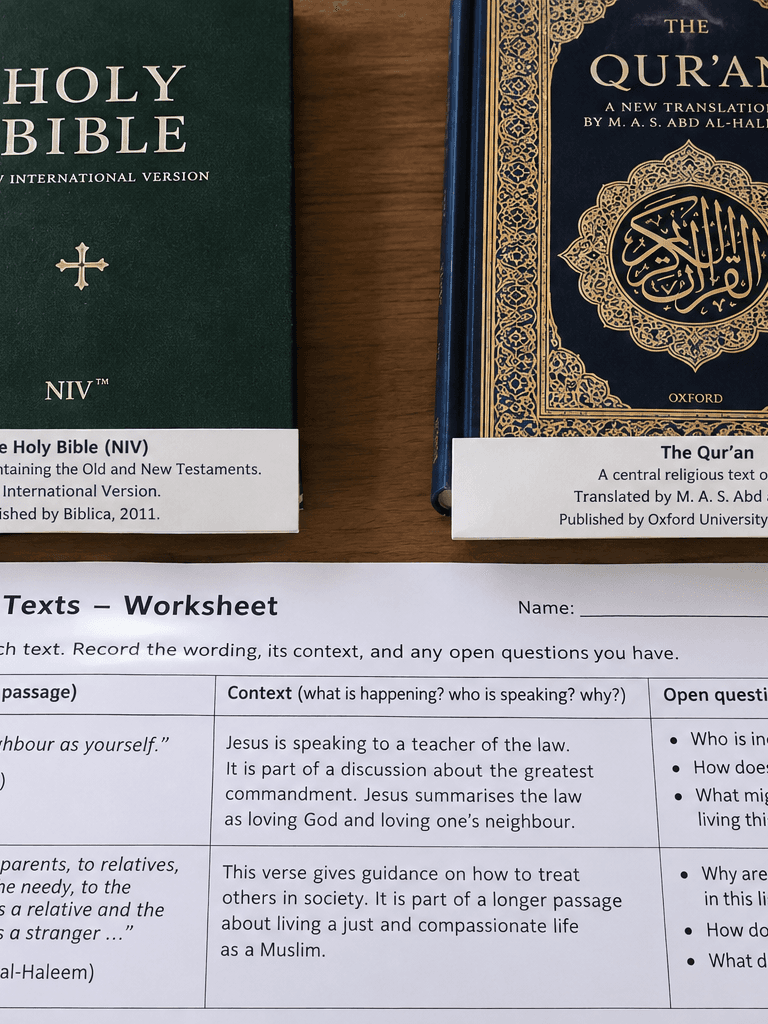
Compare sacred-text translations using a worksheet and Dhammapada example. Identify editions, check context, and separate wording from doctrinal conclusions.