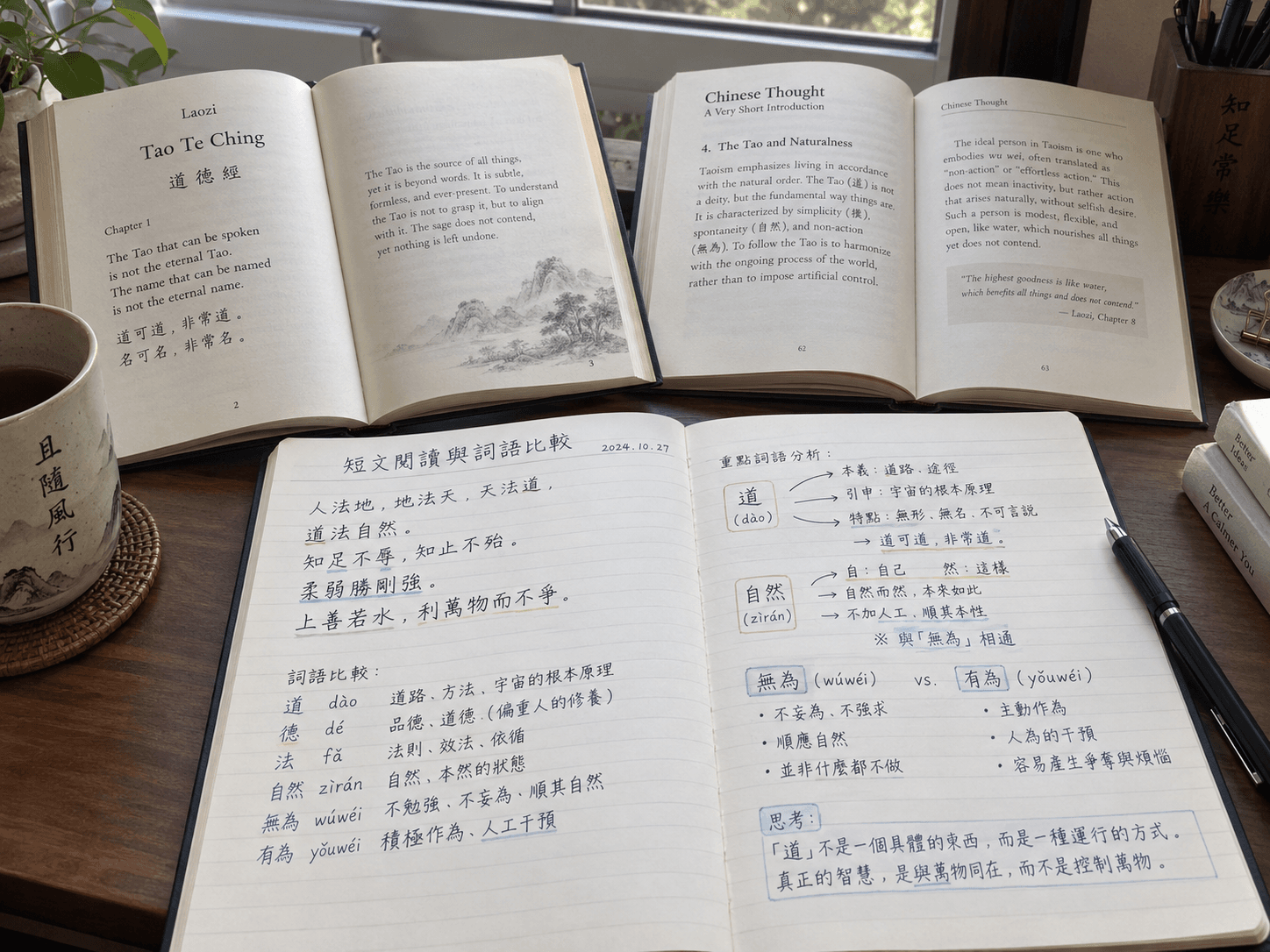
Tao is commonly translated as “Way,” but that word is a starting point, not a complete definition. In the Tao Te Ching, Dao names something that precedes heaven and earth, sustains living things, and helps orient action. The opening chapter also questions how fully a named or expressible way can capture it. James Legge's translation, chapters 1, 25, and 34.
If you are beginning with an English translation, four terms deserve attention: dao, de, wuwei, and ziran. This guide follows them through selected chapters of the Daodejing, also called the Tao Te Ching. It focuses on this text rather than treating its vocabulary as a complete account of living Daoist traditions.
In brief: Dao is often rendered Way; de, virtue or power; wuwei, nonaction; and ziran, naturalness or spontaneity. Each English choice needs context. “Nonaction” does not simply mean that nothing happens, and “naturalness” need not mean wilderness. Read the surrounding chapter before turning a translation into a doctrine or a life rule.
In this article:
First separate spelling from translation. Tao and Dao are romanizations of the same Chinese character, 道. The familiar spelling with T belongs to Wade–Giles usage; Dao follows pinyin. This spelling difference does not identify two different spiritual principles. Stanford's guide to reading Chinese philosophical terms gives the pairing directly.
“Way” is an English translation. Keeping Dao untranslated makes the source term visible, while using “Way” gives the reader an accessible association with a path or course. Neither approach removes the need for interpretation. A reader can misunderstand a familiar English word, but can also mistake an unfamiliar Chinese word for an explanation.
The title poses the same problem. Tao Te Ching and Daodejing name the same work. Titles such as Classic of the Way and Virtue and Classic of the Way and Its Power show how choices about de affect the whole book's presentation. Compare the titles used in the Stanford Encyclopedia of Philosophy and Columbia University's primary-text selection.
These are reading prompts, not four interchangeable definitions of Daoism. The chapter numbers follow the familiar received text.
|
Term |
Common English starting points |
Useful chapters |
Question to keep open |
|---|---|---|---|
|
Dao 道 |
Way, course; sometimes left untranslated |
1, 25, 34 |
Is this passage discussing naming, origin, or how things unfold? |
|
De 德 |
Virtue, power, potency, characteristics |
38, 51 |
What quality or capacity is being described, and how does it work? |
|
Wuwei 無為 |
Nonaction; non-coercive or uncontrived action |
2, 37, 48, 64 |
What kind of activity is restrained, and what still happens? |
|
Ziran 自然 |
Naturalness, spontaneity; being so of itself |
17, 25, 64 |
What emerges without being imposed or claimed by someone else? |
The ranges of English wording are discussed by Alan Chan in “Laozi,” sections 6–7. The passages themselves remain the best test of whether a proposed English gloss helps you read.
Chapter 25 gives a concrete reason to resist a one-word definition. It describes something prior to heaven and earth, then introduces Dao as the designation given to it. Legge adds “the Way or Course” to his rendering. Naming occurs inside the passage's argument; the text does not begin by offering a tidy dictionary entry. Legge, chapter 25.
This matters when “Way” sounds like a route someone has already drawn. Chapter 25 also speaks of movement, distance, and return. Chapter 34 depicts the Dao as sustaining things without claiming mastery over them. The imagery asks readers to consider both the emergence of things and a manner of acting among them. Chapters 25 and 34.
A useful reading note might therefore say: “Here, Dao is discussed through origin and sustaining activity.” That is more precise than writing “Dao means my personal path” beside every occurrence.
It also prevents a premature comparison with other traditions. Descriptions of origin do not by themselves establish that Dao is identical to a creator God, Brahman, or a modern account of nature. Those comparisons need their own sources and arguments. The guide to comparing religions explains how to begin with each tradition's terms before choosing a shared question.
“Virtue” may make de sound like a collection of approved behaviors. “Power” may suggest domination. Neither association fits every passage.
In chapter 38, Legge repeatedly uses “attributes” where many readers expect virtue. The chapter contrasts the highest condition with anxious efforts to exhibit or retain it, then moves through benevolence, righteousness, and ritual propriety. Its sequence suggests that de cannot simply be equated with displaying moral correctness. Legge, chapter 38.
Chapter 51 offers another setting. Dao brings things into being, while what Legge calls its “outflowing operation” nourishes them. The chapter ends with growth supported without possession or controlling mastery. Reading chapters 38 and 51 together broadens the question from “Which rules does a virtuous person obey?” to “How does this quality nourish and sustain life?” Chapter 51.
Chan's scholarly discussion explains why “virtue” remains a defensible choice while also discussing capacity and differing commentarial accounts. There is no need to declare one English term correct everywhere. Record what the translator chose and ask what the chapter makes that choice mean. “Laozi,” section 6.
Wuwei is often rendered “nonaction.” To understand the apparent paradox, read the actions surrounding it.
In chapter 2, the sage's manner of acting is connected with things arising and work being completed without ownership or attachment to achievement. Chapter 37 joins nonaction to transformation and restraint of desire. Chapter 48 describes diminishing rather than accumulating until nonaction is reached. These passages are concerned with how activity proceeds, not only how much activity occurs. Legge, chapters 2, 37, and 48.
Chapter 64 makes a blanket rule of passivity particularly difficult. It urges attention before disorder develops and ends with supporting things' own development. A reading that says “never respond to anything” struggles to account for those instructions. Chapter 64.
Phrases such as “non-forcing action” can help modern readers notice the contrast, but they are explanatory glosses. They should not silently replace every occurrence of wuwei. Columbia's introduction to early Daoist thought likewise explains nonaction through activity in keeping with Dao rather than absolute inactivity.
Before applying the term, ask: Is this chapter challenging coercion, desire, possession, or deliberate interference? The answer can vary with the passage. A modern slogan about working effortlessly is not enough to settle it.
Ziran is commonly translated as naturalness or spontaneity. Chan explains its components through being “self” and “so.” This helps resist the assumption that the term always refers to forests, untouched landscapes, or whatever someone happens to feel like doing. “Laozi,” section 7.
Chapter 25 places the term at the end of a sequence linking human beings, earth, heaven, and Dao. Legge renders the final relationship as Dao's “being what it is.” The sentence deserves attention before it is turned into a claim that Dao obeys an external entity called Nature. Legge, chapter 25.
Other passages bring the idea into human affairs. In chapter 17, successful undertakings leave the people understanding their condition as arising of themselves. In chapter 64, the sage supports the development of things without imposing a private purpose on them. Chapters 17 and 64.
The connection with wuwei is therefore useful: the text asks how things develop when possessive or disruptive intervention is reduced. Still, “naturalness” is not permission to declare every impulse wise. Read what the passage says about desire, action, and the people or things affected.
Chapter 1 offers a small comparison you can repeat yourself:
These short excerpts come from Legge's chapter 1 and the Columbia selection, chapter 1. The latter is reproduced from the volume compiled by Wm. Theodore de Bary and Irene Bloom; the online selection does not identify a separate translator for this passage.
The difference changes what an English reader notices first: a course that can be followed, or a way that can be expressed. That observation alone does not establish that the translations teach two incompatible doctrines. Both opening sentences distinguish their expressible or followable formulation from the constant or enduring Dao, and both continue into naming.
Use this five-part note rather than choosing the sentence that sounds most inspiring:
The translation-comparison guide develops this method beyond one line. Preserve the wording you actually used in your notes, even when you prefer another translation later.
They are different romanized spellings of the same Chinese character, 道. Tao is familiar from Wade–Giles usage; Dao uses pinyin. Changing the spelling does not create a different doctrine. A translation that uses the English word “Way” has made a further choice about how to convey the term.
“Nonaction” is a common translation, but complete inactivity is an inadequate reading of these selected chapters. Chapters 2 and 37 describe accomplishment or transformation, and chapter 64 calls for timely attention. Ask what kind of intervention the passage resists and what kind of response it leaves possible.
Both are established starting points, and Legge also uses wording such as attributes or operation. Chapter 38 concerns qualities that are not anxiously displayed; chapter 51 concerns nourishment. Read the translator's notes and the passage before assuming that de means either moral respectability or the ability to control others.
Begin with an edition that identifies its translator, underlying text, and interpretive notes. Compare the same chapter in a second attributed translation. Legge and the Columbia selection make the opening-line exercise here checkable; they are examples for study, not a ranking of every available edition.
The difficulty of Tao translation is productive when it sends you back to a passage. Choose chapter 1, 25, 38, or 64, record the English choices, and explain what the surrounding text allows you to say. Leave room for a better reading.
For a sustained example of these terms in one setting, read the Tao Te Ching's leadership passages. Notice how the meanings become clearer through the work, people, and outcomes described in each chapter.
For Plurilore's available Daoist material, read the public Taoism source guide. It identifies James Legge's two-part Texts of Taoism and explains the collection's limits. Use a separately attributed edition for the modern translation comparison rather than assuming the collection contains every version.
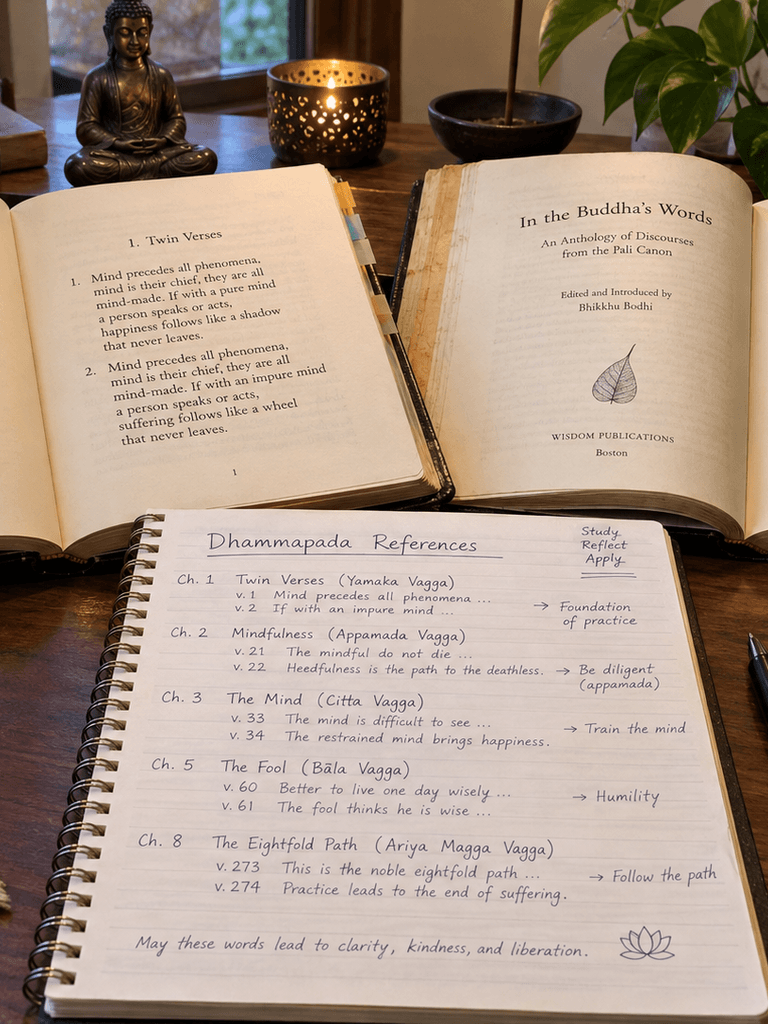
Start reading the Dhammapada with a guide to its 423 verses, central teachings, and translation choices. Follow a short reading route with sources and notes.