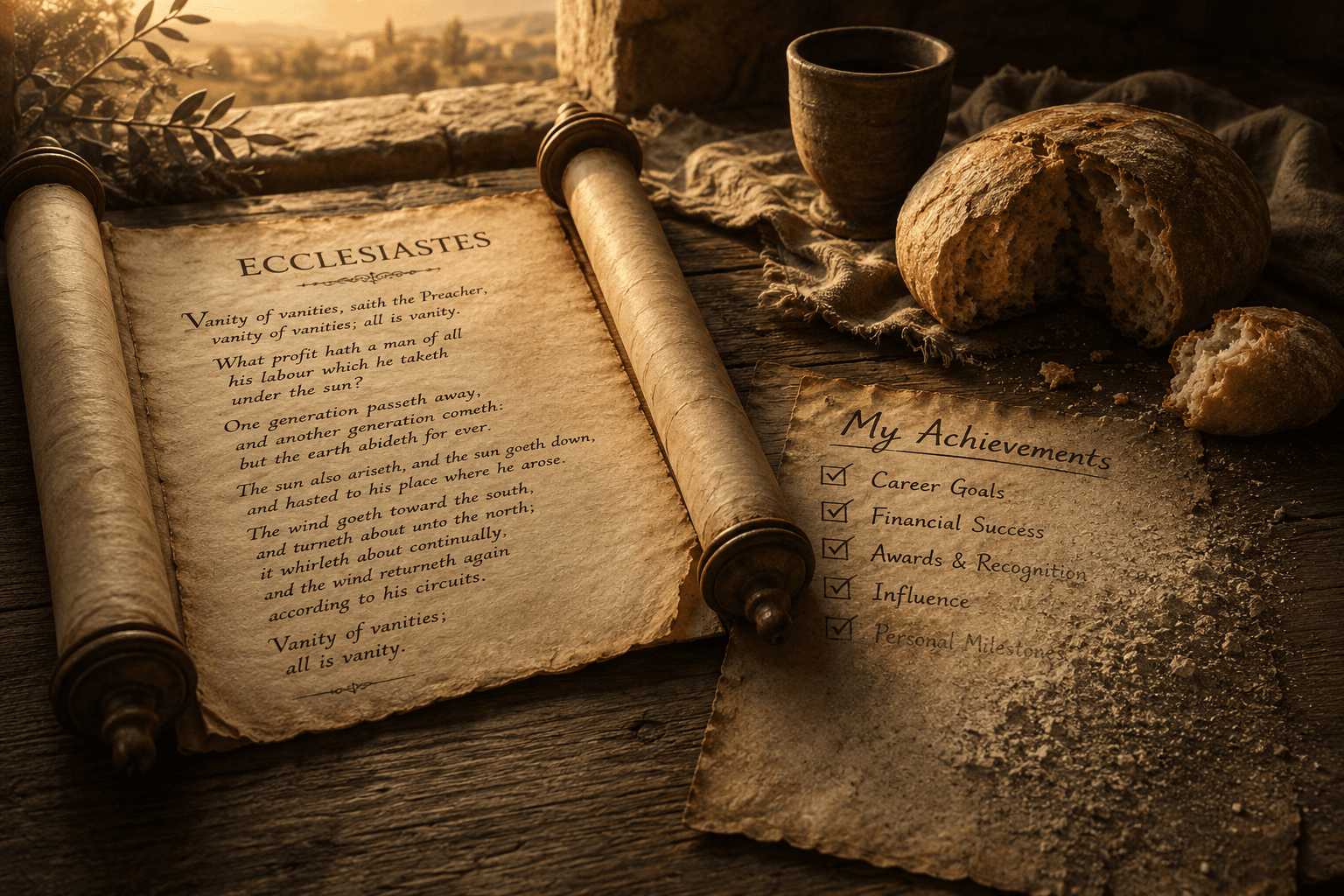
Ecclesiastes does not simply declare that life is meaningless. It asks what lasting gain human beings can secure through wisdom, pleasure, wealth, work, or achievement when death eventually takes everything out of their hands.
Its answer is severe but not empty. Achievement cannot make life permanent, guarantee justice, or give a person control over what comes next. Yet food, work, companionship, love, and the present day can still be received as gifts rather than turned into proof that a life matters.
In brief: Ecclesiastes confronts mortality by stripping achievement of its promise to make us secure. The Hebrew word hevel evokes breath or vapor: life is brief, elusive, and often resistant to a fair explanation. The book does not say that nothing matters. It recommends humble enjoyment, faithful action, companionship, and reverence for God within limits no career or possession can remove.
“Ecclesiastes” is the Greek-derived title of the biblical book. Its central speaker is called Qohelet in Hebrew, a name or role often translated as Teacher, Preacher, or Assembler.
Ecclesiastes belongs to the wisdom literature of the Hebrew Bible alongside Proverbs and the Book of Job's argument about innocent suffering. Each tests inherited wisdom differently: Job challenges the link between conduct and suffering, while Qohelet asks what wisdom can secure when death and uncertainty remain.
The opening presents Qohelet as a son of David and king in Jerusalem (Ecclesiastes 1:1–12). Jewish and Christian tradition long identified him with Solomon, whose wisdom, building projects, and wealth fit the royal experiment described in chapter 2.
Many contemporary scholars distinguish the speaker from the historical Solomon. The book's later form of Hebrew and its Persian loanwords point to a period centuries after Solomon. On this reading, the royal voice is a literary frame: Qohelet adopts a Solomon-like position to test what wisdom, pleasure, power, and accomplishment can deliver when a person has the resources to pursue all of them.
The distinction should be stated without dismissing tradition. “Solomon wrote Ecclesiastes” is an established Jewish and Christian attribution. “The book uses a Solomonic persona and was composed later” is a historical-critical conclusion based on language and literary features. Readers should know which kind of claim they are hearing.
Yale Bible Study's introduction to Ecclesiastes explains the authorship question, the book's historical language, and the tensions between Qohelet's speeches and the closing epilogue.
The book begins with a famous line often translated “vanity of vanities.” The key Hebrew word is hevel. Its concrete image is breath, vapor, or mist.
No single English word captures every use. Depending on the passage and translation, hevel can suggest:
“Meaningless” can be useful in some contexts, but it easily becomes too absolute. It makes Qohelet sound as though he believes nothing has value. Yet the book repeatedly calls wisdom better than folly, condemns oppression, praises companionship, and tells readers to enjoy ordinary goods.
“Vapor” preserves the image. A breath is real, but it does not last. Mist can be seen, but it cannot be held in place. Life and its achievements are not necessarily nonexistent or worthless; they are unable to bear the permanent weight people place on them.
The word also resists one mechanical definition. Scholarly discussion of hevel includes readings such as fleeting, futile, and absurd. A careful article should let the immediate passage guide the sense rather than forcing the same English label into every verse.
Ecclesiastes 1:2–3 places hevel beside another key word: yitron, usually translated gain, profit, or advantage. Qohelet asks what lasting surplus remains from all the toil done “under the sun.”
The phrase “under the sun” keeps attention on mortal life as people experience it. Generations come and go. Natural cycles continue. Human beings work, seek knowledge, build, inherit, and are forgotten.
The question is not merely “What should I do today?” It is “What can I secure that death, chance, injustice, and another generation cannot take away?”
That is why ordinary success does not satisfy the inquiry. A project can succeed and still fail to become permanent gain. A person can become wise and still die. Wealth can grow and pass to an heir who did not build it. A reputation can fade as collective memory moves on.
Ecclesiastes tests meaning at the point where achievement is strongest and finds that achievement cannot control its own future.
Ecclesiastes 2 describes an unusually large experiment. The royal speaker pursues pleasure, houses, vineyards, gardens, servants, livestock, silver, entertainment, wisdom, and public greatness.
This is not the complaint of someone who failed to achieve enough. Qohelet imagines reaching the top of the available measures and then asks what the success can finally keep.
Pleasure is real in Ecclesiastes, but pleasure pursued as a total answer becomes another experiment that cannot produce lasting gain. Amusement does not correct injustice, stop death, or make every day intelligible.
That does not lead Qohelet to condemn every pleasure. It teaches him to distinguish pleasure received in its moment from pleasure assigned the impossible job of making life permanent.
Qohelet repeatedly treats wisdom as genuinely better than folly. Wisdom can improve judgment and help a person navigate danger. Yet the wise and the foolish share the same final event: both die, and both may be forgotten.
Ecclesiastes does not say wisdom has no value. It says a real, limited value is not the same as ultimate control.
The sharpest criticism falls on toil when it promises a durable identity. Qohelet hates the thought of leaving everything to a successor whose wisdom he cannot guarantee (Ecclesiastes 2:18–23). The worker's mind may remain restless even at night.
The problem is not simply effort. It is the expectation that effort will give one person permanent possession of what time necessarily hands to another.
Ecclesiastes 4:4–6 observes that skillful work can be driven by rivalry. The answer is neither frantic competition nor total idleness. Qohelet contrasts restless abundance with a smaller portion joined to quiet.
This remains a searching question for modern work: how much striving serves the work itself, and how much depends on being seen above someone else?
Mortality is not a side topic in Ecclesiastes. It is the pressure applied to every claim about gain.
The famous poem in Ecclesiastes 3:1–8 names a time for birth and death, mourning and dancing, keeping and discarding. The poem is often used as reassurance that everything happens at the right time. The surrounding verses are less comfortable. Human beings cannot grasp the whole of what God is doing, and they do not control the times they inhabit.
Qohelet also compares the fate of humans and animals in Ecclesiastes 3:18–22. Both breathe and die; the speaker questions what can be known about what follows. Readers should not hurry past this uncertainty by importing a later, fully developed doctrine of resurrection or the afterlife into Qohelet's speech.
The “house of mourning” in Ecclesiastes 7:1–4 therefore has an educational role. Death reveals the end facing the living. Mourning can interrupt the illusion that there will always be more time to repair a relationship, use a gift, or decide what matters.
The book's closing poem turns toward aging and death through images of a darkened house, failing strength, and a broken vessel (Ecclesiastes 12:1–8). Whatever the debated details of each image, the cumulative movement is clear: embodied life narrows and ends.
Ecclesiastes does not use mortality to make the present worthless. Mortality is what makes the present impossible to own.
If Ecclesiastes were only about personal satisfaction, it could become a refined self-help manual. The book will not stay that small.
Qohelet sees injustice in the place of judgment (Ecclesiastes 3:16–17). He sees the tears of oppressed people who have no comforter and power on the side of those who oppress them (Ecclesiastes 4:1–3). He sees wealth that harms its owner, labor without satisfaction, and outcomes that do not reliably match merit.
These observations complicate any claim that diligent work automatically produces a good life. Achievement occurs inside social systems, and those systems can reward exploitation, conceal suffering, or take the product of one person's labor for another.
Qohelet does not provide a political program that resolves these conditions. His witness is still morally important. The world is not merely hard because individuals have chosen the wrong goals. It is also hard because power is unequal and justice is unreliable.
This is one reason hevel can suggest absurdity as well as brevity. A righteous person may receive what wickedness appears to deserve, while a wicked person receives what righteousness appears to deserve (Ecclesiastes 8:14). The outcome violates the moral pattern wisdom expects.
Qohelet's answer to limits is surprisingly ordinary. Several passages commend eating, drinking, work, companionship, and enjoyment as goods available within a life that cannot be secured.
The first such turn comes immediately after the critique of restless toil. Ecclesiastes 2:24–26 presents enjoyment in food, drink, and work as coming from God's hand. Similar refrains appear in chapters 3, 5, 8, 9, and 11.
These passages are not a prosperity promise. They do not guarantee that everyone has equal access to safety, food, satisfying work, or celebration. The book has already noticed oppression and deprivation.
Nor are they simple commands to maximize pleasure. Qohelet's royal experiment has shown why accumulation cannot settle the problem. Enjoyment is received as a portion, not mastered as an achievement.
That difference changes the posture:
Enjoyment becomes possible when it is no longer required to defeat death.
Ecclesiastes 4:7–12 moves from a solitary worker with no end to his toil toward the better portion of two people who can share a return, lift one another after a fall, keep warm, and resist attack.
The passage is often read at weddings, but its claim is wider than marriage. Companionship is a practical answer to vulnerability. No person is fully self-sufficient, and accumulating more cannot replace someone who helps when the body falls.
The contrast also sharpens the book's critique of achievement. The solitary worker keeps asking whom the labor is for. The question is not solved by reaching a larger number. It is answered partly by recovering relationship as a good that work should support rather than consume.
Ecclesiastes does not romanticize every relationship. It simply observes that fragile people need one another. Mortality makes companionship more valuable, not less.
The final chapter changes voice. Ecclesiastes 12:9–14 speaks about Qohelet in the third person, commends his teaching, warns about endless books, and concludes with fear of God, commandments, and judgment.
Many scholars treat these verses as an epilogue by one or more later framing voices. Traditional readers may understand the ending as the book's authoritative conclusion and the key that orders everything before it.
Either way, the ending should not make the preceding questions disappear. The canon preserves Qohelet's skepticism, observations of injustice, uncertainty about death, and repeated enjoyment sayings alongside the command to fear God.
The result is not a simple formula in which one final sentence cancels eleven chapters. Reverence and obedience are placed beside a teacher who has shown how little human beings can control or fully understand.
To fear God in this setting is not to possess an explanation for everything God permits. It is to know that a human being is not God—and that moral accountability still matters even in a world whose outcomes are not predictable.
Wisdom, work, wealth, pleasure, and reputation can be real goods. None can guarantee permanence, a just outcome, or control over the person who receives what comes next.
Death is not merely an event at the end. It reveals the limits already present in ownership, planning, memory, and control.
Food, companionship, love, and work do not need to become permanent before they can be received as good. Their value is not identical to their duration.
The book distinguishes wisdom from folly, condemns oppression, praises companionship, commends joy, and ends with accountability before God. “Nothing matters” is too flat for its argument.
Skill helps, but timing, chance, power, inheritance, injustice, and mortality disrupt the equation between effort and outcome. The book explicitly refuses a guaranteed meritocracy.
“Enjoy your work” is not permission to ignore exploited workers, loneliness, exhaustion, or people who lack a secure portion. Qohelet's enjoyment sayings remain beside his witness to oppression.
Use these questions for a career, project, possession, or ambition:
The aim is not to become indifferent to excellence. It is to stop requiring excellence to do what no achievement can do.
Ecclesiastes asks what lasting gain people can secure through work, wisdom, pleasure, and wealth in the face of death and uncertainty. It finds no achievement that guarantees permanence, yet it still commends reverence for God, moral seriousness, companionship, and ordinary enjoyment received as a gift.
Not so simply. The Hebrew hevel can evoke vapor, brevity, frustration, futility, or absurdity. Ecclesiastes denies that human striving can secure lasting control, but it still distinguishes good from evil and wisdom from folly. It treats finite food, work, love, and companionship as real goods.
The phrase translates a Hebrew expression built from hevel, literally breath or vapor. It describes life and achievement as fleeting, difficult to grasp, and unable to yield the permanent gain people expect. “Vanity” can mislead modern readers if it sounds like mere pride or total worthlessness.
Jewish and Christian tradition commonly attributes Ecclesiastes to Solomon. Many modern scholars instead read the royal son-of-David voice as a literary persona because the book's Hebrew and loanwords point to a later period. The text evokes Solomon without naming him directly.
Work can contain skill and enjoyment, but it can also become restless toil, rivalry, loneliness, and an attempt to control the future. Its products pass to others, and outcomes do not always match effort. Qohelet recommends receiving enjoyment in work without treating achievement as permanent security.
Ecclesiastes is skeptical about control and honest about death, injustice, and uncertainty. It can sound pessimistic because it refuses conventional reassurance. Yet its repeated invitations to enjoy food, relationship, and work are life-affirming within limits. The book holds protest and gratitude together without fully resolving the tension.
The book does not give a modern one-line theory of life's meaning. It dismantles the search for permanent gain through achievement, commends present goods as gifts, preserves moral accountability, and ends with reverence for God. Meaning is practiced within limits rather than secured as a possession.
Ecclesiastes does not flatter ambition. A finished project can be forgotten. A wise person can lose to chance. Wealth can pass into careless hands. No achievement negotiates an exemption from death.
The book's answer is not apathy. Work well, but do not ask work to make you permanent. Seek wisdom, but do not confuse wisdom with control. Notice injustice rather than calling every outcome deserved. Share the portion available now with people who can help and be helped.
Mortality limits achievement, but it does not make a meal, a friendship, a just action, or a day's honest work unreal. Their finitude is not the same as their worthlessness. Ecclesiastes' attention to death also clarifies why sacred texts respond differently to grief after a loss and why traditions cannot be reduced to one explanation of suffering.
Use Plurilore to study Ecclesiastes passage by passage, compare translations, and follow the source before turning a memorable line into a slogan.

Read Matthew 5:38-48 closely: where “hate your enemy” comes from, what the command actually asks for, and how Christians have disagreed about it since.