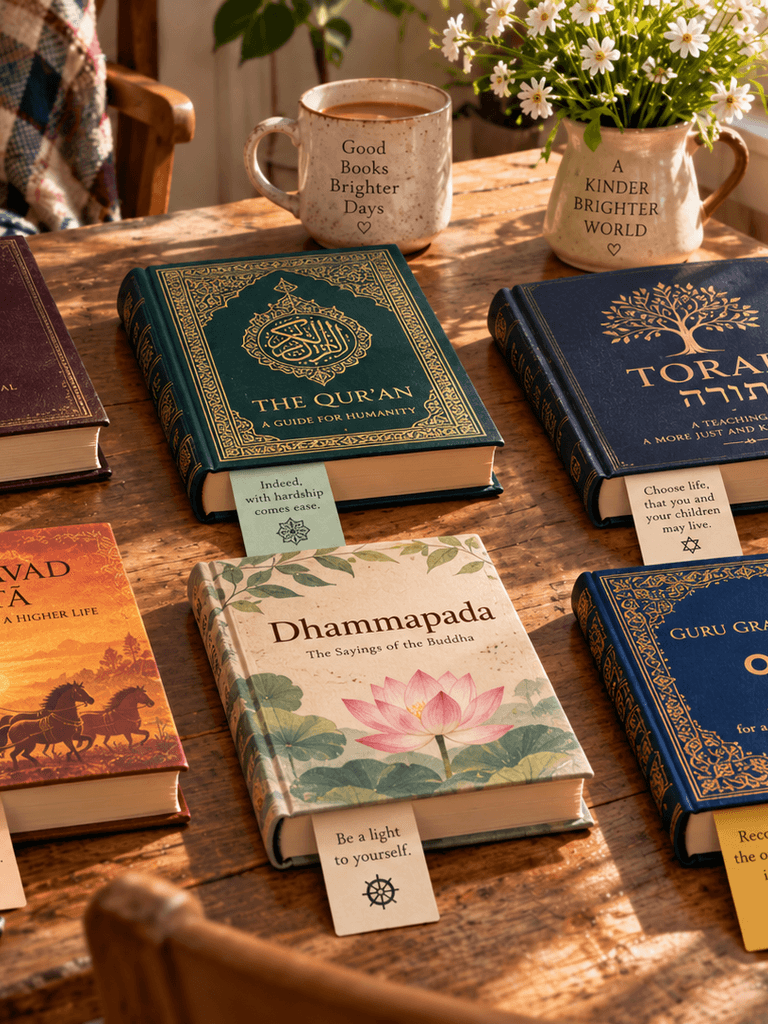
Sacred texts do not give grief one universal meaning or one approved emotional shape.
The Hebrew Bible preserves lament that may end without relief. The New Testament joins tears to resurrection hope. The Quran shows grief in a prophet while commending patient trust in God. Early Buddhist texts trace grief through attachment and impermanence toward release. These are not interchangeable ways of describing loss.
Religious teachings on grief become clearest when each passage is read in its own tradition instead of being reduced to a collection of comforting quotations.
In brief: Selected Jewish, Christian, Islamic, and early Buddhist texts make room for the reality of grief while directing it differently—toward lament before God, hope in resurrection, patient return to God, or insight into impermanence and attachment. None of these texts supports rushing a mourner, blaming grief on weak faith, or promising that spiritual practice will remove pain on a schedule.
This article compares a small set of passages about bereavement, lament, mortality, and consolation:
It is not a survey of everything Judaism, Christianity, Islam, or Buddhism teaches about death. Each tradition contains later commentaries, rituals, community practices, schools, and disagreements that a few passages cannot represent.
“Sacred text” also does not carry the same meaning in every tradition. The Quran's place in Islam, the Bible's place in Jewish and Christian communities, and the Pali discourses' place among diverse Buddhist canons are not identical. This comparison asks a narrower question: how do these named texts speak when someone has died or when the reality of separation becomes unavoidable?
Grief is not the same as the philosophical problem of suffering. The Book of Job's argument about innocent suffering asks why moral order appears to fail. A grief passage may instead give words, practices, hope, or a way to understand attachment after a particular loss.
|
Textual setting |
What grief is allowed to do |
Direction offered by the text |
What should not be inferred |
|---|---|---|---|
|
Hebrew Bible |
Cry out, question, protest, remember, sit in silence, enter mourning |
Address God truthfully; remain with the bereaved; learn from mortality |
Every lament quickly becomes praise or every loss has a visible cause |
|
New Testament |
Weep and feel absence even while holding hope |
Mourn within a community shaped by Jesus' death and resurrection |
Resurrection hope makes present tears unnecessary |
|
Quran |
Lament loss, name sorrow, pray, and endure without abandoning trust |
Practice sabr, return to God, and seek divine mercy |
Patience means emotional numbness or forbids tears |
|
Early Buddhist texts |
Recognize sorrow as a real consequence of clinging to what changes |
Understand impermanence, cultivate the path, and loosen grasping |
The texts teach a creator's plan or merely advise suppressing emotion |
The similarities are limited but important. These texts take grief seriously, place the mourner inside a larger account of reality, and resist the fantasy that love can make separation impossible. Their explanations of God, self, death, hope, and final release remain materially different.
The Hebrew Bible does not preserve only prayers that move smoothly from sorrow to confidence. It includes mourning, accusation, bodily distress, silence, and unresolved darkness.
Psalm 13 begins by asking how long God will seem absent. The speaker does not wait for a calm state before praying. Fear, complaint, petition, and trust all appear in six verses.
Psalm 88 is more difficult. It ends in darkness rather than an obvious turn to praise. Its inclusion in scripture matters because not every faithful prayer reaches emotional resolution before the page ends.
These laments do not offer a five-stage process. They give language for a relationship under strain. A mourner can speak to God from disorientation instead of pretending that devotion has already settled the loss.
After Job loses his children, household, livelihood, and health, his friends sit with him for seven days without speaking (Job 2:11–13). Their silent companionship recognizes the scale of his pain.
The relationship deteriorates once they insist on explaining why Job must deserve his suffering. Job asks for kindness and evidence; they offer accusation. The contrast gives a practical lesson without turning the whole book into a grief manual: presence may help, while an unearned explanation may deepen the wound.
Ecclesiastes 7:1–4 says that the house of mourning can teach more than the house of feasting because death is the end facing everyone. The point is not that sadness is morally superior in every moment. Mourning exposes a truth that entertainment can postpone: life is finite.
That insight belongs to Ecclesiastes' wider argument about mortality, achievement, and limits. It does not promise an explanation for a particular death. It asks the living to let mortality reorder how they spend the life they still have.
Christian scripture inherits the laments and wisdom texts of the Hebrew Bible. Its distinctive hope centers on the death and resurrection of Jesus, but that hope does not erase grief from the present.
In John 11, Mary and Martha mourn their brother Lazarus. Jesus speaks of resurrection and then weeps at the tomb.
The sequence matters. The story does not present tears as a failure to believe what Jesus has said. Knowledge of what comes next does not make the death, the sisters' pain, or Jesus' own response unreal.
Readers interpret the reasons for Jesus' tears differently: compassion, love, anger at death, the grief around him, or a combination of these. The text at least prevents a simple opposition between faith and visible sorrow.
First Thessalonians 4:13–18 addresses a community concerned about members who have died before Christ's return. Paul does not command the church not to grieve. He says they should not grieve in the same way as those without hope, then grounds Christian consolation in Jesus' resurrection and the promised reunion of the community.
The difference is not grief versus no grief. It is grief shaped by a particular future claim.
Christian communities disagree about many details of death, the intermediate state, resurrection, and the end times. A careful use of this passage should preserve its central comfort without turning one interpretation of the timeline into the whole Christian view.
Quranic teaching often joins loss with sabr: patient endurance, constancy, and restraint in faithfulness. The story of Jacob and Joseph shows that such patience does not require the absence of grief.
In Quran 12:84–86, Jacob turns away in grief over Joseph. His sons see how deeply the loss continues to affect him. Jacob says that he directs his suffering and grief to God and continues to hope in what God knows.
This is not emotional denial. Sorrow is visible in the body, spoken aloud, and brought to God. Jacob's trust does not depend on pretending that Joseph's absence no longer hurts.
The passage also belongs to a longer narrative. Joseph is missing rather than known by Jacob to be dead, and the story eventually moves toward reunion. It should not be converted into a promise that every bereaved family will receive the same earthly outcome.
Quran 2:155–157 names fear, hunger, and loss of property and lives among the trials people face. It commends those who respond to disaster by remembering that they belong to God and return to God.
Sabr in this setting is not passive indifference. It is steadfastness within loss: continuing in prayer, trust, moral responsibility, and community while acknowledging that life does not belong to human control.
Muslim practice around bereavement also draws on hadith, law, prayer, funeral rites, charity, family obligation, and local custom. A Quran-only summary cannot stand for all Islamic mourning practice. A qualified Muslim reviewer should check any public application of these passages, especially claims about what forms of lament are permitted or discouraged.
Early Buddhist texts approach grief without a creator God or a promise of resurrection. They connect sorrow to attachment within a world in which everything conditioned changes.
In Saṃyutta Nikāya 42.11, the Buddha asks a village chief why harm to some people would cause him sorrow while harm to others would not. The chief recognizes that grief arises in relation to those for whom he feels desire, affection, and attachment.
The teaching is analytical rather than accusatory. Love and attachment make loss personally consequential. The text uses that observation to explain the arising of suffering, not to reveal a divine reason for the event.
The Dart in Sutta Nipāta 3.8 reflects on the inevitability of death and separation. Lament cannot reverse what has happened, and the practitioner is urged to remove the inner “dart” of consuming sorrow through understanding and discipline.
This can sound severe when lifted out of its path of practice. It is not the same as telling a newly bereaved person to stop crying. The text aims at liberation from clinging through insight into impermanence, ethical life, meditation, and wisdom. It speaks from a different view of self and final freedom than the biblical and Quranic passages.
In Saṃyutta Nikāya 5.3, the nun Kisāgotamī answers Māra's attempt to use the death of her child against her. She speaks as someone who has passed beyond grief through awakening.
Later Buddhist traditions tell fuller stories about Kisāgotamī seeking medicine for her dead child and learning that no household is untouched by death. The early verses linked here are narrower. They should not be made to carry every detail of the later mustard-seed narrative without identifying the source.
The endpoint is not a better explanation for why one child died. It is freedom from the conditions through which death and attachment dominate the mind.
Several limited points of contact are real:
The deeper frameworks remain different.
|
Question |
Biblical and Quranic passages in this article |
Early Buddhist passages in this article |
|---|---|---|
|
Ultimate frame |
Relationship to God, though Jewish, Christian, and Islamic claims differ |
Conditioned existence without appeal to a creator God |
|
Meaning of hope |
Trust in God, divine mercy, resurrection, or return to God |
Cessation of suffering through awakening and release from clinging |
|
Meaning of the self |
A person stands in relation to God and community |
No permanent, independent self is found in conditioned phenomena |
|
Role of attachment |
Love and grief can remain meaningful within covenant and community |
Attachment is analyzed as a condition that gives rise to suffering |
|
Final answer to death |
Traditions articulate different forms of divine faithfulness and future |
Liberation is not bodily resurrection or reunion by a creator |
Even the first column cannot be blended. Jewish lament, Christian resurrection, and Quranic return to God are not three names for one doctrine. A careful comparison method begins by letting each source keep its own question and vocabulary.
Job laments, the Psalms protest, Jesus weeps, Jacob sorrows, and Buddhist texts begin from the fact that attachment and separation hurt. Traditions may discipline grief differently, but visible sorrow is not by itself evidence of spiritual failure.
None of the passages examined here gives every mourner a fixed sequence or deadline. The popular idea of orderly “stages of grief” should not be imposed as a test people must pass. The NHS guidance on bereavement and loss likewise notes that grief affects people differently and may not follow a particular order.
The texts are prayed, recited, taught, and practiced among people. Job needs friends who do not accuse him. Paul addresses a grieving church. Quranic patience belongs to worship and communal obligation. Buddhist practice depends on teaching and spiritual friendship. Private reading can help, but isolation is not the only sacred response.
A text may place death inside providence, resurrection hope, divine return, karma, rebirth, or impermanence. That does not require a mourner to call the death good, necessary, or emotionally resolved.
Scripture, ritual, clergy, teachers, family, peer support, and clinical care can serve different needs. The American Psychiatric Association explains that intense, persistent grief can sometimes interfere severely with daily life and that support and evidence-based care are available.
If grief is making basic daily life impossible, is joined by severe depression, substance use, self-harm, or thoughts of suicide, seek qualified local help. In an immediate crisis, use local emergency or crisis services rather than relying on an article or chatbot.
Use six questions before applying a sacred text to yourself or someone else:
When offering a text to someone else, ask permission. A familiar verse may comfort one person and feel like an attempt to close the conversation for another.
Religions do not teach one thing about grief. The texts examined here direct grief toward lament before God, resurrection hope, patient trust in God, or Buddhist insight into impermanence and attachment. Their practices and final hopes differ, so a responsible answer must name the tradition and source.
No. Sacred texts portray faithful people grieving openly: Job laments, psalmists protest, Jesus weeps, and Jacob's sorrow is visible. Early Buddhist texts seek freedom from grief, but they begin by analyzing its real causes rather than treating pain as proof of bad character.
Not in the passages examined here. Quran 12 portrays Jacob's deep sorrow alongside continued trust in God. Biblical lament uses tears and protest as prayer. Traditions may set different boundaries around mourning practices, but patience should not be reduced to emotional numbness.
These texts do not support one universal slogan. Job withholds a usable explanation from the sufferer. The Quran places loss within divine testing and return to God. Early Buddhist texts analyze causes and conditions without a creator's plan. Each claim must be read in its own framework.
Prayer, recitation, ritual, meditation, remembrance, service, and community can help people carry grief and locate it within a larger tradition. They are not guaranteed cures or substitutes for professional care. The right support depends on the person, the loss, the tradition, and the severity of distress.
Choose a passage that fits the question you can bear. Psalm 88 allows unresolved darkness; John 11 joins tears and hope; Quran 12:84–86 shows sorrow brought to God; Sutta Nipāta 3.8 reflects on mortality and release. Read the surrounding text and, when possible, read with a trusted community or teacher.
Sacred texts can give grief words, practices, community, and a horizon wider than the first shock of loss. They should not be used to hurry someone toward a conclusion.
Let a lament remain a lament. Let resurrection hope coexist with tears. Let sabr include sorrow brought to God. Let Buddhist teaching on impermanence remain part of a path rather than a slogan about “letting go.”
The careful next step is small: choose one passage, read its full setting, and ask what it permits the mourner to say before asking what it teaches the mourner to do. That same attention to distinct frameworks is essential when considering the wider range of religious responses to suffering.
Plurilore lets readers open the primary passages, inspect the sources consulted, and continue studying without treating the traditions as interchangeable.
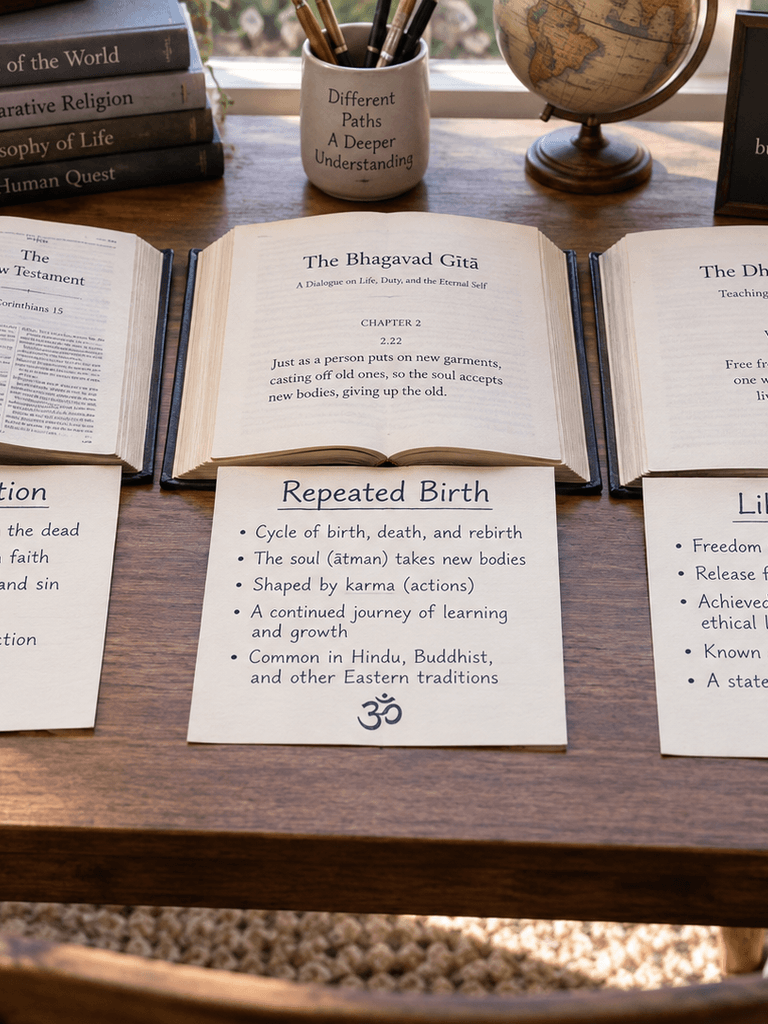
Compare resurrection, reincarnation, moksha, and nirvana through named texts. Learn why repeated birth and liberation answer different questions.