The Book of Job does not explain why every innocent person suffers. It does something more unsettling: it places a person the story calls blameless inside terrible loss, lets inadequate explanations fail, and never tells Job what the reader learned in the opening scene.
Job protests, questions God, and refuses to confess to crimes he did not commit. His friends defend a tidy moral system in which suffering must reveal guilt. By the end, God rebukes the friends, but the book still does not turn Job's losses into a simple lesson.
In brief: The Book of Job rejects the claim that suffering reliably proves personal wrongdoing. It makes room for grief, anger, moral protest, and encounter with God, while withholding a complete explanation for innocent suffering. Its clearest practical warning is directed at would-be comforters: do not protect a theory by blaming the person in pain.
Job belongs to the wisdom literature of the Hebrew Bible. It is also part of the Christian Old Testament, and it has generated long, varied histories of Jewish and Christian interpretation. The story is set in the land of Uz, outside Israel, and Job is not introduced as an Israelite king, prophet, or priest. His question is presented in broadly human terms: can a moral life be understood through a reliable system of reward and punishment?
The book combines several literary forms:
The shifts in voice and form matter. A sentence spoken by one of the friends is not automatically the book's conclusion. Readers have to ask who is speaking, what that character knows, and how the ending judges the argument. Yale Bible Study's guide to Job's literary structure is a useful companion for following those changes.
The first verse describes Job as “blameless and upright” (Job 1:1). The description is repeated in the heavenly scene, and Job 2:3 says he still holds to his integrity after being struck without cause.
That does not mean Job is presented as a human being incapable of any fault. It means the story rules out the explanation his friends keep offering: these disasters are not a punishment proportionate to some hidden offense.
This distinction is the foundation of the book. If readers decide in advance that Job must deserve what happened, they repeat the friends' mistake and undo the question the narrative has deliberately raised.
The book therefore challenges a common moral shortcut:
Job accepts the importance of justice but rejects the last inference. His experience does not fit the system, and he will not let a system erase what he knows about his conduct.
Job 1–2 gives the reader information Job never receives. In the heavenly court, “the Adversary” questions whether Job reveres God without material benefit. Job's household, children, livelihood, and body become the ground on which that question is tested.
In the Hebrew setting, ha-satan means “the adversary” or “the accuser.” The figure is a member of the heavenly court in this scene, not yet the fully developed enemy of God found in some later Jewish and Christian thought. Translating the title as the proper name “Satan” can import a later framework into the story.
The scene is morally difficult, and the book does not ask readers to pretend otherwise. Job's children are not abstractions. Servants die along with them. A wager in heaven does not make their deaths less terrible on earth.
Most importantly, the opening is not an explanation available to the sufferer. Job never learns about the heavenly exchange. The reader's information therefore cannot become a pastoral speech to Job: “This happened because God was testing you.” Job's friends do not know enough to explain his pain, and neither does Job.
The phrase “the patience of Job” can hide most of the book.
Job does begin with acts of mourning and worship. His friends then sit beside him for seven days without speaking because they see the severity of his pain (Job 2:11–13). That silent presence is the last unambiguously helpful thing they do.
When Job finally speaks in chapter 3, he curses the day of his birth. He does not politely summarize a doctrine of suffering. He wishes that the day had vanished from the calendar and asks why life continues when a person longs for relief.
The language is extreme because the loss is extreme. The poem makes room for a sufferer to say what pain feels like before anyone tries to correct the feeling.
Job's later speeches remain candid. He complains, accuses, questions, remembers his former life, and asks for a hearing. Lament here is neither calm acceptance nor the abandonment of faith. Job directs his protest toward the God from whom he demands justice.
This is one reason Job remains important within both Jewish and Christian traditions. The book preserves argument with God inside scripture rather than allowing only praise, gratitude, or submission to count as faithful speech.
Eliphaz, Bildad, and Zophar do not begin as cartoon villains. They travel to console Job and share his silence. When they start speaking, however, they become increasingly committed to explaining why Job must be at fault.
Their reasoning contains ideas that may sound religiously respectable:
The problem is not that every sentence they speak is false in every setting. The problem is that they apply general principles to a specific sufferer without evidence. When Job's experience contradicts their theory, they protect the theory by inventing greater guilt.
Job 6:14–30 shows what Job wanted instead: kindness from a friend and an honest account of what he had done wrong. The friends give him neither. Their speeches become a warning about the difference between defending an idea and caring for a person.
God's judgment at the end is decisive. In Job 42:7–9, God says that the friends have not spoken rightly as Job has. Job then prays for them. The people who believed they were defending God need the intercession of the person they accused.
Job's complaint grows beyond his private pain. He asks why the wicked can live long and prosper while others suffer (Job 21). He remembers a former life in which he defended people who were poor, vulnerable, or without help, and then gives a final defense of his integrity (Job 29–31).
His central questions include:
These are questions of theodicy: how belief in divine justice can be held alongside undeserved suffering and evil. Yet Job is not a tidy philosophical essay. The questions come from a damaged body, dead children, lost standing, and failed friendship. Any interpretation that forgets those losses becomes too abstract for the book itself.
God finally answers in Job 38–41, but the answer does not reveal the exchange from chapters 1–2. It does not list a hidden sin. It does not give Job a formula that will make future suffering predictable.
Instead, God asks questions about the foundations of the earth, the sea, weather, constellations, wild animals, Behemoth, and Leviathan. The speeches describe a creation that is vast, dangerous, ordered, and not arranged solely around human reward.
Readers interpret this response in different ways.
The text supports continued argument because God never says, “Here is why your children died.” The Yale Bible Study guide to the whirlwind speeches likewise notes that Job's question about guilt and innocence is not directly answered.
The speeches change the scale of the conversation, but greater scale is not the same as a complete explanation.
Job 42:1–6 is one of the book's most disputed passages. English translations differ over whether Job “repents,” “recants,” “retracts,” or is comforted concerning dust and ashes. The Hebrew wording and Job's final posture have produced more than one defensible interpretation.
Some readers understand Job to withdraw his case in humility after encountering God. Others argue that he rejects or abandons his previous words without confessing the secret guilt alleged by his friends. Still others read the scene as Job finding consolation while remaining a person whose integrity the narrative has defended.
Two points should remain clear even when interpretations differ:
The ending therefore cannot honestly be summarized as “Job admits that his suffering was deserved.”
The prose ending describes restored health, wealth, community, and a new family. It is tempting to treat this as a balance sheet in which everything lost has been returned.
That reading turns people into replaceable quantities. New children do not erase the deaths of Job's first children. New possessions do not make the days of anguish unreal. Even a long future does not change what happened.
The restoration can be read as renewed life after devastation: Job again receives relationship, work, material stability, and years in which to live. It should not be used to promise that every faithful sufferer will recover wealth, health, or family in this life.
Yale scholars discussing company in suffering make this pastoral limit explicit: later blessing does not undo the hurt of the earlier loss.
Job's relatives and acquaintances also return, eat with him, comfort him, and give practical gifts (Job 42:11). The book's social ending matters. Restoration includes people coming back to sit at the table, not only a solitary change of mind.
The narrative establishes Job's integrity before disaster begins. No reader or caregiver should infer moral guilt merely from the severity of another person's pain.
Job's anger and questions are not edited out of scripture. A person can address God honestly without first making grief sound calm, instructive, or spiritually impressive.
The friends speak most harmfully when certainty exceeds knowledge. Presence, listening, practical care, and an honest “I do not know” may be more faithful than a theory imposed on someone else's loss.
The heavenly scene describes the plot of this story. It is not a universal claim that every tragedy results from a similar test. Nor does the whirlwind disclose why each particular evil is permitted.
The ending is part of Job's story, not a contract guaranteeing that health, children, livelihood, or status will be returned to every sufferer before death.
The book can show integrity, encounter, and renewed life after devastation without calling the devastation itself desirable. Its readers should resist turning another person's injury into material for their own lesson.
Job offers a short practical test for comfort:
This is a reading practice, not medical or pastoral treatment. People in danger, severe distress, or a mental-health crisis need appropriate local professional and emergency support as well as companionship.
The Book of Job challenges the belief that suffering always reveals personal guilt. It follows an upright person through loss, lament, failed consolation, argument with God, and renewed life. The book defends honest protest more strongly than easy explanation and warns readers not to blame sufferers to preserve a moral theory.
The opening tells readers that Job's losses follow a challenge in the heavenly court, but Job is never given that information. The book does not turn this plot into a general explanation for innocent suffering. Its lasting question is what faith, integrity, and friendship look like when the cause remains hidden.
Job endures, but he is not silent or emotionally untroubled. He curses the day of his birth, disputes his friends, protests his treatment, and demands an audience with God. “Patient” is accurate only if it includes persistent relationship and integrity alongside anger, grief, and argument.
God answers Job personally but does not disclose why the disasters occurred. The whirlwind speeches broaden the view to a vast and untamable creation. Some readers experience that encounter as an answer; others see the moral question as unresolved. The book leaves room for both responses.
Job does not give readers a reason they can apply to every loss. It rejects the friends' confident causal stories and never lets Job see behind the curtain. The book affirms that human knowledge is limited, but limited knowledge is not permission to invent a divine reason for another person's suffering.
The friends insist that Job's suffering must reveal serious wrongdoing. Their certainty leads them to accuse an innocent person and misrepresent God. In Job 42, God says they have not spoken rightly as Job has and requires them to seek Job's prayer.
The Book of Job is not a code that converts innocent suffering into a satisfying reason. It is a long refusal to let moral formulas silence experience.
Read the opening so Job's innocence remains in view. Read the dialogues slowly enough to distinguish the friends' doctrine from the book's judgment. Let Job's lament sound like lament. When the whirlwind arrives, notice both the grandeur of creation and the explanation that is still withheld.
Then carry the book's most practical lesson into real relationships: when someone suffers, do not make their pain prove your theory. Begin with presence, honesty, and care.
Job's protest occupies one place within the wider range of answers traditions give to suffering.
Use Plurilore to study Job by passage, follow the sources consulted, and compare interpretations while keeping the primary text open.
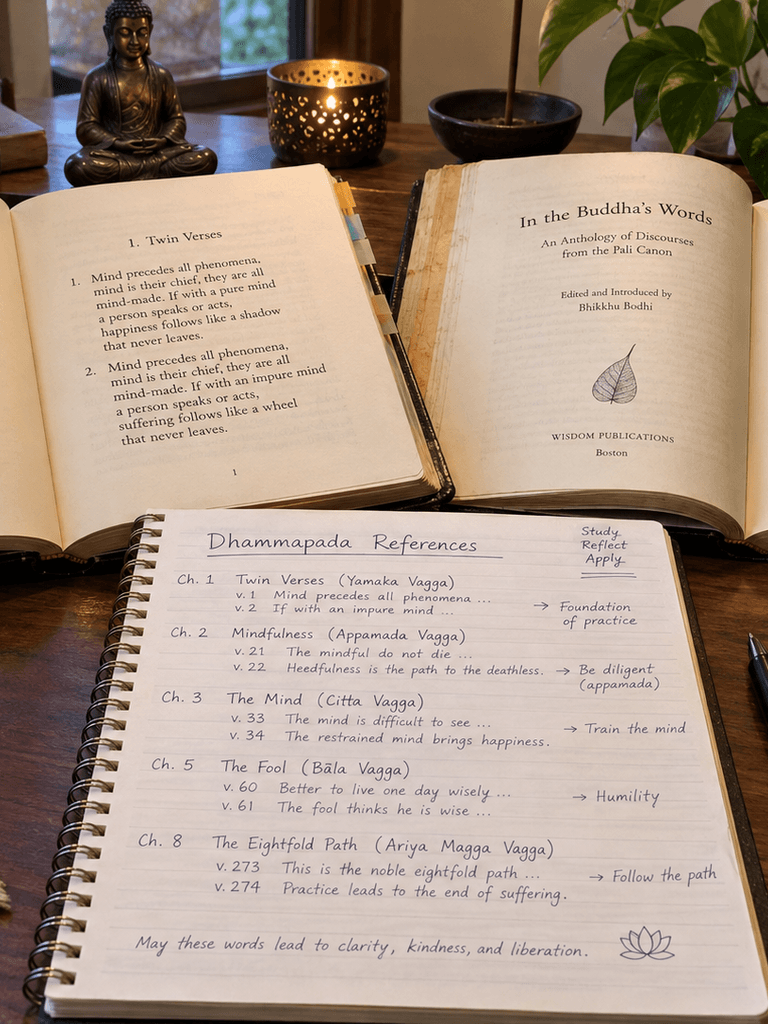
Start reading the Dhammapada with a guide to its 423 verses, central teachings, and translation choices. Follow a short reading route with sources and notes.