Religions say different things about death and the afterlife because they differ about what a person is, what death changes, and what human life is ultimately for. Being raised from death, being born again, and becoming free from further birth are distinct possibilities in the sources we will read.
For someone beginning comparative study, the most useful question is therefore more specific than “Where do people go?” Ask what continues, what changes, and what counts as the final hope.
In brief: Christian and Quranic sources describe resurrection; Jewish sources also contain resurrection and world-to-come teachings, interpreted in varied ways. The Bhagavad Gita describes repeated embodiment and freedom from rebirth. Early Buddhist texts teach release without treating the changing constituents of experience as a permanent self. Jain philosophy describes the liberation of an enduring individual soul. These teachings need their own definitions before comparison.
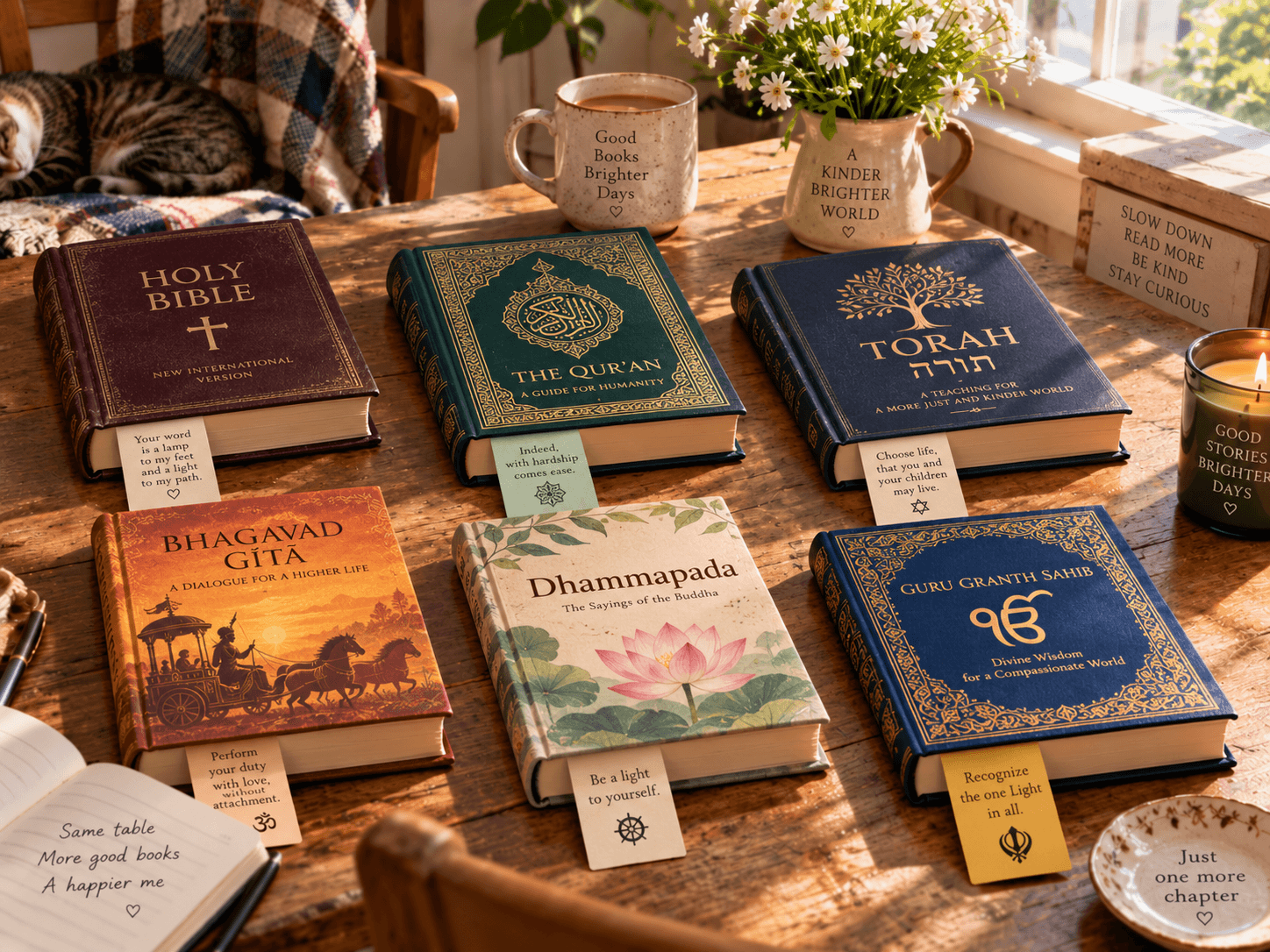
This guide samples six traditions. It introduces selected texts and interpretations, not every religion or every believer's understanding. It describes teachings rather than claiming to establish what happens after death.
What is being described? A passage may concern the moment of death, an interval before resurrection, another birth, or a final state of freedom. A table that puts all four under “destination” can conceal the very distinction a reader needs.
What continues? Do not carry an English word such as soul from one text into another without checking it. The enduring soul in Jain philosophy and the analysis of not-self in an early Buddhist discourse cannot be treated as two names for the same account.
What kind of source is speaking? Scripture, later commentary, an official doctrinal statement, and a contemporary rabbi's explanation have different roles. Naming those roles lets us compare a particular teaching without making it stand for everyone.
These questions also leave room for uncertainty. If a passage does not answer a question, write “not answered here.” Supplying an answer from a different tradition makes a chart look complete at the cost of accuracy. Our guide to comparing religions develops this approach beyond the afterlife question.
The linked passages are starting points. Each row describes the sources named, rather than an exhaustive doctrine.
|
Tradition and source |
Teaching to notice |
Distinction to preserve |
|---|---|---|
|
Christianity: 1 Corinthians 15:12–28, 35–54 |
Paul connects the resurrection of the dead with Christ's resurrection and describes transformation. |
Resurrection is more than the claim that a soul survives. |
|
Islam: Quran 23:99–103 |
A request to return is refused; a barrier precedes resurrection and the weighing of deeds. |
The interval before resurrection is not another earthly lifetime. |
|
Judaism: Daniel 12:2 and Mishnah Sanhedrin 10:1 |
Awakening from death and the world to come appear in different kinds of Jewish text. |
These sources should be read within Jewish interpretation, not as an unfinished Christian account. |
|
Hindu traditions: Bhagavad Gita 2.22 and 8.16 |
Further embodiment is distinguished from attaining Krishna without further birth. |
Another birth and liberation from birth are different outcomes. |
|
Early Buddhism: Samyutta Nikaya 22.59 and Itivuttaka 44 |
Not-self and release change the terms of the question about what continues. |
Nirvana is not simply a place where an immortal soul goes. |
|
Jain philosophy: Tattvarthasutra 1.1 and 1.4, discussed in the Stanford Encyclopedia |
Right view, knowledge, and conduct lead toward freedom from karmic bondage. |
Liberation preserves the individual soul; it is not its dissolution. |
Paul's argument in 1 Corinthians 15 begins with Christ's resurrection and asks what follows for the dead. In verses 12–28, the two questions belong together. In verses 35–54, he addresses the kind of body involved through images of sowing, growth, and transformation.
This is why “Christians believe the soul goes to heaven” is an incomplete summary of this passage. Paul's contrast concerns mortal and imperishable life. His language of a spiritual body does not make the discussion of embodiment disappear.
The Catholic Catechism, paragraphs 988–1017, provides a later, explicitly Catholic account. It distinguishes the soul's separation from the body at death from bodily resurrection. That helps us see why an account of the interval after death and an account of the final hope need separate entries.
The catechism is a source for Catholic teaching, not a substitute for identifying Orthodox or Protestant interpretations. This introductory reading does not settle disagreements about judgment, the intermediate state, or the interpretation of Paul's bodily language.
Quran 23:99–100 depicts a person asking, at death, to return and do good. The request is refused, and the passage names a barzakh, a barrier, until resurrection. Verses 101–103 move to the trumpet and the weighing of deeds.
The sequence matters. Death, the barrier, resurrection, and judgment are related moments, not interchangeable descriptions. Reading the passage as a lesson about getting another earthly chance would reverse the refusal at its center.
This is a Quran-focused introduction. A fuller Islamic account would also need named hadith collections, commentary, and theological interpretations. The selected verses do not, by themselves, supply every detail later Muslim authors discuss about the grave or the intermediate state.
A careful study note might therefore say: “Quran 23 describes a barrier before resurrection and accountability for deeds.” That is a specific textual claim. “This paragraph explains everything Muslims believe about death” would be a much larger, unsupported one.
The claim that Judaism has no afterlife teaching does not survive a close reading of its sources. Daniel 12:2 describes people sleeping in the earth awakening to different outcomes. Mishnah Sanhedrin 10:1 discusses a share in the world to come, olam ha-ba, and treats denial of resurrection from the Torah as consequential.
These are different sources: Daniel belongs to the Hebrew Bible; the Mishnah is rabbinic teaching. They establish that resurrection and a future beyond death are part of Jewish textual discussion. They do not turn that discussion into one uniform timetable.
For a contemporary example of diversity, Rabbi Evan Moffic's Reform Jewish explanation of afterlife beliefs includes both resurrection and the enduring influence of a life on later generations. That article speaks from a particular Jewish setting; it cannot represent every Jewish community.
Read Jewish sources on their own terms. A shared word such as resurrection does not give permission to import Christ's role in Paul's argument into the Mishnah.
Bhagavad Gita 2.22 compares the embodied self's taking another body to changing worn clothes. The image distinguishes the body that is left from the one who becomes embodied again. It makes continued birth intelligible within the teaching Krishna gives Arjuna.
But continued birth is not the final aim described in 8.16. That verse contrasts worlds subject to return with attaining Krishna, after which there is no further birth. Rebirth belongs to the continuing cycle; liberation ends that condition.
The word moksha names liberation. Precisely how freedom, self, and ultimate reality relate requires a named Hindu philosophical or devotional interpretation. This article follows the Gita passages in Swami Mukundananda's translation, whose devotional framing should remain visible. It does not turn that rendering into the only Hindu explanation.
For the related question of what conditions birth and action, the Hindu, Buddhist, and Jain karma source matrix explains why even the shared word karma needs different definitions.
In Samyutta Nikaya 22.59, the Buddha examines bodily form, feeling, perception, mental formations, and consciousness. Each is treated as impermanent and unfit to be regarded as a permanent self. An explanation of Buddhist rebirth therefore cannot simply borrow the Gita's clothes-changing image and assume the same account of what travels onward.
Nirvana, called nibbana in Pali, also needs care. Itivuttaka 44 distinguishes release while the liberated person still has functioning senses from release with no remainder when that life ends. Its first description concerns a living person who still experiences pleasant and painful sensations. Nirvana is consequently not just a synonym for dying.
Nor should the absence of a permanent self be turned into an easy claim that liberation means personal annihilation. In Samyutta Nikaya 44.10, the Buddha declines answers that would lead the questioner toward either eternalism or a mistaken sense that a former self has been destroyed.
These are early Pali discourses, not a complete account of Buddhist traditions.
Jain teaching offers an especially useful contrast with the Buddhist material. It affirms an enduring individual soul, jiva, bound by karma understood as subtle matter. Liberation concerns the ending of that bondage.
The Stanford Encyclopedia's account of Jain philosophy explains this framework through the Tattvarthasutra and later philosophical discussion. The soul's capacities for knowledge and perception are obstructed; freedom involves removing the obstruction.
The Harvard Pluralism Project's explanation of jiva emphasizes that liberated souls retain their individuality. Liberation is not absorption into a single universal soul. It is also different from obtaining a better birth while still bound by karma.
This gives the comparison a concrete test: if the word liberation appears in both a Jain and a Buddhist account, ask what each says about the self. Similar descriptions of release do not erase their different answers.
Choose two passages from the table and make a short record for each:
For example, put Gita 8.16 beside Itivuttaka 44. You can compare their concern with release while preserving their different language and treatment of personhood. You cannot conclude from that shared concern that both describe an identical destination.
If you are choosing Buddhist material to study in Plurilore, the Buddhism source guide helps identify the included texts and the limits of that selection. A study library's coverage is always narrower than a living tradition.
No. The sources compared here differ about embodiment, personal continuity, judgment, and liberation. They also address different stages: an interval after death is not the same as resurrection or freedom from rebirth. Agreement that death matters does not establish agreement about what follows it.
No. In Paul's argument, resurrection is connected to Christ and transformed life. The Gita's image of taking new bodies concerns repeated embodiment. A comparison can ask what continues in each case, but describing both simply as “living again” leaves out the structure of the teachings.
That is misleading for the early discourses discussed here. Itivuttaka 44 describes liberation while a person is still alive, as well as release with no remainder. Nirvana should not be defined as a destination to which an immortal soul travels after death.
Yes, resurrection is present in Jewish sources, including Daniel 12:2 and Mishnah Sanhedrin 10:1. That does not mean every Jewish interpreter understands the afterlife identically. Identify the source and community rather than treating either a traditional account or a modern interpretation as universal.
The passages examined here do not make biological death identical with liberation. The Gita distinguishes repeated birth from freedom from it, and Itivuttaka 44 describes a liberated person who remains alive. Understanding either teaching requires studying its account of the path, rather than treating death itself as the achievement.
Biblical references use the New Revised Standard Version Updated Edition for 1 Corinthians and The JPS Tanakh: Gender-Sensitive Edition for Daniel. The Mishnah reference was checked in Sefaria's William Davidson Edition – English; its explanatory wording should be distinguished from the underlying Hebrew. The Catholic Catechism and Rabbi Moffic's article are later interpretive sources.
Quran passages were checked in Mustafa Khattab's The Clear Quran. Gita passages use Swami Mukundananda's translation. Buddhist passages use Thanissaro Bhikkhu's translations, which render nibbana as “Unbinding.” The Jain discussion uses scholarly explanations of the Tattvarthasutra and jiva, rather than claiming a direct reading of an entire Jain canon.
The article paraphrases these sources. Translations and commentaries are identified so readers can separate the passage from its interpretation and compare another edition if needed.
Studying religions on death and the afterlife becomes clearer when the question becomes smaller. Choose one passage, read the surrounding section, and write down what it says about continuity and change. Then open a second source and let its different answer remain different.
Compare ahimsa in Jain, Hindu, and Buddhist sources through vows, intention, living beings, compassion, karma, and the limits of nonviolence.