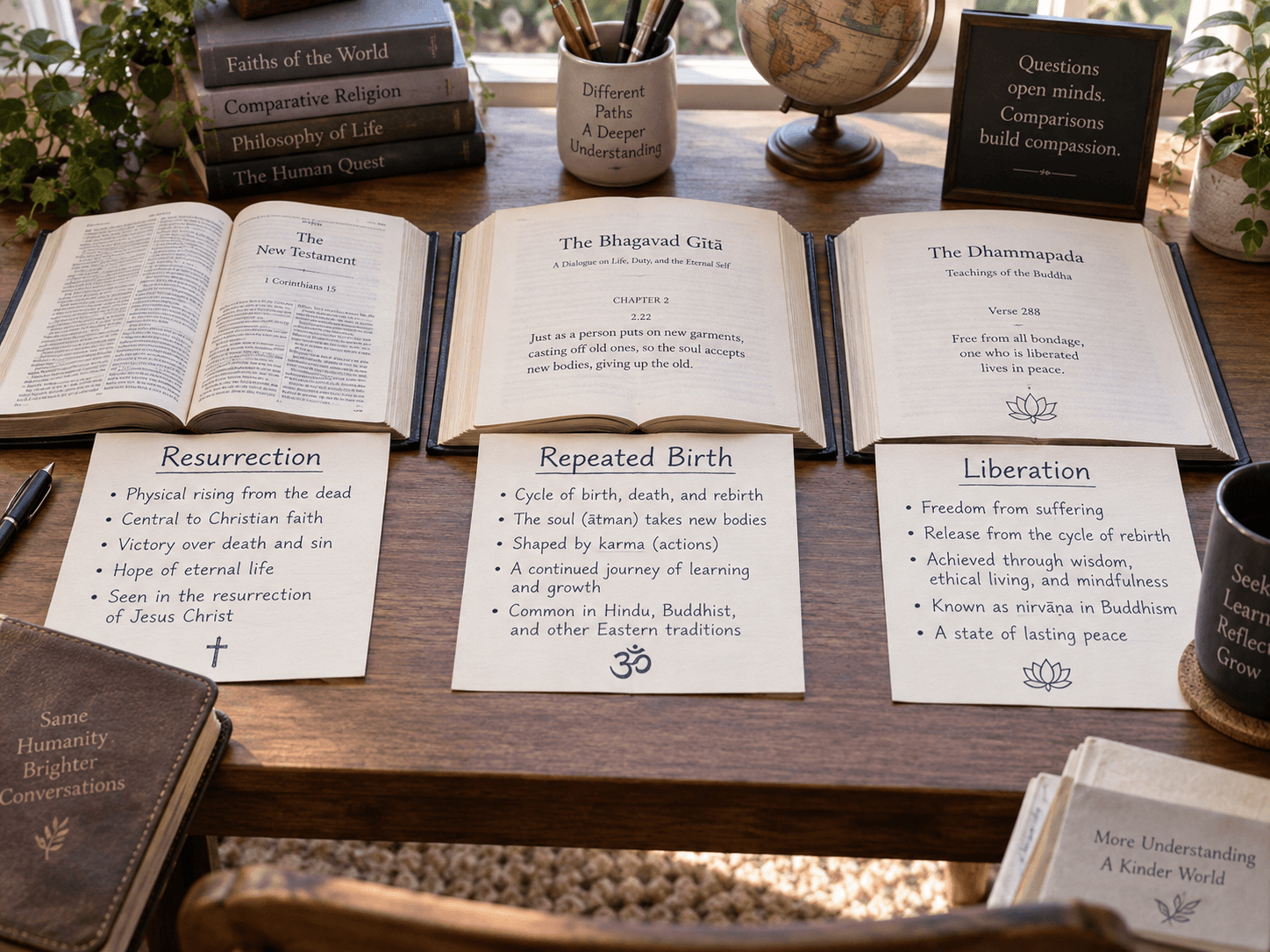
Resurrection, reincarnation, moksha, and nirvana are not four names for the same destination. They address different questions about death, continuity, and freedom. A useful comparison begins by asking what each term is doing in a particular text.
In brief: In the sources examined here, resurrection concerns God raising the dead; reincarnation concerns renewed embodied life; moksha concerns release from bondage and repeated birth; and nirvana concerns the ending of the causes of suffering. Repeated birth describes a continuing process. Liberation describes freedom from that process.
This guide is for readers encountering these terms together for the first time. It compares Paul's First Letter to the Corinthians, selected verses of the Bhagavad Gita, and early Buddhist discourses. These sources provide a manageable starting point, not a complete account of Christian, Hindu, or Buddhist thought. For the wider setting, begin with religions, death, and the afterlife.
The source column matters as much as the definition. It tells you where a summary applies and where you need another reading.
|
Term in this comparison |
What it concerns |
A starting passage |
What to keep distinct |
|---|---|---|---|
|
Resurrection in Paul |
God's raising of the dead into transformed life |
Rising from death and undergoing another ordinary birth |
|
|
Reincarnation in the Gita |
The embodied self taking another body |
Continued embodiment and final liberation |
|
|
Rebirth in early Buddhist teaching |
Conditioned continuation without an unchanged consciousness traveling between lives |
Causal continuity and a permanent soul |
|
|
Moksha, approached through the Gita |
Freedom from bondage and further birth |
Attaining liberation and obtaining a better next life |
|
|
Nirvana in early Buddhist teaching |
The ending of passion, aversion, and delusion |
Liberation and a pleasant destination after death |
This table is a reading aid. It does not decide whether the teachings are true or rank the kinds of hope they offer. It also avoids making an English label stand in for every tradition that uses related vocabulary.
Paul's argument begins with Christ's resurrection and extends to those who belong to Christ. Death is to be overcome. His comparison between a seed and its growth emphasizes transformation: the risen body is not simply ordinary mortal life restarted. See 1 Corinthians 15:20–26, 35–54.
The phrase “spiritual body” in verse 44 needs care: Paul still speaks of a body. A later Catholic formulation, Catechism paragraph 990, explicitly distinguishes bodily resurrection from the soul's continued existence. That is a named tradition's interpretation, rather than a substitute for reading Paul's wording.
Calling this reincarnation would change the claim. Paul's concern is God's victory over death, not successive embodiments within a continuing cycle. Nor does this chapter, by itself, settle every Christian question about the interval between death and resurrection.
When reading it, keep the question about bodily transformation separate from the question about what immediately follows death.
In Bhagavad Gita 2.22, Krishna compares changing bodies to changing worn clothing. Swami Mukundananda's translation calls what takes a new body the soul. The comparison distinguishes the continuing self from a particular body.
That image explains why “reincarnation” can fit this passage. Something enduring takes another embodied form. But the verse is not a complete description of liberation, and its clothing image cannot be transferred unchanged to every account of rebirth.
In MN 38, the monk Sati claims that the same consciousness continues from birth to birth. The Buddha rejects that account and teaches that consciousness arises dependent on conditions.
The distinction is more than a preference for the word “rebirth.” Substituting “stream of consciousness” for “soul” does not help if the stream is then imagined as an unchanged traveler. The discourse asks readers to examine dependent processes.
Mark Siderits's scholarly account of the Buddha, especially its discussion of karma and rebirth, explains why continuity without a permanent self became a central philosophical problem. Buddhist thinkers developed accounts of how actions and consequences remain connected without the enduring self affirmed by competing schools.
For this comparison, retain two different questions: Does another birth occur? What, if anything, remains identical? Agreement on the first does not establish agreement on the second. The separate article on karma in Hindu, Buddhist, and Jain sources examines the connection between action, continuity, and bondage.
Moksha means liberation or release. In the comparison here, it addresses freedom from the bondage associated with repeated birth. It should therefore not sit beside reincarnation as though both named alternative final destinations.
Bhagavad Gita 8.15 describes those who attain Krishna as no longer taking birth in the transient world marked by suffering. The verse makes the difference between continuation and release especially clear. In this setting, another life is not the completion of the path.
The Gita also keeps the relationship with Krishna visible. In 18.66, Krishna calls Arjuna to surrender to him and promises release from the consequences of sin. Any summary that makes liberation purely a matter of impersonal technique misses this passage's devotional address.
Hindu philosophical schools disagree about the relation between the self and ultimate reality. Shankara's Advaita Vedanta understands liberation through the recognition of the self's identity with Brahman. Ramanuja's Vishishtadvaita preserves the reality of individual selves within their dependence on Brahman and gives devotion a central role. Shyam Ranganathan's survey of Hindu philosophy explains these differences.
“Merging with God” cannot cover both accounts without further explanation. Even for Advaita, the image can mislead by suggesting that two previously separate things are physically joined. A reader needs to know which school is interpreting the text and what that school thinks the self already is.
In SN 38.1, Sariputta explains nibbana through the ending of passion, aversion, and delusion. He then identifies the noble eightfold path as the practice leading to its realization.
Here nibbana is the Pali form of the term usually written nirvana in English. Thanissaro Bhikkhu translates it as “unbinding.” His wording highlights release; it should not be silently treated as the only possible English rendering.
Itivuttaka 44 describes an arahant, a fully liberated practitioner, whose senses still function. Pleasure and pain remain possible, while passion, aversion, and delusion have ended. The text distinguishes this condition from unbinding with no remaining fuel, associated with the end of that life.
That distinction prevents two mistakes: assuming liberation must wait until death, and assuming a liberated person can no longer experience physical pain. “Nirvana is death” cannot explain the living practitioner described here.
Nor should “nirvana is annihilation” be offered as a simple replacement. In MN 72, the Buddha declines the alternatives that a liberated one exists after death, does not exist, both, or neither. Its extinguished-fire comparison challenges the categories used in the question.
These passages support restraint about what follows final liberation. They give clearer grounds for describing what ends than for drawing a picture of a person living somewhere afterward. The companion guide to nirvana, bodhi, and awakening looks more closely at that vocabulary.
A useful comparison does not begin with “Which religion's version of heaven is this?” That question supplies a destination before the text has said whether a destination is the issue.
Try these questions with one passage from each column:
Then write a comparison in this form:
In [passage and translation], [term] addresses [question]. In [second passage and translation], [term] addresses [question]. They overlap in [specific concern], while differing over [specific claim].
For a study group, give each reader responsibility for one passage. Have the group check the completed sentences against both texts before discussing broader similarities. This makes disagreements easier to locate: in the source, in a translation choice, or in the comparison itself.
The exercise can also expose a weak question. If your notes say one source explains continuation and another explains release, revise the question before filling in more details. More information will not repair a comparison built around mismatched categories.
No. In Paul's account, resurrection concerns the dead being raised through God's action. The Gita's clothing comparison concerns the embodied self taking another body. Both address continuity across death, but they describe different kinds of change and belong to different accounts of the human situation.
The Gita distinguishes further birth from attaining Krishna without returning to another birth. In this context, reincarnation describes continuation; liberation is the goal under discussion. “Hindu teaching” is too broad for every detail of that goal: different schools interpret freedom, selfhood, and devotion differently.
That wording imports an enduring soul into the explanation. MN 38 specifically rejects the claim that an unchanged consciousness travels through successive lives. Buddhist rebirth should therefore be explained through conditions and continuity, with attention to the source, rather than by borrowing the Gita's embodied-self model.
They can both be discussed as liberation, but that shared description does not make their doctrinal settings identical. Ask what bondage means, how the self is understood, and what the path involves. The comparison in this article is between selected sources, not a universal rule assigning one word to each religion.
The early Buddhist passages examined here describe release through ending the causes of suffering. Itivuttaka 44 includes liberation during life, while MN 72 resists familiar descriptions of the liberated one's condition after death. Treating nirvana simply as a heavenly place obscures both features.
The biblical reading uses the New Revised Standard Version Updated Edition. Gita references use Swami Mukundananda's translation at Holy Bhagavad Gita. This is a devotional interpretation, not a neutral summary of every Hindu school. The linked pages distinguish verse translations from commentary; the article's passage summaries follow the verse translations.
Buddhist passages use Thanissaro Bhikkhu's translations at dhammatalks.org. MN means Majjhima Nikaya; SN means Samyutta Nikaya; Itivuttaka is a separate collection. The article mainly paraphrases and retains passage numbers so that you can compare another translation. Later commentaries and living communities may develop these readings differently.
Resurrection, reincarnation, moksha, and nirvana become easier to compare when the question stays attached to the source. Begin with the distinction between a continuing process and liberation, then ask how each text understands the person and the change being described.
Choose two linked passages and complete the reading exercise before expanding the comparison. Plurilore's Hinduism source guide explains the texts available for further study and where the Gita sits within them. Keep the passage, translation, and interpretation together as your notes grow.

Compare karma in Hindu, Buddhist, and Jain sources through action, intention, selfhood, rebirth, bondage, and liberation in one source matrix.