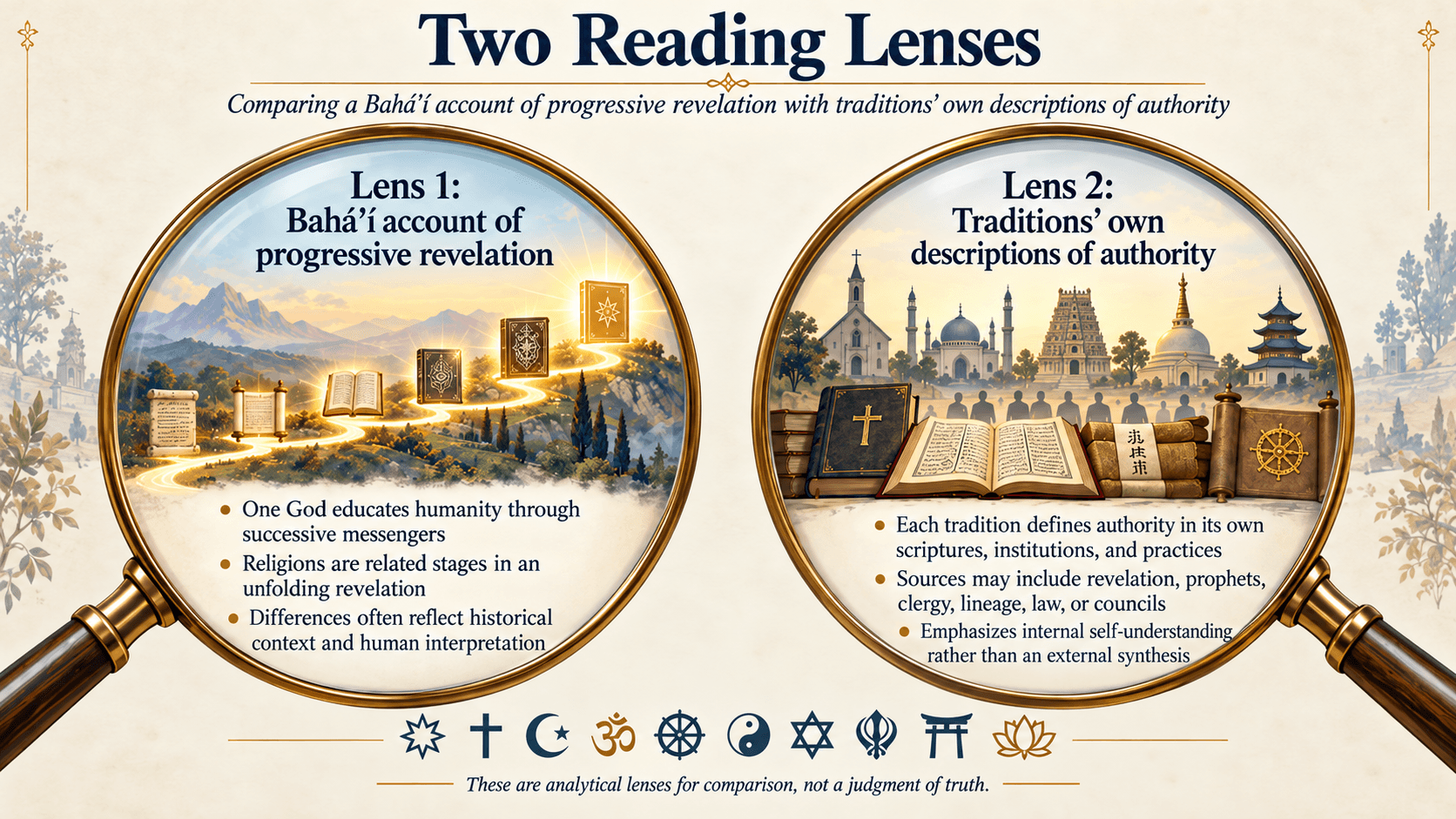
Progressive revelation is a Bahá’í teaching about how God guides humanity across history. In this framework, a succession of figures called Manifestations of God brings divine guidance suited to different times and social conditions. Their spiritual purpose is one, while their identities, missions, scriptures, and laws remain distinct.
That is a Bahá’í account of religious history—not a neutral conclusion that every earlier tradition accepts. A careful comparison can explain the framework on its own terms while also letting Christians, Muslims, Buddhists, Hindus, Jews, and others describe authority in their own categories.
The phrase progressive revelation also appears in some Christian theology for the unfolding of revelation within the Bible or Christian tradition. That is a different use. This guide examines the Bahá’í doctrine of successive Manifestations and dispensations. Andrews University scholarly repository, “Adventist Doctrines and Progressive Revelation”
In brief: Progressive revelation holds that one God educates humanity through successive Manifestations, including figures such as Moses, Jesus, Muḥammad, the Báb, and Bahá’u’lláh. It explains continuity through a shared divine source and difference through changing missions and historical needs. It does not mean that all religions teach the same doctrines, or that their followers accept the Bahá’í interpretation.
In this guide:
The worldwide Bahá’í community describes progressive revelation as a process in which the Manifestations of God provide guidance for humanity’s spiritual and social development. Its official overview names Abraham, Krishna, Zoroaster, Moses, Buddha, Jesus Christ, Muḥammad, the Báb, and Bahá’u’lláh among these figures. The list is part of a Bahá’í theological claim; it should not be presented as a classification agreed upon by all the traditions named. Bahá’í worldwide community, “Manifestations of God”
Bahá’u’lláh’s writings supply the framework’s primary vocabulary. In section XXXI of Gleanings from the Writings of Bahá’u’lláh, he describes a chain of successive revelations from Adam to the Báb, with each bearer entrusted with a particular message. In the Kitáb-i-Íqán, written in Baghdad in 1861–62, he explains both the essential unity of the Manifestations and the distinct mission of each. Gleanings, sections XXIV–XXXI; Kitáb-i-Íqán, Part Two
An independent Encyclopædia Iranica account places the doctrine within the development of the Bábí and Bahá’í religions in nineteenth-century Iran. It summarizes the Bahá’í view that divine educators establish religious laws appropriate to social conditions and notes that the set of figures recognized in Bahá’í discourse developed across the writings of Bahá’u’lláh and ‘Abdu’l-Bahá. That historical description and the Bahá’í writings answer different questions: one maps a doctrine’s development; the others express the doctrine from within. Encyclopædia Iranica, “Bahaism i. The Faith”
|
Claim in Bahá’í thought |
What it explains |
What it does not establish by itself |
|---|---|---|
|
One divine source |
Why Bahá’ís can affirm several religions as divinely grounded |
That their scriptures, doctrines, or histories are interchangeable |
|
Successive Manifestations |
Why revelation can recur rather than end with one historical messenger |
That other communities accept “Manifestation of God” as the right category for their founder |
|
Distinct missions and measures |
Why teachings, institutions, and laws can differ across periods |
That every difference has one simple cause or follows a straight line of improvement |
|
Guidance for the present age |
Why Bahá’ís follow Bahá’u’lláh while honoring earlier Manifestations |
That honoring an earlier tradition means continuing under all of its laws or accepting its current self-interpretation |
These claims belong together. Unity without distinction turns the religions into copies. Distinction without unity loses the doctrine’s central claim that revelation is one continuing divine process.
The Kitáb-i-Íqán gives the Manifestations a twofold station. In one respect they share an essential unity: each reveals God’s guidance. In another, each has a distinct individuality, mission, revelation, and set of limits. The same work therefore provides Bahá’í readers with a reason to speak both of one religion and of genuinely different dispensations. Kitáb-i-Íqán, twofold station
The mirror image used in Bahá’í explanation helps define the first claim. God is not reduced to a human person; the Manifestations are described as reflecting divine attributes and guidance. But the image should not erase the second claim. Moses is not Jesus under another historical name, and the Buddha is not Muḥammad with a different vocabulary. A Bahá’í account connects them without denying that each appears in a particular setting and gives rise to a different textual and communal history.
“Manifestation of God” is therefore a technical Bahá’í category. When it is applied to the Buddha, Krishna, Jesus, or Muḥammad, the sentence should begin “In Bahá’í teaching…” It should not be rewritten as “Buddhism teaches that the Buddha was a Manifestation of God” or “Muslims regard Muḥammad as one in a continuing series after whom Bahá’u’lláh appears.” Those statements would replace the traditions’ own categories with an outside one.
Bahá’í explanations often distinguish enduring spiritual principles from social laws shaped for a particular stage of human development. The official overview uses the analogy of a physician who understands humanity’s condition and prescribes an appropriate remedy. The comparison says that changed guidance can come from the same source; it does not say that every historical difference can be diagnosed from one modern summary. Bahá’í worldwide community, “Manifestations of God”
This distinction has practical consequences. Bahá’ís do not merely collect selected teachings from earlier religions. They regard Bahá’u’lláh’s revelation as authoritative for the present age and follow Bahá’í scripture, law, and institutions. The introduction to the Kitáb-i-Aqdas, Bahá’u’lláh’s book of laws written around 1873, presents its laws as guidance for a new dispensation while locating them on a foundation laid by earlier religions. Kitáb-i-Aqdas, introduction
That means progressive revelation contains both continuity and succession. It is inaccurate to describe the Bahá’í Faith as saying only that every religion is equally current in every detail. It is also inaccurate to describe earlier religions as discarded errors. Within the framework, their divine origin and historical value remain affirmed even when a later revelation has normative priority for Bahá’ís.
Here, “progressive” refers to an unfolding process of divine education. Shoghi Effendi’s The World Order of Bahá’u’lláh states the principle sharply: Bahá’í teaching treats revelation as progressive rather than final and established religions as connected in origin and purpose. This is an authoritative Bahá’í interpretation, not a claim that historians can verify simply by arranging religions on a timeline. The World Order of Bahá’u’lláh, “The Dispensation of Bahá’u’lláh”
The word does not require four common shortcuts:
The framework is teleological: it interprets religious history as moving within a divine purpose. Historical research can study when and how that interpretation arose, but it cannot turn the theological purpose into a religiously neutral measurement.
Within the Bahá’í framework, progressive revelation changes the question from “Which religion is simply true and which is simply false?” to “How might distinct revelations participate in one long process?” That move can support respect across religious boundaries. It also changes how differences are interpreted: varying laws may be related to time and social capacity, while recurrent ethical teachings may be read as signs of continuity.
Yet the framework does more than celebrate common ground. It rereads earlier founders and scriptures within a Bahá’í story whose most recent central figures are the Báb and Bahá’u’lláh. In the Kitáb-i-Íqán, earlier prophetic rejection, scriptural symbolism, return, and renewal form part of an argument for recognizing a new revelation. The book’s immediate nineteenth-century Bábí and Islamic setting matters; it was not written as a detached encyclopedia of all world religions. About the Kitáb-i-Íqán
This gives a reader two valid but different research tasks:
Confusing the tasks produces either apologetics presented as neutral history or a detached summary that never lets the Bahá’í doctrine speak in its own terms.
Earlier traditions do not share one response to Bahá’í claims. The following examples are representative boundaries, not summaries of every Christian, Muslim, or Buddhist school.
|
Tradition-specific example |
Source’s own claim |
Tension with a Bahá’í reading |
|---|---|---|
|
Roman Catholic Christianity |
The Catechism of the Catholic Church §§65–67 calls Christ the fullness of revelation and says no new public revelation is expected before his return. Vatican text |
A later public revelation through the Báb or Bahá’u’lláh is not simply an extension of this Catholic claim. Other Christian traditions require their own sources. |
|
Mainstream Islamic interpretation |
Qur’an 33:40 calls Muḥammad the “seal of the prophets”; the finality of prophecy is a widely held Muslim interpretation, documented in the Oxford Handbook of the Abrahamic Religions. Oxford Academic |
Bahá’í texts interpret prophetic finality and renewal through a different eschatological framework. Calling that “the Islamic view” would erase the disagreement. |
|
Buddhist traditions |
Buddhist thought does not ordinarily begin with one creator God sending a series of prophets. Peter Harvey’s Cambridge study describes Buddhism as lacking the idea of a unique creator God while retaining varied cosmologies and many divine beings. Cambridge University Press |
Calling the Buddha a Manifestation of God is a Bahá’í identification, not a Buddhist definition of buddhahood. Buddhist schools also differ among themselves. |
The point is not to decide the theology by a three-row table. It is to identify asymmetry. Bahá’í teaching can affirm a figure from another tradition while interpreting that figure in a way the other tradition would not adopt. Respectful comparison makes that asymmetry visible.
The same caution applies beyond these examples. “Krishna,” “covenant,” “prophet,” “revelation,” and “religion” can each carry several meanings within Hindu, Jewish, Christian, Islamic, and academic discussions. Start with a named source and community rather than assuming that a Bahá’í category translates without remainder.
The scope question also includes traditions left outside familiar Abrahamic and major Asian lists. A 2025 peer-reviewed study by Christopher Buck and Michael A. Orona examines how Bahá’í progressive revelation can engage Indigenous spiritual traditions and brings an Indigenous co-author’s positionality into the method. Its argument is not permission for outsiders to rename Indigenous figures. It shows why a universal framework still needs community-specific sources, living voices, and attention to what has been omitted. Buck and Orona, Religions
Use two lenses for every cross-tradition claim:
|
Field |
Bahá’í lens |
Tradition-specific lens |
|---|---|---|
|
Source |
Name the Bahá’í work, author, section, translation, and authority |
Name the other tradition’s text, school, interpreter, and historical setting |
|
Category |
Define Manifestation, revelation, dispensation, or unity from Bahá’í sources |
Use the tradition’s own category before proposing an analogy |
|
Claim |
State exactly what the Bahá’í source affirms about the earlier figure or religion |
State what the selected community or source says about itself |
|
Relationship |
Identify continuity, reinterpretation, fulfillment, or succession |
Record agreement, non-equivalence, or direct disagreement |
|
Limit |
Say what the Bahá’í source does not cover |
Say whose voices, schools, periods, or practices remain outside the comparison |
For example, a comparison involving Islam should place the Kitáb-i-Íqán beside Qur’an 33:40 and a named Muslim interpretation. Its conclusion should read: “Bahá’í scripture interprets finality through this framework, while this Muslim source understands it that way.” It should not read: “Islam really predicts the Bahá’í Faith,” unless clearly presented as a Bahá’í confessional claim rather than a shared conclusion.
This method extends the source-and-limit practice in how to compare religions without flattening their differences. When English wording carries the comparison, also record the edition and use the worksheet in how to compare sacred-text translations.
Plurilore’s Bahai coverage guide describes a single public-domain English collection available to its Bahai study agent. That corpus can help locate passages about unity and revelation, but it is not a complete set of authorized translations, historical documents, scholarship, or current institutional guidance. Check the authoritative Bahá’í Reference Library and independent scholarship before making a claim about the doctrine as a whole.
No. Bahá’í teaching connects the religions through one divine source and purpose, but it also assigns each Manifestation a distinct mission and revelation. Texts, laws, doctrines, institutions, and historical communities still differ. “One in source” should not be rewritten as “identical in content.”
It is one particular theology of religious plurality, not a generic label for accepting many religions. It affirms several religions while placing them within a Bahá’í sequence of Manifestations and dispensations. Other pluralist, inclusivist, and exclusivist models organize religious difference differently.
No. Bahá’í teaching presents revelation as continuing, although Bahá’u’lláh is authoritative for the present dispensation. “Most recent” and “last forever” are therefore different claims. The timing and status of any future Manifestation belong to Bahá’í doctrine and should be explained from authoritative sources rather than guessed.
They do not have one collective answer, and many communities reject important parts of it. Catholic teaching on definitive revelation, mainstream Muslim teaching on the finality of prophecy, and Buddhist accounts that do not begin with a creator God show different kinds of tension. Hindu and other traditions require equally source-specific treatment.
That description misses its independent scriptures, claims, laws, covenant, and institutions. Progressive revelation interprets earlier religions within a new religious framework; it is not simply a collage of selected teachings. Whether one accepts its theological claims is a separate question from describing the Faith accurately.
Progressive revelation is most useful in comparative study when its location is explicit: it is a Bahá’í framework that joins unity, difference, succession, and continuing revelation. Read the Bahá’í claim from its primary texts. Then give the earlier tradition an independent column with its own sources and categories. The comparison becomes more respectful—not less—when agreement and disagreement are both allowed to remain visible.
Nick works in IT and holds a master's degree in the field. His interests sit where philosophy, spirituality and technology meet. He started Plurilore as a side project shaped by those interests.