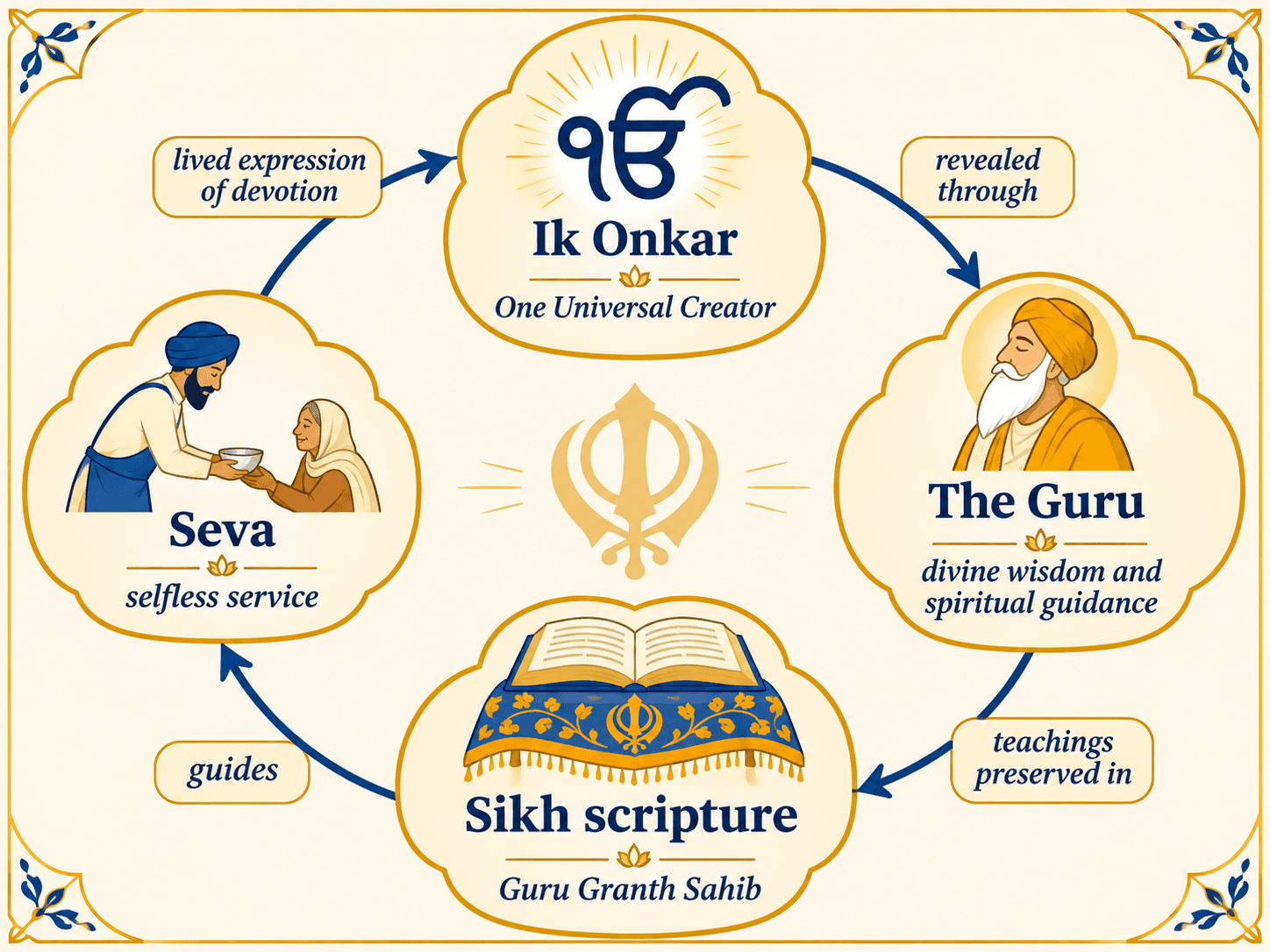
Sikhism, also called Sikhi, is a distinct religious tradition that began with Guru Nanak in the Punjab region of South Asia. It joins devotion to the One with truthful living, learning from the Guru, and service to others. The word Sikh means a learner or disciple. UC Davis's introduction to the Sikh religion provides a useful starting point for this history and identity.
For a beginner asking “what is Sikhism?”, four connected ideas help: Ik Onkar, Guru, seva, and scripture. Each changes how the others should be understood. Service has a spiritual setting; scripture has a living place in the community; learning asks something of how a person lives.
In brief: Sikhism centers on the One, expressed in Ik Onkar; the guidance of the ten human Gurus and the Guru Granth Sahib; and a life of remembrance, honest work, sharing, and seva. Its scripture, community, and practices belong together. A list of beliefs alone gives an incomplete introduction.
Guru Nanak lived from 1469 to 1539. He was born at Talwandi, now Nankana Sahib in Pakistan, in a region that today crosses the India–Pakistan border. His teaching and the community around it developed in conversation with the religious and social world of Punjab. Harvard's Pluralism Project introduction to Guru Nanak distinguishes his life from the later janamsakhi narratives through which Sikhs have remembered it.
Historical contact with Hindu and Muslim communities does not make Sikhism a mixture of two religions. Its understanding of the Guru, its scriptural canon, and its forms of collective life deserve attention on their own terms. UC Davis explicitly cautions against that mixture description in its overview linked above.
A useful question is therefore “How does this Sikh source describe the relationship between the Divine, the Guru, and human conduct?” That gives the tradition room to speak before comparison begins. Our guide to comparing religions without flattening their differences develops this reading habit further.
Ik Onkar, also written Ik Oankar, is represented by ੴ at the opening of the Guru Granth Sahib. English explanations often begin with “One God” or “One Creator.” The Sikh Research Institute's introduction to Ik Oankar emphasizes the One as embracing all creation, rather than a divinity belonging exclusively to one community.
Read the expression in its setting. At the opening of the Guru Granth Sahib, ang 1, the Mul Mantar, or opening root formula, describes the Divine through truth, creative presence, freedom from fear and hostility, timelessness, and the Guru's grace. The linked page displays Gurmukhi alongside Sant Singh Khalsa's English translation. This paragraph summarizes the passage rather than supplying a new translation.
An ang, literally a limb, is the customary locator in the standardized scripture. It is more dependable than the page number in a separate English edition or PDF.
The point reaches beyond counting deities. The Sikh Coalition's account of Sikh beliefs connects divine presence with the equal dignity of human beings. Oneness informs how people are treated. It should not be used to announce that every religion's account of God is identical.
In Sikh usage, Guru is more than a helpful teacher or an admired modern mentor. The Gurus guide the learner toward the Divine. Sikh tradition recognizes ten human Gurus, beginning with Guru Nanak and ending with Guru Gobind Singh. The Shiromani Gurdwara Parbandhak Committee (SGPC)'s introduction to the ten Gurus places that succession alongside the continuing Guruship of the Guru Granth Sahib.
The Guru Granth Sahib is received as the enduring Guru, rather than simply a record left by earlier leaders. The Sikh Coalition's historical overview also explains the authority of the Guru Khalsa Panth, the community of initiated Sikhs. Saying that the human succession ended should not erase the community's responsibilities for collective religious life.
For readers, this changes the question asked of scripture. “What information is in this book?” is useful, but insufficient. It also matters how the Guru's word guides hearing, reflection, worship, and conduct.
The Guru Granth Sahib contains poetic compositions of Sikh Gurus and other devotional voices, including figures such as Kabir and Sheikh Farid. Much of it is arranged for musical expression. Its place in Sikh life includes reading and singing in the gurdwara, the Sikh place of worship and gathering. Harvard's account of Sikh scripture explains its compilation and religious role.
That inclusion of different voices is significant. It does not make the scripture an anthology in which every contributor's historical community holds the same doctrines.
Different questions also require different sources:
|
If you want to understand… |
Begin with… |
Keep this distinction visible |
|---|---|---|
|
A scriptural teaching |
The complete composition in the Guru Granth Sahib, with its ang and a named translation |
An isolated English sentence may miss poetic context |
|
A passage's language and interpretation |
Gurmukhi text, qualified commentary, and Sikh teachers |
A translation and an explanation make different contributions |
|
Congregational or personal discipline |
The Sikh Rehat Maryada and relevant community guidance |
A code of conduct has a different function from scripture |
|
Guru Nanak's remembered life |
A named janamsakhi account alongside historical scholarship |
Religious narrative and independently established biography are different kinds of evidence |
The SGPC's Sikh Rehat Maryada, or code of conduct, addresses individual and congregational life. It is an important institutional reference, not a substitute for the Guru Granth Sahib or a complete description of every Sikh community.
For English-language reading, keep the translator's name beside your notes. Our guide to comparing sacred-text translations offers a practical way to separate the original wording, a translator's choices, and your own inference.
Seva is commonly translated as selfless service. The Sikh Coalition describes it as service inspired by love and gratitude to the Divine. It belongs alongside devotion and truthful living, rather than being an optional charitable extra.
Langar, the community kitchen and shared meal, offers a concrete example. People cook, serve, eat, and clean together. Harvard's account of langar explains how sharing food expresses equality and community, including welcome for visitors.
This makes service more demanding than the image of a generous donor giving to a grateful recipient. Who shares the work? Who is welcomed? Does the act protect another person's dignity? These questions help a reader notice what a simple translation can leave out.
Langar is one expression of seva. It does not exhaust the practice, and a photograph of food distribution cannot explain its entire religious meaning.
Guru Gobind Singh established the Khalsa in 1699. Initiation involves a defined religious commitment, including the five articles of faith often called the Five Ks: kesh (unshorn hair), kanga (comb), kara (steel bracelet), kachera (a particular undergarment), and kirpan (a sword worn as an article of faith, associated with responsibility and protection). The Sikh Coalition's introduction to Sikh identity cautions against reducing these articles to practical functions or decorative symbols.
The turban is also an important expression of Sikh identity and can be worn by women and men. Practices and levels of observance vary. The Coalition's frequently asked questions makes clear that a Sikh person who cuts their hair is not thereby excluded from the community. Appearance alone is a poor basis for deciding another person's identity or commitment.
Equality also needs careful description. Sikh teachings reject caste-based hierarchy, but that does not establish that caste discrimination has disappeared from Sikh society. Sociologist Surinder S. Jodhka's overview of caste in the Sikh Panth distinguishes the religious rejection of caste divisions from their changing social persistence. A teaching and the conditions it challenges should both remain visible.
Start with one passage rather than a collection of quotations. The opening of Japji Sahib at ang 1 is a manageable place to begin, provided you read with the surrounding composition and seek help with unfamiliar language.
Keep a short note with five fields:
For example, an ang 1 note might identify Guru Nanak's Japji Sahib, record Sant Singh Khalsa's translation, and observe that the opening joins divine oneness with grace. It should not conclude that one English rendering settles every interpretation of Ik Onkar.
Plurilore's Sikhism study guide describes its indexed edition: Sant Singh Khalsa's English translation of the Guru Granth Sahib. That gives readers a resource for locating passages, but it does not provide complete Gurmukhi linguistic analysis, the full historical literature, or every Sikh interpretive tradition. Read beyond a retrieved excerpt and bring questions of authoritative interpretation or practice to qualified Sikh teachers and communities.
Sikhism is a distinct tradition that began with Guru Nanak in Punjab. It developed in a region with Hindu and Muslim communities, but historical interaction does not make it a branch or blend of either. Its Gurus, scripture, institutions, and practices need to be studied in their own setting.
The Guru Granth Sahib is Sikh scripture and is received as the enduring Guru. It contains poetic compositions by Sikh Gurus and other devotional contributors. Calling it a holy book is understandable, but readers also need to know its religious authority and central place in congregational life.
Sikh tradition does not require a priestly intermediary between a person and the Divine. It does have learned religious roles, including granthis who care for and read scripture and help teach the community. The absence of a priestly caste should not be confused with an absence of learning or leadership. The Sikh Coalition's FAQ explains this distinction.
Yes. Gurdwaras welcome visitors from different backgrounds. Contact the local gurdwara for visiting arrangements, accessibility, head covering, footwear, and guidance around the Guru Granth Sahib. The Sikh Coalition's FAQ confirms that welcome; the host community can explain its practical arrangements and answer questions respectfully.
Ask how a particular passage connects the One, the Guru's guidance, and life with other people. Record its source, read beyond the excerpt, and leave room for a teacher or community to explain what your first reading misses. That is a stronger beginning than memorizing four disconnected definitions.
Nick works in IT and holds a master's degree in the field. His interests sit where philosophy, spirituality and technology meet. He started Plurilore as a side project shaped by those interests.