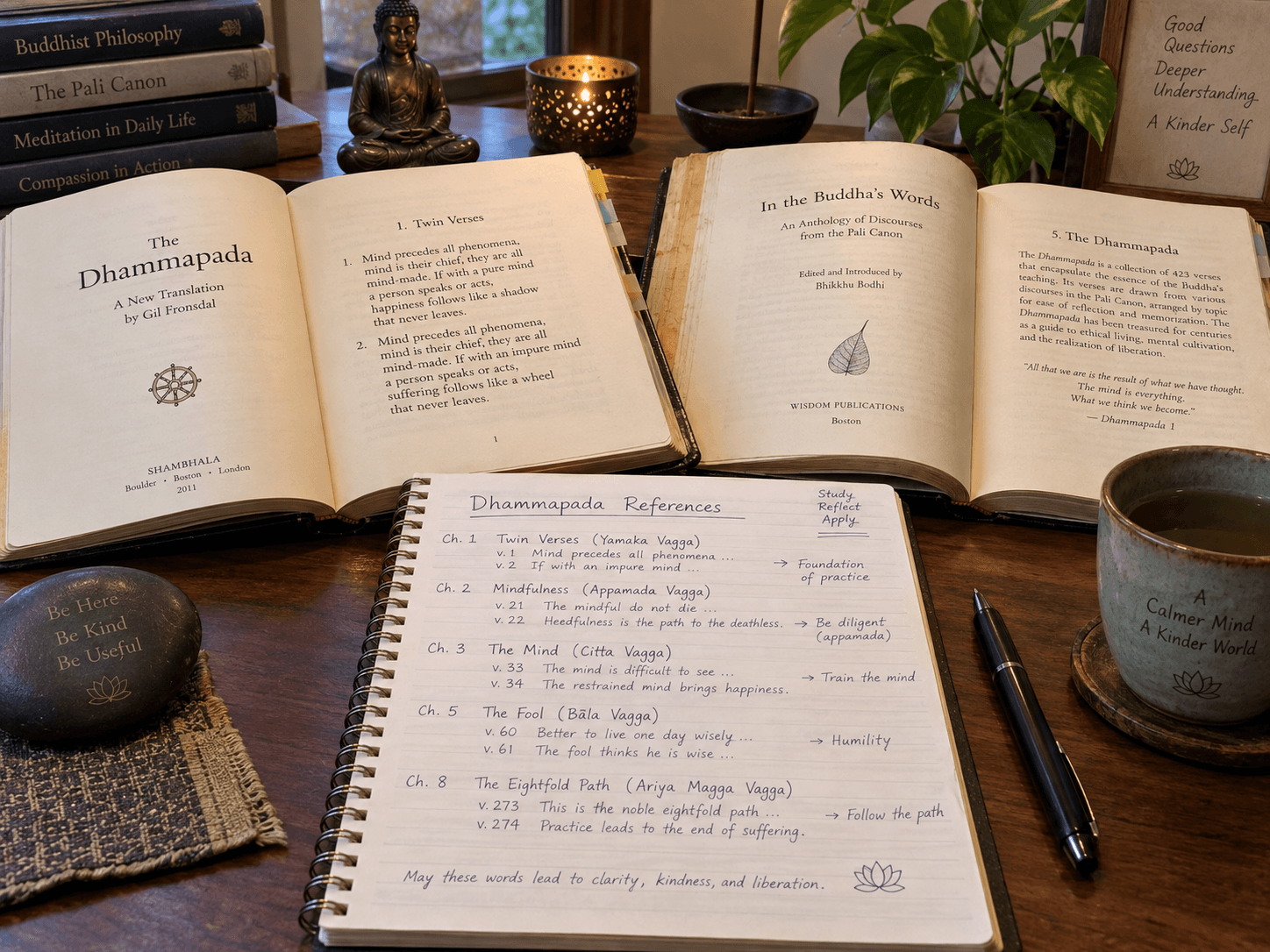
The Dhammapada is a collection of short Buddhist verses about conduct, the mind, and liberation. The Pali version contains 423 verses in 26 chapters and belongs to the Khuddaka Nikaya, a collection within the Sutta Pitaka of the Theravada Buddhist canon. Its brief passages offer a manageable beginning, but they reward more than a quick search for an inspiring quotation. Buddharakkhita edition and contents
This Dhammapada guide is for readers opening the text for the first time. It explains how the collection works, suggests a reading route, and shows why naming your translation matters.
In brief: Begin with a named translation, read a whole chapter around any verse that interests you, and keep its Buddhist setting in view. The Dhammapada connects everyday conduct with training the mind and release from suffering. Its memorable lines belong to a larger path of practice.
The chapters gather verses around themes such as heedfulness, the mind, violence, anger, craving, and the path. Other headings use images, including flowers and the elephant. They help you find related material; they do not turn the book into a continuous argument or a biography of the Buddha. Bhikkhu Bodhi's introduction explains this thematic arrangement. Introduction and chapter list
Two ways of reading therefore complement each other. Reading from beginning to end lets unfamiliar themes challenge your expectations. Returning to a chapter lets you examine one question closely.
Verse numbers usually remain easier to match than English chapter titles. When someone cites “Dhammapada 183,” they mean verse 183, not chapter 183. Record the translator as well: matching numbers identify the passage, but do not guarantee identical English wording.
The Pali collection is also one member of a wider textual family. In his study of early Buddhist transmission, Mark Allon compares a Pali Dhammapada verse with related passages in the Gandhari Dharmapada, Patna Dharmapada, and Sanskrit Udanavarga. These are distinct transmitted collections, not simply different English translations of one unchanged book. The counts in this guide refer specifically to the Pali Dhammapada. Allon, pp. 55–59
Start with these five chapters. The order below is an editorial reading suggestion, not a traditional curriculum or a claim that the other chapters are less important. Each link opens Acharya Buddharakkhita's translation.
|
Reading |
Chapter and verses |
A question to carry into it |
|---|---|---|
|
1 |
What changes between each pair of contrasting verses? |
|
|
2 |
What makes careful attention part of an ethical life? |
|
|
3 |
What do the images suggest about the difficulty of training the mind? |
|
|
4 |
How does recognizing another being's vulnerability change conduct? |
|
|
5 |
What goal gives these instructions their direction? |
At each stop, read the chapter once without taking notes. On the second reading, choose one verse and write down what the surrounding verses add. Then follow the translator's note, if there is one.
For example, verse 33 compares training the mind to straightening an arrow. Verse 34 moves to a fish struggling out of water. Read together, the images invite questions about skill, effort, and agitation. A single pleasant quotation would not convey that range. Verses 33–34
After these readings, return to the full collection. Let the chapters on renunciation, craving, and monastic life remain part of the encounter, even if your original interest was attention or ordinary conflict.
In chapter 2, heedfulness includes effort, moral conduct, self-restraint, and sustained attention. Verse 24 brings several of these qualities together; verse 23 connects perseverance with Nibbana, the Pali term commonly encountered in English as nirvana. Verses 21–25
Reading this chapter as a productivity lesson misses its stated destination. The question is larger than how to concentrate on a task: what kind of conduct and understanding leads toward freedom from suffering?
Verses 129–130 ask readers to consider vulnerability to violence and attachment to life, then connect that recognition with refraining from killing or causing killing. The argument moves from recognizing something shared to changing what one does. Verses 129–130
That movement is useful to notice before extracting an abstract principle. Ask which action the passage addresses and how it makes its case. An English word such as compassion may help describe your interpretation, but your note should preserve the verse's actual reasoning.
Verse 183 joins avoiding wrongdoing, developing good conduct, and purifying the mind. Nearby verses introduce patience, non-harming, monastic discipline, and the ending of craving. These verses give ethical behavior a place within a more demanding religious aim. Verses 183–187
Chapter 20 then names the Eightfold Path and asks readers to examine impermanence, unsatisfactoriness, and not-self. Do not feel obliged to resolve all three concepts on a first reading. Notice instead that the text connects conduct with a way of understanding experience. Verses 273–279
The ending also matters. In chapter 26, verse 393 rejects birth and lineage as sufficient grounds for the spiritual distinction being praised. The chapter's Pali heading concerns the brahmana, often rendered “brahmin”; Buddharakkhita uses “holy man.” Its language needs the surrounding Buddhist discussion of conduct and liberation, rather than assumptions drawn from the English label alone. Chapter 26
For an accessible starting pair, read Buddharakkhita alongside Thanissaro Bhikkhu. Both provide the full Pali collection in English with explanatory material. Their wording makes translation choices visible from the opening verse:
|
Translator |
Brief opening wording |
A question to investigate |
|---|---|---|
|
“Mind precedes all mental states.” |
How is the range of the statement expressed? |
|
|
“Phenomena are preceded by the heart” |
What associations does this wording bring into English? |
The excerpts are only beginnings. Both versions go on to connect speaking and acting with their consequences. Read those complete verses before concluding that the passage says thoughts manufacture every event or that people can think their way out of every difficulty.
A difference in English invites investigation; it does not establish a disagreement between Buddhist schools. First compare the translator's notes and introduction. Thanissaro explains how his choices balance accuracy with poetic form and the reader's response. That account gives readers something firmer than a preference for whichever sentence sounds most familiar. Thanissaro's introduction
If you later compare a Dhammapada verse with another tradition, begin with a focused method for comparing religions. A familiar English word is a starting question, not proof of shared doctrine.
Keep three layers distinct: the numbered verses, traditional explanations of them, and modern historical scholarship.
The collection attributes its teachings to the Buddha. The stories explaining particular occasions belong to the commentarial tradition; they are not all narrated in the verses themselves. Buddharakkhita identifies his use of commentary in explaining difficult passages. Treat those explanations as a named interpretive source, and identify them when retelling a story. Translator's preface
Historical research asks different questions about collection, language, and transmission. Allon's comparison of related versions shows why scholars examine more than one surviving textual witness. It does not give a beginner a simple way to reconstruct the exact spoken occasion behind every verse. Allon's study
You can respect the text's religious authority while remaining precise about which layer supplies a detail.
For any verse, record:
Keep quotations separate from your paraphrase. If you use AI to locate a passage, check the religious citation against the named source before adding it to your notes. An answer that omits the translator leaves part of the research unfinished.
If you use Plurilore to find related passages, its Buddhism study guide explains the available workflow. Keep the edition you actually read in every note.
Yes. Short verses and thematic chapters make it approachable. However, a brief verse may assume Buddhist ideas or use imagery that needs explanation. Start with a translation that includes notes, read surrounding verses, and keep a list of questions rather than expecting every line to be immediately transparent. Thanissaro's introduction
No. You can begin with a chapter that interests you and use the reading route above to broaden your view. Later, read the whole collection so your understanding includes passages that did not initially attract you. A themed selection is a useful introduction, not a substitute for the rest.
No. The Pali Dhammapada is one work within the Theravada canon. This guide's source selection does not represent the complete range of Buddhist scriptures, communities, or interpretations. Treat it as an entry into a particular collection and its teachings. Canonical placement
Open chapter 1 in a named translation. Choose a pair of verses, read both together, and make one reading note. On your next visit, follow a question into another chapter or translation. That gives you a durable starting point: a passage you can find again, a reading you can explain, and a question worth pursuing.

Compare karma in Hindu, Buddhist, and Jain sources through action, intention, selfhood, rebirth, bondage, and liberation in one source matrix.