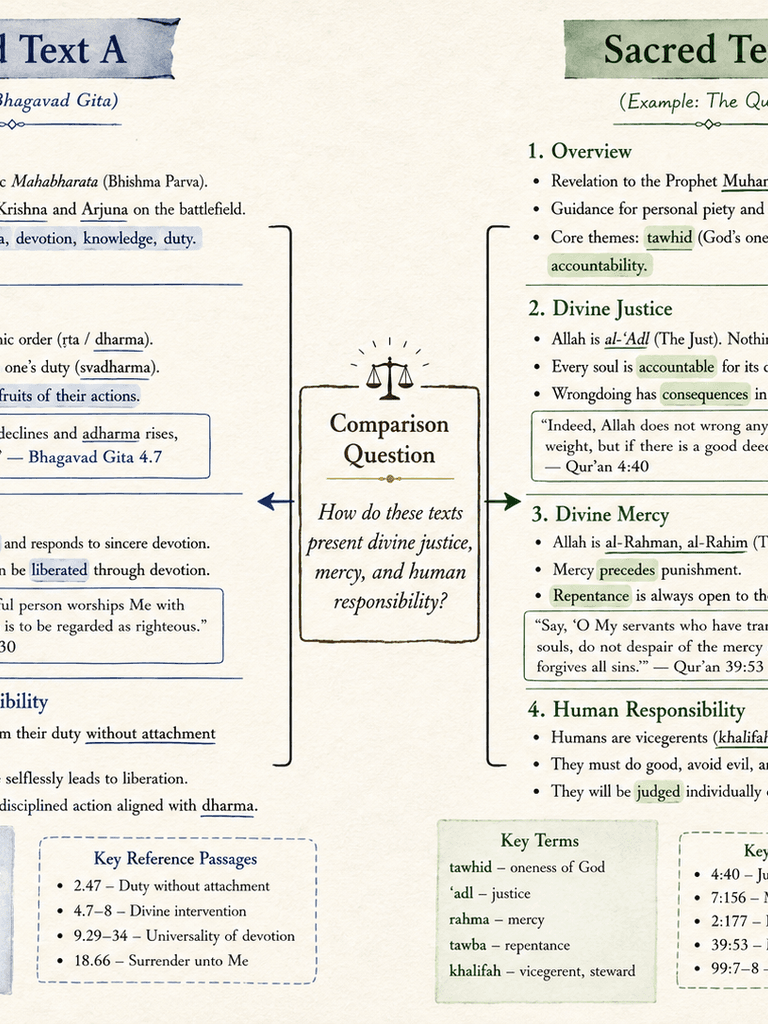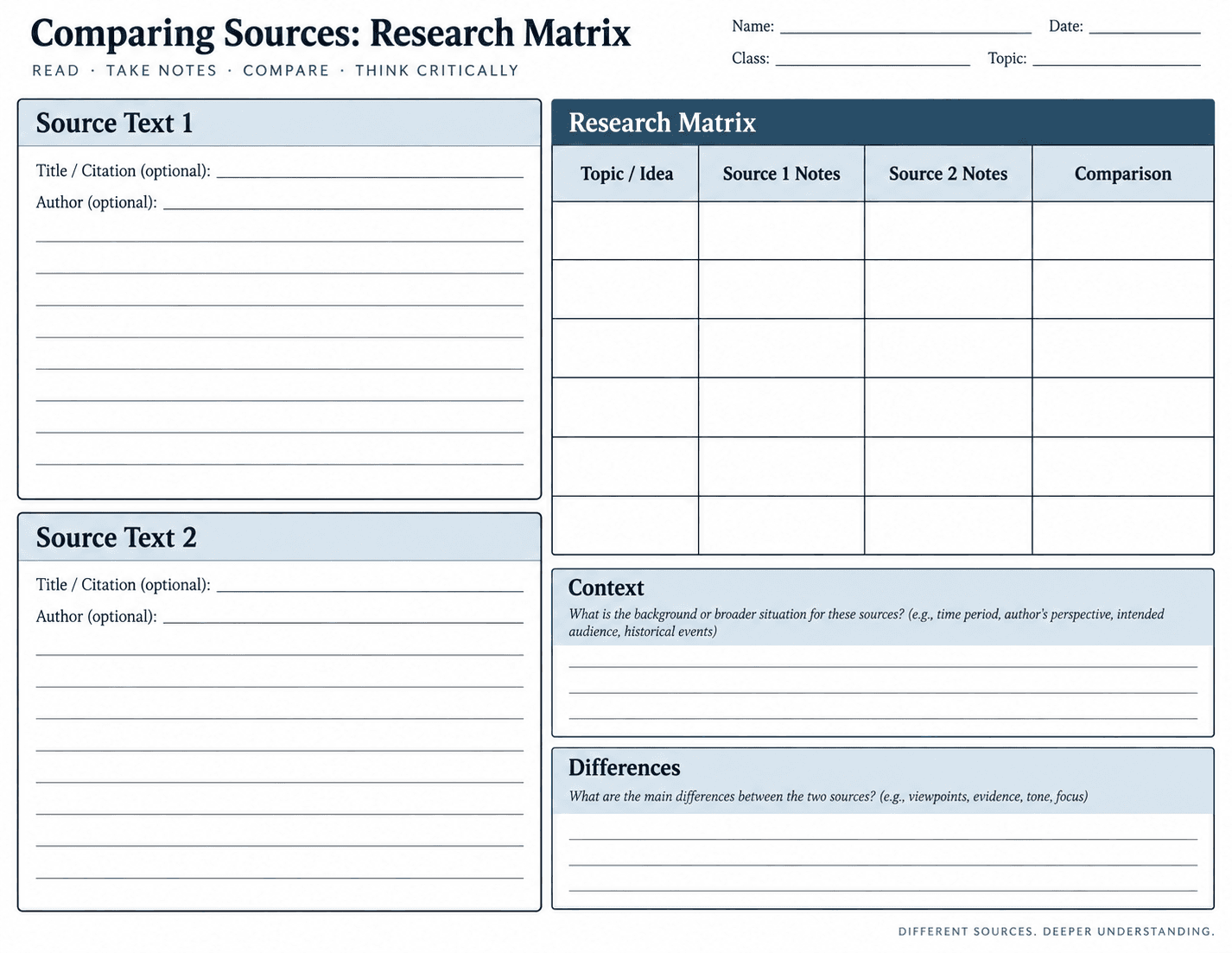
A comparative religion research matrix template should help you compare identifiable sources under one question. Give each source its own record, name the edition and context, then write both the similarity and the difference. Leave room for what the evidence cannot establish.
This template is for students, independent readers, and study groups working with a manageable set of sources. Copy the blank matrix below into a document or spreadsheet, then use the filled example to see how a comparison can remain useful without becoming a claim about entire religions.
In brief: Build the matrix in two passes. First record each source on its own: location, edition, source type, context, and what it supports. Then compare those records under a shared question, preserving differences and uncertainties. One column per religion with a single “belief” in each is usually too coarse for this work.
“What do religions believe about goodness?” gives you little control over what belongs in the table. “How do these two passages describe a response to hostility, and what reasons do they give?” identifies something you can examine.
Write the question above the matrix. Then name the unit you are comparing: passages, commentaries, practices in named communities, or another defined source set. Keep the scale consistent unless the difference in scale is itself part of the question.
Oliver Freiberger's study of comparative methodology treats comparison as dependent on prior study of the things being compared. It also distinguishes selecting and describing sources from placing them together and revising the resulting account. The practical implication here is simple: do not let the table substitute for reading each source.
Our guide to comparing religions explains that larger method. This article provides the working record you can use while applying it.
The matrix has two parts so long source details do not disappear inside a crowded comparison table. Copy both. They form one research record, and the identifiers connect them.
Research question:
Scope: Name the sources, communities or periods included, and the boundaries of this comparison.
Reason for selecting these sources:
Researcher and date:
Use one column per source for a small project. For a larger project, make each source a row in a spreadsheet and use these fields as columns.
|
Field |
Source A |
Source B |
|---|---|---|
|
Record identifier A B |
A |
B |
|
Tradition and named community or textual setting |
|
|
|
Work and exact passage, section, or other locator |
|
|
|
Translator or editor; edition and date where known |
|
|
|
Readable source URL or catalog reference |
|
|
|
Source type and authority in this setting |
|
|
|
Speaker, audience, genre, and surrounding context |
|
|
|
Key term and translation issue, if relevant |
|
|
|
My paraphrase of the relevant evidence |
|
|
|
Claim this source supports |
|
|
|
Limit, alternative reading, or missing evidence |
|
|
|
Checked by; date; verification status |
|
|
Write a separate row for each comparison question. Refer back to the source identifiers rather than squeezing their bibliographies into every cell.
|
Question |
Source records used |
Similarity supported by these sources |
Difference that must remain visible |
Uncertainty or next source needed |
|---|
Below that row, write:
Provisional conclusion:
What this comparison does not establish:
Revision after further reading:
These fields are prompts for inquiry, not a scoring system. Do not calculate which tradition is more compassionate, consistent, or advanced from the number of filled cells.
“The Bible” or “Buddhism” is not a usable entry in the work-and-location field. Name the passage or document you read. If you read a commentary explaining it, give that commentary its own record rather than combining its interpretation with the source text.
Identify the translation. If its publication date is unclear, say so and record the website's access date separately. Do not silently use one translator's wording and another edition's bibliographic details.
The citation-verification checklist covers these checks in detail. A matrix organizes checked evidence; it does not make unchecked citations more dependable.
Ask what kind of source this is and for whom it carries authority. A scripture, legal commentary, community statement, interview, and observer's account can each answer different questions.
For example, an interview can provide evidence of how that participant describes a practice. It does not become a universal rule for the community. A normative text may prescribe an ideal without showing how often people enact it. Record the kind of claim each source can support.
If your question concerns oral transmission or ritual authority, change the locator fields to fit the evidence: speaker, community, occasion, recording or publication, and relevant access permissions. Leave restricted material out. The template is adaptable; a tradition does not need to resemble a book to fit your research.
Do not leave an unexplained dash where evidence is missing. Use a phrase that says what happened:
None of these means “the tradition has no answer.” Explicit gaps often tell you what to read next or why the original question needs revision.
Question: How do Matthew 5:43–48 and Dhammapada 3–5 describe responding to hostility?
Scope: Two translated textual units. This example does not compare all Christian and Buddhist ethics, lived practice, or later commentary. The shared question is our choice as readers.
Text and edition: The Gospel of Matthew, 5:43–48, World English Bible at Bible Gateway, checked September 16, 2026.
Setting and source type: A Christian scriptural passage presenting Jesus' teaching in the Sermon on the Mount. This record concerns the passage rather than a denominational interpretation.
Evidence paraphrase: Enemy-love and prayer for persecutors are linked with the heavenly Father's generosity beyond a favored group.
Limit: This short record does not establish how a particular Christian community applies the passage.
Text and edition: Dhammapada, chapter 1, verses 3–5, Acharya Buddharakkhita's translation, Buddhist Publication Society, 1985; web text checked September 16, 2026.
Setting and source type: A Buddhist scriptural verse collection translated from Pāli. This record concerns the cited verses rather than every Buddhist school's ethical teaching.
Evidence paraphrase: Verses 3–4 contrast holding onto recollections of injury with relinquishing them; verse 5 sets non-hatred against the continuation of hatred.
Limit: The verse does not promise a particular response from the other person. Further work on its interpretation would need additional sources.
| Question | Source records used | Similarity supported by these sources | Difference that must remain visible | Uncertainty or next source needed |
| ----------------------------------- | ------------------- | ------------------------------------------------ | ------------------------------------------------------------------------------ | ---------------------------------------------------------------------------------- |
| What response interrupts hostility? | A and B | Both offer a response beyond returning hostility | A frames its instruction through the Father; B addresses hatred and non-hatred | Read named commentaries before extending this into a comparison of ethical systems |
Provisional conclusion: These passages can be compared around responding to hostility while their explanations remain distinct.
What this comparison does not establish: Equivalent doctrines, identical practices, historical borrowing, or a ranking of either tradition. Similarity in a chosen question is not evidence for those larger claims.
The matrix has produced a useful result even though it has not filled every research gap. It tells us what the comparison concerns and where further reading would change it.
Begin with one tradition and a narrow question. Open Sources consulted and follow the relevant reference into the Library. Complete the source record from what you read, supplementing missing edition information from the source guide or original publication.
Repeat for the second source. If you use cross-reference Chat, still verify each source separately. A single comparative answer can be useful working material, but it should not supply every cell without your checking it.
The exact external translations in the worked example are identified above. The example does not assert that Plurilore supplies those same editions. Check the agent source guides and the text returned for your own session.
Atlas can lead you from topics or cross-tradition connections to supporting evidence. Record the passages you inspect. Treat the connection label as a lead until you can explain the similarity and difference in your own words.
If your search produces no useful passage, record that limitation. A missing result describes your search and the material available; it does not establish an absence in the religion itself.
Use a spreadsheet for a wide matrix or a document for a small one. In Plurilore Notes, you can use a separate note for each source with the same field labels and a comparison note that refers to them. This workflow does not require a dedicated matrix feature in the app.
Keep the question, source links, and revisions together using the verifiable study-trail workflow. Export important local notes for backup, especially before clearing browser data or changing devices.
Start with the question and name the sources. State the similarity only at the level those sources support. Follow it immediately with the difference that changes how the similarity should be understood. Finish with a limit or an unresolved question where it matters.
Try this sentence pattern in your own words: “On the question of [question], source A and source B both [supported similarity]. They differ in [consequential difference]. This comparison covers [scope]; it does not establish [limit].”
Then read the paragraph without the table. Can someone tell whose teaching you describe, which source supports it, and where your interpretation begins? If the answer depends on knowing what you meant by an empty cell, revise the record before polishing the prose.
Freiberger's methodological discussion allows comparison to change the descriptions and categories with which a study began. Apply that openness to your draft: if a shared word turns out to hide different questions, revise the question instead of forcing the sources into the original headings.
It is a structured record connecting a comparison question to identifiable sources, their contexts, and the similarities and differences they support. It helps you see the evidence behind a paragraph and locate gaps before making a larger claim. It is not a substitute for reading or qualified interpretation.
For close research, give each source its own record. A tradition may need several records for different texts, communities, periods, or interpreters. One row per religion can be a summary after that work, provided it does not conceal the differences or imply complete coverage.
It can suggest fields, organize material you provide, or propose sources to investigate. Treat proposed entries as unchecked until you have read the sources yourself. Do not let the same generated answer supply the claim, the citation, and the claim's verification without independent reading.
Use enough to support the question you actually ask. Two passages can support a bounded comparison of those passages. They cannot establish what two entire traditions believe or how their communities behave. Broader claims need broader and more varied evidence, plus appropriate review.
Yes. Copy both parts into a document, spreadsheet, or notebook. The identifiers and field labels work with external websites, library books, and properly documented non-textual evidence. Plurilore offers connected study surfaces; it is not required to use the template.
Choose one question and two sources. Complete their records, write one supported similarity, and preserve one consequential difference. If you cannot yet write the limit of the comparison, return to the sources before expanding the table.
Compare karma in Hindu, Buddhist, and Jain sources through action, intention, selfhood, rebirth, bondage, and liberation in one source matrix.