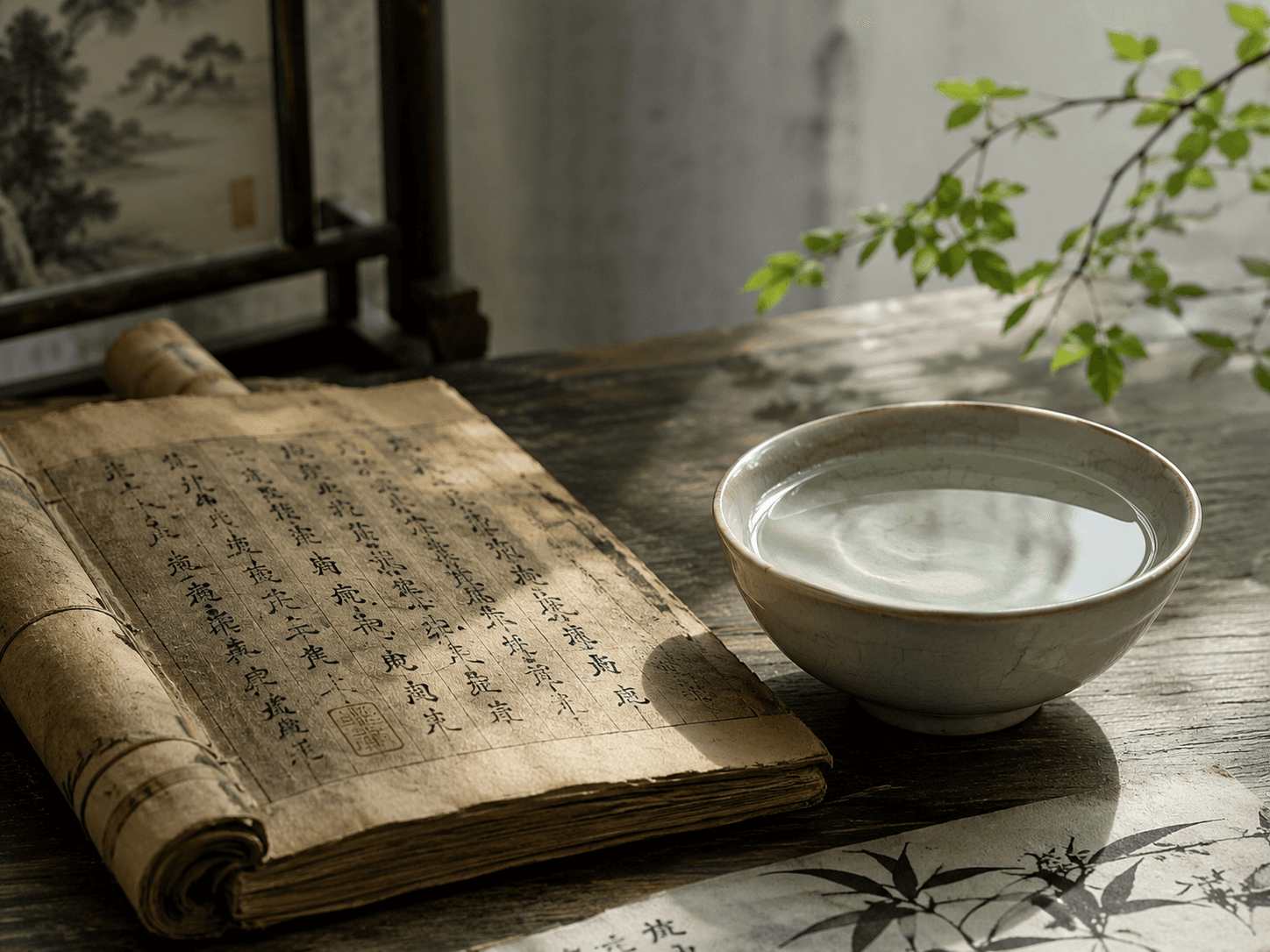
The Tao Te Ching presents leadership as the art of making less of the leader.
Its ruler does not seek constant visibility, multiply controls, or force every outcome. The text praises humility, restraint, softness, and wuwei: action that does not impose a strained pattern on people or events. Good order appears when the leader stops making personal display and coercive interference the center of government.
In brief: The Tao Te Ching teaches that leaders become effective by reducing ego, contention, excess, and needless control. They create conditions in which people can act well, intervene carefully, accept the lower position, and avoid claiming every success. This is an ancient political vision, not a modern management handbook, and several chapters require critical reading rather than easy application.
No defensible history supports that exact superlative.
Ancient Egyptian, Mesopotamian, Indian, Greek, Chinese, and other texts discussed rule, counsel, duty, and statecraft before or alongside the materials that became the Tao Te Ching. Calling it “the oldest leadership book” creates a memorable headline by erasing that wider history.
It is fair to call the Tao Te Ching one of the most influential ancient texts on rulership and restrained action. Many chapters address the ruler or ruling elite, even though the book also speaks about the Dao, personal cultivation, desire, knowledge, conflict, and the realized person.
Scholars also do not treat the work as a transcript written at one moment by a historically secure individual named Laozi. The Stanford Encyclopedia of Philosophy's account of religious Daoism explains that shorter early forms circulated by the later fourth century BCE and that a form close to the received text was probably compiled later. Traditional Daoist accounts and modern historical scholarship approach authorship differently, and both belong in a careful introduction.
English translations vary because the Chinese text is brief, layered, and open to more than one defensible reading. Four recurring terms help orient a leadership reading.
Dao can mean a way or path, but in the Tao Te Ching it also names the ungraspable source and pattern through which things emerge. The opening chapter warns that any way fully captured in speech is not the constant Dao.
For leadership, this means reality is not created by the leader's plan. The leader acts inside processes larger than personal intention.
De is often translated as virtue, but it can also suggest potency, character, or the efficacy through which the Dao becomes present in a person. It is not merely a list of moral rules.
A leader with de does not need to advertise moral status. Influence is shown through the quality of presence and action.
Wuwei is often translated as “non-action.” That phrase can mislead modern readers into hearing laziness or total withdrawal.
In leadership passages, wuwei points toward action free from compulsive interference, self-display, and force. The leader still responds, but the response fits the situation rather than treating intensity as proof of competence.
Ziran is often translated as naturalness or spontaneity. It describes what emerges from its own character rather than being made through external pressure.
The political question becomes: can leadership create enough space for people and communities to order themselves, or does it make them dependent on constant commands?
Chapter 2 introduces a pattern that recurs throughout the text. The sage acts without laying claim to the result, helps things grow without treating them as possessions, and does not remain fixed on personal achievement (Tao Te Ching, chapter 2).
For leaders, the passage challenges three habits:
The alternative is not anonymity for its own sake. It is work whose value does not depend on the leader receiving ownership of every outcome.
Chapter 8 compares the highest excellence to water. Water benefits living things, does not contend, and occupies low places that others avoid (chapter 8).
This image gives Daoist leadership a physical grammar:
Water is not weak because it lacks effect. Its power comes from persistence, responsiveness, and refusal to meet every obstacle on the obstacle's terms.
Applied carefully, the image asks leaders to notice whether their presence helps people work or merely makes authority visible.
Chapter 17 offers a sequence of rulers: the best are scarcely known, lesser rulers are loved and praised, worse rulers are feared, and the worst are despised. When the work succeeds under the best ruler, the people understand the achievement as their own (chapter 17).
This passage is often turned into a slogan about invisible leadership. Its sharper point concerns trust and ownership.
The leader should not make collective capacity disappear beneath personal charisma. If every process stops when one person leaves, the system has produced dependence rather than strength. If people can understand, maintain, and improve the work, the leader's restraint has become a form of institution-building.
The chapter does not prove that leaders should never communicate or accept responsibility. Silence can hide neglect as easily as wisdom. The test is whether reduced visibility gives others real agency or merely protects the leader from scrutiny.
The Tao Te Ching repeatedly distrusts violence and triumphalism. Chapters 30 and 31 warn that conquest produces resistance and that weapons should be treated as instruments of misfortune, not objects of glory.
This matters for leadership beyond war. Coercion may produce quick compliance while damaging trust, information flow, and the ability to correct mistakes. People who fear punishment learn to conceal problems. A system can appear orderly at the exact moment it becomes fragile.
The text's warning is not that authority never constrains harmful behavior. It is that force expands easily, leaves consequences behind, and tempts leaders to mistake submission for agreement.
Chapter 57 links multiplying prohibitions and clever interventions with disorder. The sage reduces self-directed activity so that people can transform themselves (chapter 57).
A modern reader may hear a case for deregulation, but that translation is too quick. The chapter belongs to an ancient argument about rule, desire, and social simplicity, not a present-day policy platform.
Its lasting question is still useful: Which problems are created by the system's attempts to control them?
Rules can protect people, make expectations clear, and restrain abuse. They can also multiply because leaders fear uncertainty. Daoist restraint asks whether a new rule addresses the source of harm or only makes managerial activity more visible.
Chapter 60 compares governing a large state to cooking a small fish (chapter 60). The familiar interpretation is that too much handling ruins what is being prepared.
The image does not provide a complete theory of government. It gives one memorable warning: intervention has costs.
Leaders often see a problem and respond by reorganizing, renaming, measuring, escalating, and meeting. Each action may appear reasonable in isolation. Together they can break the relationships and local knowledge that allowed the work to function.
A small-fish test for intervention asks:
That framework is a modern application, not a claim about the chapter's one original meaning.
Chapter 66 says rivers and seas become gathering places because they remain below the streams. The sage who would be above the people speaks from below them; the one who would go before them places the self behind (chapter 66).
Humility here is structural, not decorative.
A leader may use humble language while retaining every privilege, controlling every decision, and avoiding every cost. The chapter asks for a real change of position: receive what flows from others, bear weight without making that weight oppressive, and stop treating precedence as a personal right.
In a team, this can mean leaders absorb uncertainty, give clear credit, invite disagreement before a decision, and take responsibility when a system they designed fails.
Chapter 67 names three treasures commonly translated as compassion or gentleness, frugality, and not daring to be first. Chapter 68 then praises the skilled person who does not display aggression, rage, or contention (chapters 67–68).
These chapters reject a leadership style built around theatrical dominance.
Compassion keeps decisions connected to their human cost. Economy resists the belief that more resources and greater scale always prove success. Refusing to be first weakens the leader's appetite for status. Non-contention chooses an effective response without turning every disagreement into a contest of identity.
None of this requires avoiding hard decisions. A leader can set a boundary, remove someone from a harmful role, or change direction without anger becoming the method.
Chapter 78 returns to water and the claim that the soft can overcome the hard. It then links leadership with the capacity to receive a state's disgrace and misfortune (chapter 78).
This is not the modern habit of accepting blame in public while distributing consequences downward. Bearing reproach means authority carries responsibility.
The leader cannot claim credit as personal and failure as someone else's execution problem. The chapter's paradox is that the person able to receive what others reject becomes fit to hold authority.
For a broader view of how Daoist restraint responds to hardship, compare what major traditions say about suffering.
The chapters can be organized into five tests for action.
|
Test |
Question |
Chapters |
|
Ego |
Am I acting for the work, or to prove that I am the leader? |
2, 9, 17 |
|
Force |
Will this intervention solve the problem or produce resistance and concealment? |
30, 31, 57 |
|
Fit |
Does the response match the situation's scale, timing, and existing order? |
8, 60 |
|
Position |
Am I willing to stand below, listen, and let others own the result? |
66, 67 |
|
Responsibility |
Will I bear the cost and reproach that come with authority? |
68, 78 |
The framework is useful precisely because it resists one universal technique. The answer may be to intervene, wait, simplify, stop, listen, or act decisively with minimum force.
Neglect can hide behind Daoist language. If people are being harmed, information is withheld, or a decision belongs to the leader's role, “letting things unfold” may be cowardice.
Wuwei asks for non-forcing action, not exemption from responsibility.
The Tao Te Ching is not a collection of tips for increasing quarterly performance. Its critique of desire, status, force, knowledge, and government is more unsettling than “delegate better.”
A corporate reading that keeps every goal of expansion and competition intact while borrowing the language of flow has not allowed the text to challenge much.
The text often assumes a ruler and subjects, not democratic citizenship or equal participation. Some chapters can sound paternalistic, especially when they praise keeping people simple or without certain forms of knowledge.
Readers should not baptize every ancient political claim as timeless wisdom. The text can criticize coercive rule while still carrying assumptions modern readers have reason to reject.
That balance—learning from old texts without treating every ancient claim as automatically timeless—is part of why ancient wisdom still speaks.
Key words such as dao, de, wuwei, and ziran do not map neatly to one English term. Excavated manuscripts, received versions, commentarial traditions, and translator choices matter.
Compare at least two scholarly translations before building a major argument around one English phrase. A beautiful sentence may reflect the translator's interpretation as much as the underlying Chinese.
A good leader is restrained, humble, non-contentious, careful with force, willing to stand below others, and slow to claim the work as a personal possession. The leader creates conditions for people to act well without making constant intervention the source of order.
No. Wuwei is better understood as non-forcing or uncontrived action. It can include decisive action when the situation calls for it. The contrast is with compulsive control, ego-driven display, and intervention that fights the structure of the situation.
Start with chapters 2, 8, 17, 30–31, 57, 60, 66–68, and 78. Read chapter 3 and chapter 65 as well because they expose difficult political assumptions that a purely inspirational selection may hide.
Laozi is a foundational figure in Daoist tradition, but many modern scholars treat the Tao Te Ching as a composite work rather than the writing of one securely documented sixth-century BCE author. A respectful reading can state both the traditional attribution and the historical debate.
Its questions can improve modern leadership: reduce needless control, distribute ownership, act at the right scale, and examine the ego behind intervention. The ancient text does not supply employment law, democratic governance, safety procedures, or a complete organizational design. It should inform judgment, not replace it.
The Tao Te Ching does not ask leaders to disappear. It asks them to stop treating prominence, force, and visible activity as proof of value.
Its best leader helps people become less dependent on leadership. Its strongest action may look soft. Its most durable achievement may be the one people understand as their own.
Read the text slowly in more than one translation. Ask where intervention is needed, where it is feeding the problem, and whether the desire to act belongs to the situation or to the leader's need to be seen acting.
Use Plurilore to explore the Tao Te Ching alongside other Daoist sources and follow cited passages into the Library before applying a line outside its context.

Forgiveness in the Quran is four Arabic roots, not one word. Read the vocabulary, the conditions attached to repentance, and where mercy meets repair.