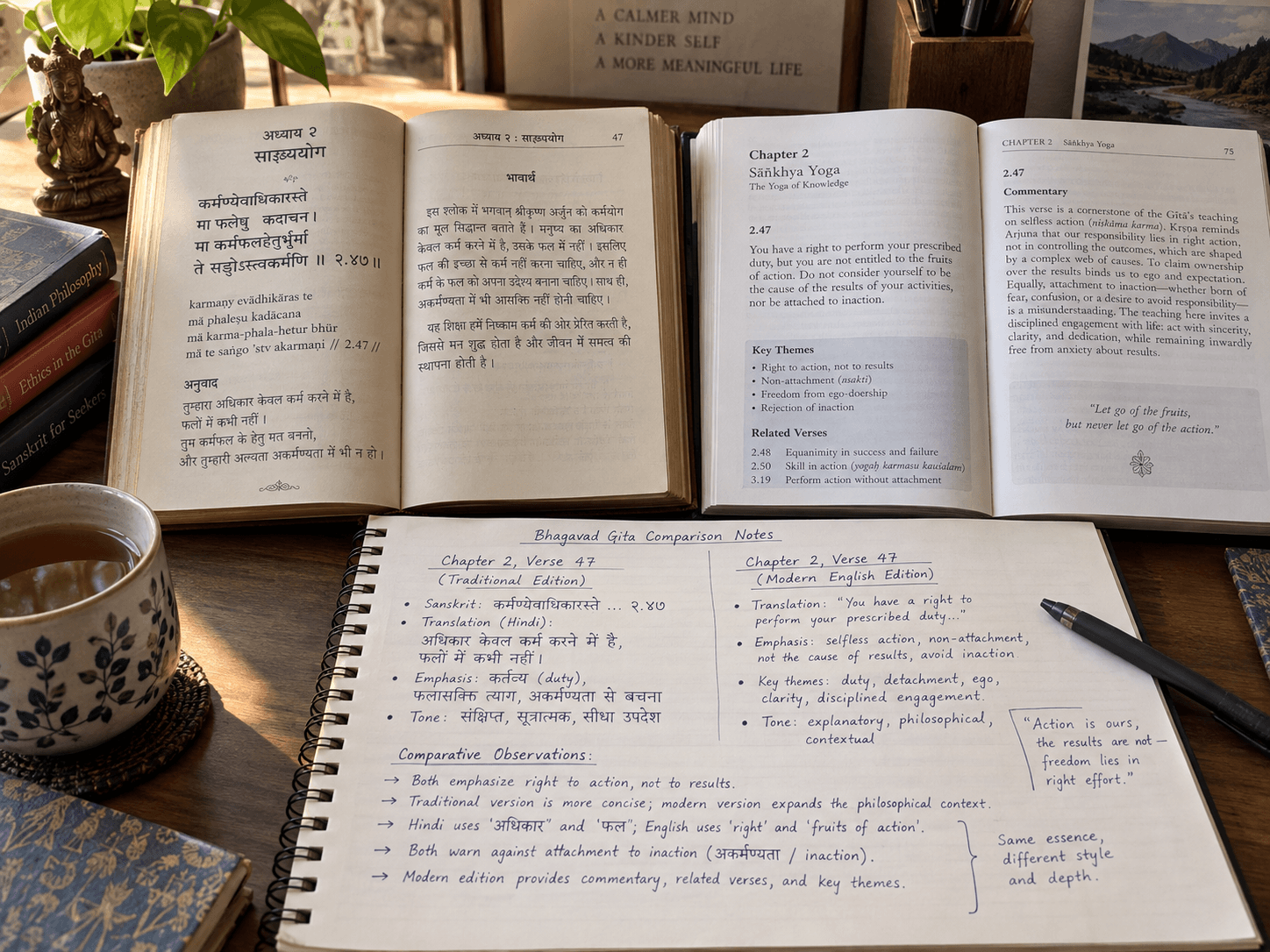
Bhagavad Gita chapter 2 brings three questions together: what endures when a body dies, what Arjuna owes as a warrior, and how he can act without becoming attached to the result. Krishna's answer moves from the nature of the self to disciplined action and a description of steady wisdom. Reading those parts together gives the chapter more depth than its famous advice about the fruits of work.
This guide is for readers studying the Gita in English. It follows selected verses and compares two named translations, keeping their explanations distinct from the text they translate.
In brief: Chapter 2 connects Krishna's teaching about the enduring self with Arjuna's difficult duty and action without attachment. Its closing verses describe steadiness amid desire and disturbance. Translation choices help readers see different emphases, but English wording alone cannot settle the chapter's philosophical disputes.
Arjuna is facing a battle involving relatives and teachers. His difficulty concerns whether he should fight at all. In 2.7, translated by Swami Mukundananda, he acknowledges confusion about his duty and asks Krishna to teach him. The chapter therefore begins with a request for instruction inside a moral conflict.
The Gita forms part of the Mahabharata. Shyam Ranganathan's Internet Encyclopedia of Philosophy article on the Bhagavad Gita places its dialogue in that narrative and discusses its reception by commentators including Shankara, Ramanuja, and Madhva. His account is a philosophical interpretation; it does not make the text's reception uniform.
That setting matters when applying a verse to contemporary life. Advice to Arjuna cannot become an automatic endorsement of whatever a reader's employer, family, or institution calls a duty. First ask what the speaker is arguing and which problem the passage addresses. Our guide to comparing religions uses the same discipline when moving between traditions.
Use this map to follow the chapter's movement. These are practical reading divisions, rather than a claim that every edition organizes the chapter identically. The linked verses provide entry points; read the surrounding ranges in your chosen edition.
|
Verses |
Main question to follow |
Starting passage |
|---|---|---|
|
2.1–10 |
Why does Arjuna need instruction? |
|
|
2.11–30 |
How does Krishna distinguish the enduring self from bodily change? |
|
|
2.31–38 |
What does Krishna argue from Arjuna's warrior duty? |
|
|
2.39–53 |
How does understanding change the way a person acts? |
|
|
2.54–72 |
What does steady wisdom look like in conduct? |
Chapter headings also deserve attention. Mukundananda's edition calls this chapter Sānkhya Yog. Treat an edition's heading as a guide into its interpretation. The name alone does not establish that the chapter teaches every doctrine of the classical Samkhya philosophical school.
In 2.13, Krishna relates bodily change during a lifetime to taking another body after death. Verse 2.22 develops the distinction through the image of replacing worn clothing. These passages give the chapter's discussion of death a specific account of continuity.
Mukundananda's translation of 2.20 calls what endures the soul and describes it as unaffected by the body's destruction. A. C. Bhaktivedanta Swami Prabhupada's translation of the same verse also uses soul. The shared English noun helps identify the subject, but it does not tell us everything about either commentator's understanding of the self.
For a first reading, keep two questions separate: what does this passage say survives bodily change, and how does a particular school explain that survival? The first can be investigated in the verse. The second requires commentary and a wider account of the school's thought.
This is a teaching within the Gita, not a scientific demonstration or a definition shared by every Indian tradition. If you compare it with a Buddhist account, the difference over an enduring self must remain visible.
Verse 2.31 in Prabhupada's edition ties Krishna's argument to Arjuna's position as a kshatriya, a warrior, and to a battle described as religiously justified. Svadharma, one's own duty, appears here inside that particular setting.
Calling the verse “follow your passion” loses its social and moral force. Calling it “obey every assigned role” turns the argument into a rule the passage has not established for every reader. Both shortcuts avoid the difficult question: how is the claimed duty justified?
A careful reading can acknowledge Krishna's argument while continuing to examine it. Describing a text's reasoning does not require endorsing war, inherited social hierarchies, or a present-day authority's demands. The distinction also keeps a study guide from becoming personal instruction about a reader's obligations.
Verse 2.47 in Prabhupada's translation distinguishes performing prescribed duty from entitlement to its fruits. It also warns against attachment to failing to act. That last part is easy to lose when the verse appears alone on a quotation card.
In 2.48, the instruction remains active: Arjuna is to perform his duty while maintaining equanimity in success and failure. Together, the verses connect action with a changed relationship to its outcome. They offer no guarantee that the outcome will be favorable.
For study purposes, distinguish attachment to getting a desired result from judging whether an action is appropriate. The chapter's treatment of duty still requires attention. Non-attachment cannot by itself turn a harmful decision into a justified one.
The comparison of karma in Hinduism, Buddhism, and Jainism follows these questions into different accounts of action and its consequences. Here, stay with the chapter's narrower question: how does understanding change Arjuna's way of acting?
The following comparison uses Prabhupada's Bhagavad-gītā As It Is at VedaBase and Mukundananda's Bhagavad Gita, The Song of God. Both editions present devotional interpretations. They provide a readable comparison, rather than a representative survey of Hindu schools.
In Prabhupada's 2.50, the opening identifies a person engaged in devotional service. Mukundananda's 2.50 describes someone practicing work without attachment. Their closing phrases also differ:
|
Edition |
Short wording from the translation |
What to investigate |
|---|---|---|
|
Prabhupada |
“the art of all work” |
How does the edition connect yoga with devotional service? |
|
Mukundananda |
“the art of working skillfully” |
How does the edition explain skill and proper consciousness? |
Those differences are observations about the printed English. To explain them, read each page's word glosses and commentary, which are separate from its verse translation. A translator may make an interpretive connection explicit where another translation uses different language.
This comparison does not establish that the two teachers disagree about the value of devotion, or that skill means ordinary professional efficiency. Those conclusions would need more evidence than the phrases in the table.
Arjuna asks how the person described by Krishna behaves. Prabhupada's translation speaks of consciousness “merged in transcendence”; Mukundananda's translation uses “situated in divine consciousness.” Both ask about speech, sitting, and walking.
The question draws attention to conduct. It also gives readers a useful comparison task: record how each edition describes the person's condition, then examine how the next verses explain it. Our translation-comparison guide provides a fuller method for keeping wording, commentary, and your own conclusion separate.
The expression sthita-prajna is often explained as steady wisdom. In Mukundananda's edition, 2.55 describes relinquishing desires and finding satisfaction in the self; 2.56 describes steadiness amid misery and freedom from craving, attachment, fear, and anger. This gives content to the ideal Arjuna asks about.
Verses 2.62 and 2.63 present a sequence in which dwelling on sense objects leads through attachment and desire to anger and the loss of judgment. Read this as the chapter's account of disturbance, rather than a clinical explanation of every experience of anger.
The ocean image in 2.70 portrays steadiness despite the arrival of desirable things. It helps connect the earlier discussion of outcomes with the closing account of peace. Wisdom appears in the way desire is met, rather than merely in the ability to repeat a teaching.
Choose one verse and record the following before reaching for a general conclusion:
For 2.50, a bounded conclusion would be: “These editions describe the opening subject differently and use different phrases for yoga in action. I need their explanations before deciding how much philosophical difference this represents.” That is a useful research result even when it leaves a question open.
Plurilore's public Hinduism source guide describes the Gita within its Mahabharata collection. That collection uses Kisari Mohan Ganguli's English translation. The external editions compared above are separate sources. Use their verse links to read the wording and add the comparison to your own record, naming the translator beside each passage. The indexed collection should not be assumed to contain either modern edition used here.
Chapter 2 connects Krishna's teaching about the enduring self with Arjuna's warrior duty, action without attachment, and steady wisdom. Its meaning emerges from the relationship between those themes. Reading only verse 2.47 can obscure both the moral crisis that begins the chapter and the account of conduct that closes it.
The verse addresses attachment and entitlement to the fruits of action, and it also warns against attachment to inaction. Read it with 2.48 and the chapter's discussion of duty. It does not establish that an action becomes justified simply because its performer claims to be detached.
It introduces central questions about action, understanding, and attachment. The discussion continues in later chapters, including chapter 3. Use chapter 2 as an entry into the Gita's argument, while keeping later explanations distinct from what a particular verse here explicitly says.
Start with a named translator, clear verse numbering, readable notes, and an explanation of the edition's perspective. Compare a second edition at a passage that puzzles you. This guide demonstrates that process with two devotional editions; it does not rank them or identify one as universally authoritative.
Bhagavad Gita chapter 2 asks how understanding the self can change action in a difficult moral setting. Begin with Arjuna's request in 2.7, follow the movement through duty and non-attachment, and return to his question about conduct in 2.54. Then compare one verse in two named editions and write a conclusion that stays within what you actually read.
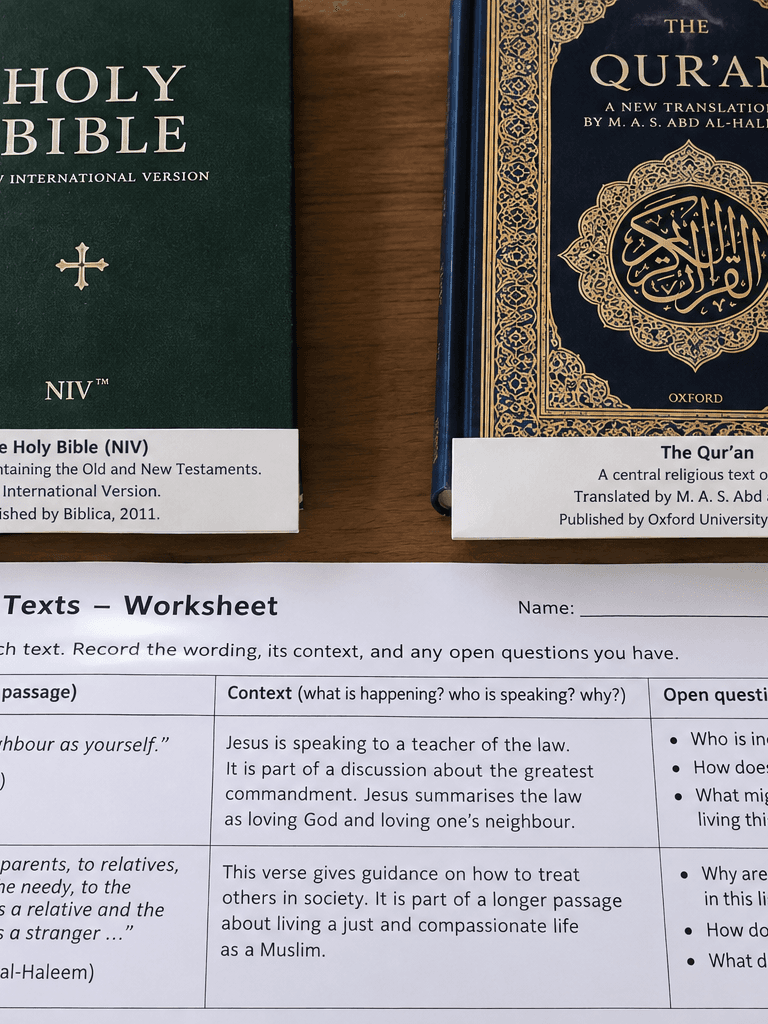
Compare sacred-text translations using a worksheet and Dhammapada example. Identify editions, check context, and separate wording from doctrinal conclusions.