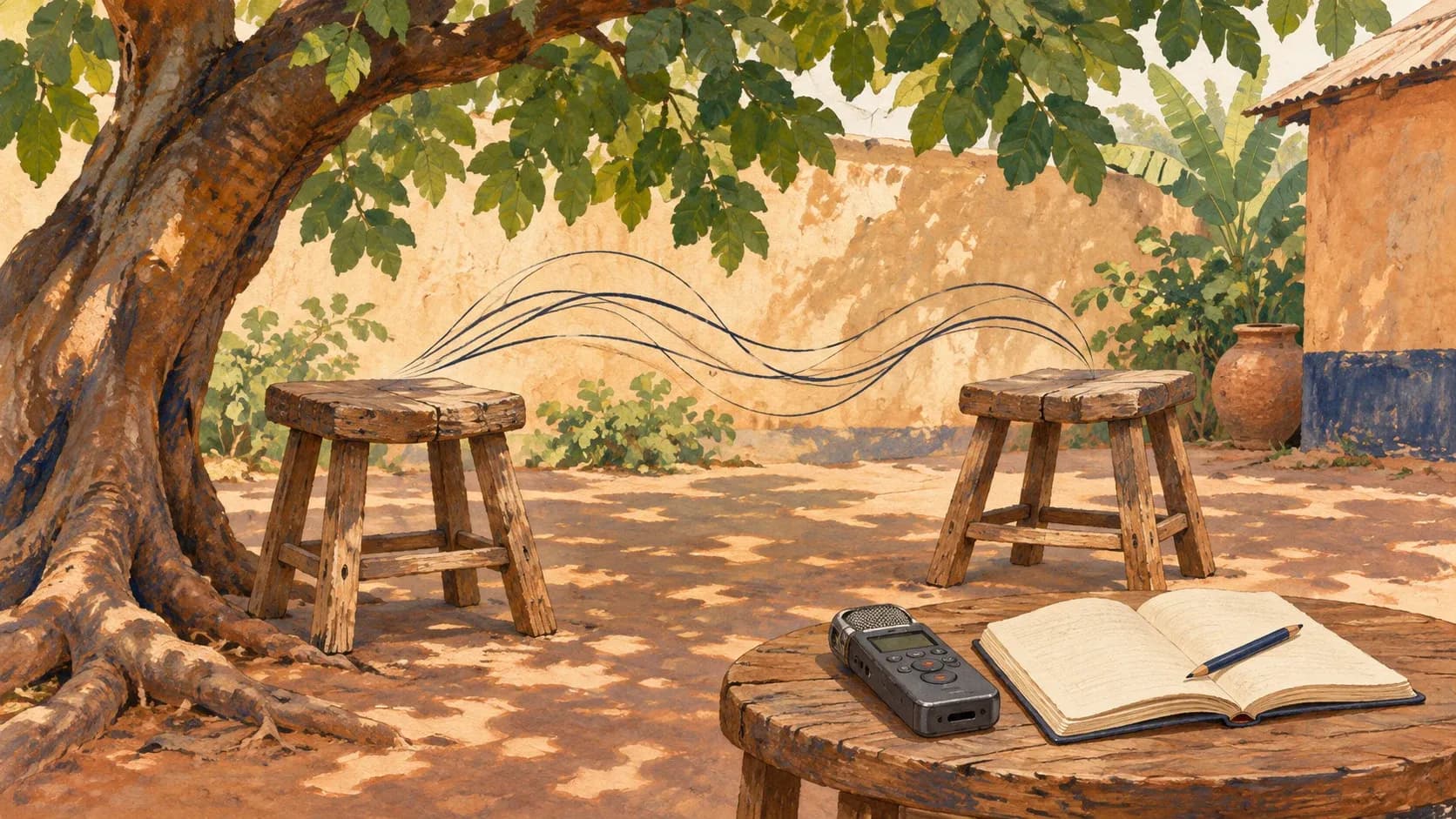
Ifá is a Yoruba tradition of divination and sacred knowledge in which trained interpreters connect signs with a large body of oral literature. Its religious meaning includes a relationship with Ọ̀rúnmìlà, associated with wisdom and divination. The Center for the Study of World Religions at Harvard describes interpretation of the verses as central to how this communication works.
For a beginner, the useful starting point is the relationship between a sign, a recited verse, and a particular human situation. Learning a list of signs alone leaves most of that relationship unexplained.
In brief: Ifá joins divination, oral poetry, religious interpretation, and learning. Its corpus is organized into 256 odù, with many verses associated with each. It belongs within a wider Yoruba religious world and has developed in different communities across the Atlantic. A printed selection can introduce its literature; it cannot stand in for the whole tradition or a practitioner's training.
Read about the 256 odù, oral learning, or use the source-reading worksheet.
Ifá offers a way into Yoruba religion, but the two terms should not be treated as identical. In his research reflection on Yoruba religion, scholar Ayodeji Ogunnaike places Ifá within a broader world of òrìṣà traditions, ritual, embodiment, and understandings of the person. The òrìṣà are divinities; Ọ̀rúnmìlà is one of them.
That wider setting matters when reading about destiny. Ogunnaike explains that orí, literally “head,” can also refer to a person's destiny or a celestial dimension of the self. The English word “destiny” therefore needs context: it does not convey everything that Yoruba accounts of personhood mean by orí. Nor should a short definition turn that complex concept into a claim that every life event is mechanically predetermined.
Keep three questions separate when studying an account: What does it say about a divine being? What does it say about a human person? What does it describe people doing together? A paragraph may connect all three, but a definition of one should not silently replace the others.
Harvard's discussion of Ifá as revelation describes a relationship between divining instruments, patterns, memorized verses, and a diviner's interpretation. The sign points toward associated material; the diviner's knowledge is essential to bringing that material into the consultation.
This helps explain why a diagram of a sign is not a complete reading. It identifies part of a larger interpretive practice. Treating the diagram as a self-explanatory answer would leave out the verse and the trained person who relates it to the situation being considered.
The same distinction helps with the word “prediction.” If a source uses it, ask what kind of claim it is making. Does it describe a practitioner explaining divine guidance, an observer reporting a consultation, or an author evaluating whether an event occurred? Those are different tasks. This introduction describes religious understandings and their interpretation; it does not establish the predictive accuracy of divination.
UNESCO's account of the Ifá divination system describes a corpus organized into 256 odù, subdivided into verses called ese. Each odù has an associated sign. The entry also explains that the number of verses is not fixed and that their concerns include language, history, religious understandings, and social life.
The number 256 describes an organizing framework. It does not mean that there are only 256 poems, that each odù has one universally agreed paragraph, or that every available compilation contains the complete corpus. The difference is similar to the distinction between a library's classification headings and everything catalogued under them, although a library is only a reading analogy here.
UNESCO's listing recognizes this living heritage; it does not certify a particular commercial edition or make every online translation equally reliable. Its account records inscription on the Representative List in 2008, following proclamation in 2005. Those dates concern heritage recognition, rather than the beginning of Ifá.
“Oral” can sound like a temporary condition waiting for somebody to print the definitive version. A better question is what recitation, memory, performance, and teaching contribute to the knowledge itself.
The scholarly collection Ifá Divination, Knowledge, Power, and Performance, edited by Jacob K. Olupona and Rowland O. Abiodun, organizes its inquiry around interpretation, translation, philosophy, performance, and sacred art. Its contents show why literary study and religious study need each other here. A verse has words that can be transcribed, but those words also belong to occasions of speaking and learning.
A published translation is still valuable. It gives readers material they can examine closely and compare. The limit is in treating that selection as exhaustive or assuming that English prose preserves everything conveyed by Yoruba poetic language.
When consulting an edition, look for the named reciter or teacher, collector, translator, language, location, and date where these are supplied. Record omissions as omissions. Our guide to comparing sacred-text translations offers a way to keep translation choices visible without assuming that one English wording settles the meaning.
In a 2024 Harvard interview, Ogunnaike discusses Ifá learning in relation to ìwà pẹ̀lẹ́, which he explains in terms of good or noble character. He describes an education concerned with how people live, rather than simply how much information they can repeat. He also distinguishes a university workshop from the sustained learning involved in living and working with a diviner.
For a reader, that distinction changes the study question. Instead of asking only, “What does this passage say will happen?”, also ask, “What kind of attention, conduct, or relationship does this account value?” This is a reading prompt, not a substitute consultation or a newly invented Ifá exercise.
It also clarifies a boundary. Reading an article, buying a book, or recognizing an odù does not demonstrate a person's qualifications to interpret for others. Public learning should not present itself as initiation, professional competence, or permission to reproduce somebody else's religious responsibilities.
A divination vessel in the Metropolitan Museum of Art makes the material setting visible. The museum identifies the object as an àgéré Ifá attributed to Owo, Nigeria, dating it to the seventeenth through nineteenth centuries. Its bowl held sacred palm nuts, and its carved figure connects skilled making with religious devotion.
Notice how specific that record is: a particular object, place, material, and date range. It provides evidence about that object and its interpretation. It cannot, by itself, show what every contemporary Ifá community owns, teaches, or permits.
Differences also appear in scholarship on the wider tradition. The Indiana University Press collection includes chapters on Afro-Cuban and Brazilian settings, transmission, and questions about women's inclusion and exclusion in the priesthood. That range is a reason to identify the community being discussed before making a universal statement about titles, training, or eligibility.
Do not assume that a public museum label grants access to a living community's private knowledge. For a visit or conversation, ask what is open to visitors, what may be recorded, and which questions the hosts wish to address. Let an unanswered question remain unanswered when someone sets a boundary.
Choose one publicly available object record, interview, or translated passage. Make a short note with five entries:
For example, the Met vessel supports a note about an Owo artwork used to hold palm nuts. It does not support a claim that all Ifá consultation follows one unchanging procedure. That small correction is useful: it turns an attractive illustration into evidence with a stated scope.
Use the same discipline when comparing traditions. Our guide to comparing religions explains why the unit of comparison needs to be clear before two descriptions are placed side by side.
Ifá is an important Yoruba tradition, but a source about its divination or literature should not be used as a complete account of Yoruba religious life. Ogunnaike's account includes multiple òrìṣà traditions and understandings of body and personhood. Identify the practice or community under discussion.
UNESCO describes many verses organized under 256 odù and does not give a closed final verse count. Printed collections are selections or particular presentations of that material. Check an edition's contributors, language, and scope before describing it as complete or universally authoritative.
You can begin with public scholarship, interviews, museum records, and responsibly presented translations. Keep the purpose clear: studying an account does not make you a diviner. Start with one source, identify whose knowledge it presents, and write down one question that only a qualified teacher in that community could answer.
About the author