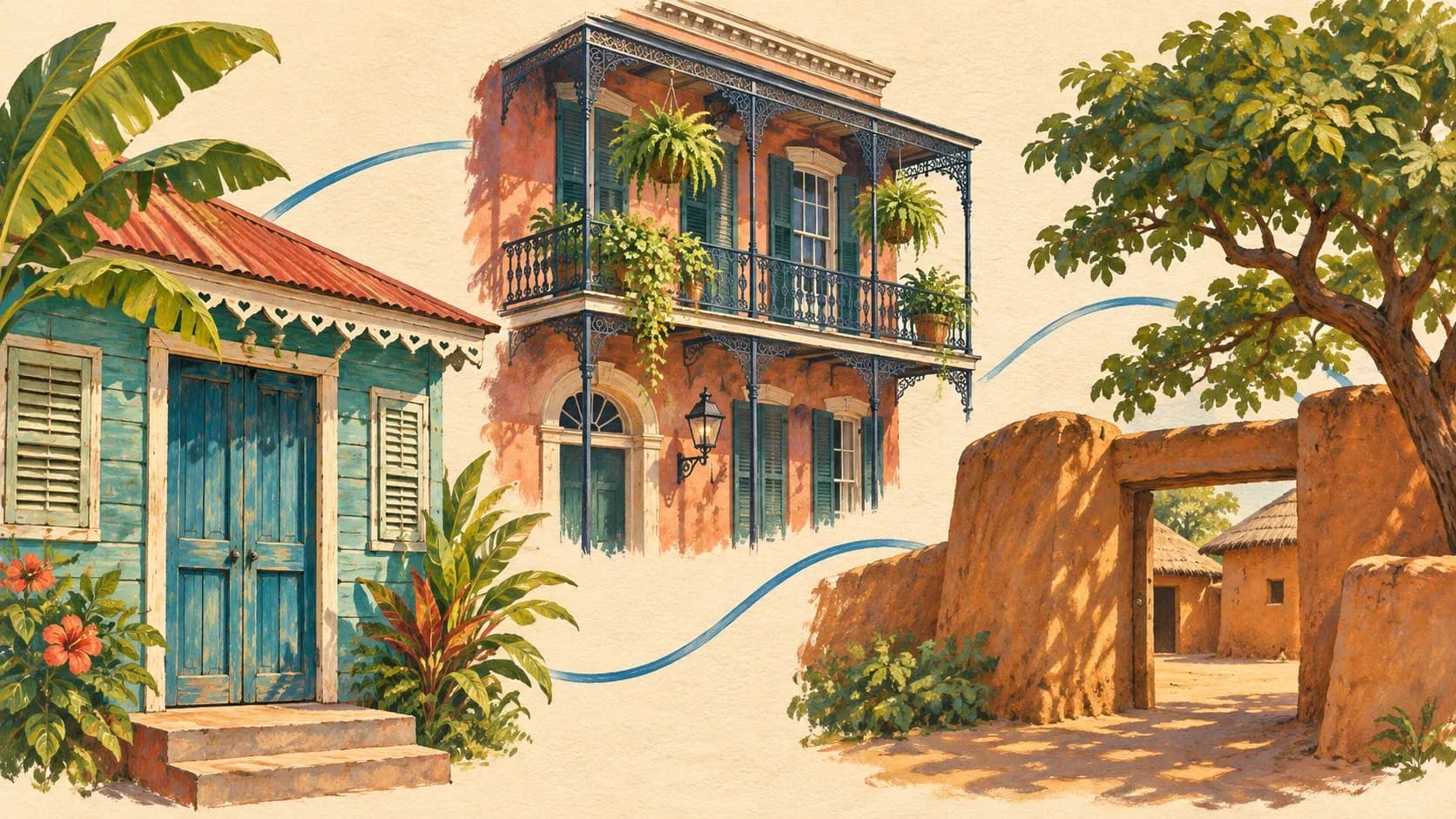
Vodou, Voodoo, and Vodun are related names that often point readers toward different places and religious histories. Haitian Vodou developed in Haiti; Louisiana Voodoo has its own history in the Mississippi River region; Vodun commonly refers to traditions in coastal West Africa. Scholarship follows their connections across the Atlantic while attending to local differences. The edited collection Spirit Service is one example of that approach.
The spellings are useful guides, but they are not an infallible naming code. Always check which community a writer means.
In brief: Haitian Vodou, Louisiana Voodoo, and West African Vodun have connected histories without being interchangeable traditions. Enslavement, migration, religious adaptation, and local communities shaped their development. Begin with place and the people speaking; then ask what a particular source can tell you about their religious life.
Use the comparison overview, read about Haitian Vodou, or try the three-source reading exercise.
Vodun, Vodún, or Vodu
Haitian Vodou
Louisiana Voodoo, also written Voudou
These working distinctions draw on the regional scope of Spirit Service, Harvard's introduction to Haitian Vodou, and the Louisiana State Museum's account. They help organize a first reading rather than assign every practitioner a compulsory label.
Notice the historian Carolyn Morrow Long's spelling, “Voudou,” in her Louisiana-focused essay. A different spelling need not mean a different religion, while a shared spelling need not mean identical practices. Read the author's definition before comparing a page with something found elsewhere.
Vodun belongs to living West African religious worlds, not simply the distant background to Caribbean religions. Spirit Service includes work on contemporary Togo and Benin alongside Haitian settings. Its contents examine different communities, histories, and forms of spirit service rather than treating an entire region as a single shrine.
For a concrete historical example, the Metropolitan Museum's account of Dahomey discusses royal life in relation to vodun and the adoption of Fa divination through exchange with Yoruba Oyo. The example shows contact and change within West Africa itself. It challenges the assumption that cultural mixture began only after people crossed the Atlantic.
Place also changes the question being asked of a source. Dana Rush's chapter abstract on Tchamba Vodun in Benin and Togo identifies remembrance of domestic enslavement as its subject. That focus should not be mistaken for a description of every Vodun community or reduced to a vague claim about “African beliefs.” A regional name opens a field of study; it does not finish the explanation.
Harvard's Pluralism Project describes Haitian Vodou through African traditions associated with Fon, Yoruba, and Kongo peoples and their encounters with French Catholicism. It also identifies service to the lwa as a central way of describing the tradition. The lwa are spirits encountered through religious relationships and ceremonial life.
The Fowler Museum's educational resource, especially its appendix on the lwa, explains them as intermediaries between human beings and Bondye, the high God. This is a more useful starting point than the idea of anonymous supernatural forces summoned for entertainment. The resource describes spirits with distinct identities and relationships to devotees.
Religious art offers another way to study that specificity. The Fowler's exhibition of Haitian ritual flags explains that drapo salute particular lwa. Their materials and designs have histories; they are not generic decorations illustrating an undifferentiated “voodoo aesthetic.” A careful encounter begins with the maker, the spirit named, the object's use, and what the source actually documents.
This does not require readers to adopt the religious claims. It requires describing those claims accurately before interpreting them.
Louisiana Voodoo developed through the religious lives of people in Louisiana, with New Orleans an important setting. The Louisiana State Museum emphasizes both its local history and the difficulty of reconstructing origins among people whose lives were poorly documented by those in power. Its account also discusses ongoing exchange with Haitian Vodou.
Marie Laveau is a useful example of why a local biography matters. The museum presents her as a religious and community leader whose life included Catholic devotion and African spirituality. Learning about her requires attention to a particular person and city, rather than treating her name as a substitute for all Haitian or West African religious practice.
There is also a difference between a visitor's first impression and the range of religious life in a city. Long's essay for 64 Parishes distinguishes tourist representations from congregational religion. An account of a souvenir shop, a film, a historical newspaper, and a contemporary religious community may all mention “Voodoo,” but they are different kinds of evidence.
The Atlantic connections are real. Long describes religious life among enslaved Africans in colonial Louisiana and the arrival of people from Saint-Domingue, including the large movement through Cuba to New Orleans in 1809. Her account places Haitian influences within a Louisiana history already underway. It does not reduce local development to one unchanging tradition arriving fully formed. Read Long's historical account.
Catholic imagery also requires more than one explanation. In its updated essay on service to the spirits, the Pluralism Project discusses the pressures of imposed Catholic affiliation and the creative expansion of Vodou's religious vocabulary. Explaining every saint image as mere disguise would leave out that second possibility.
“Syncretism” is a scholarly term for religious combination or interaction. Used carefully, it can direct attention to a particular history. Used carelessly, it can make African diasporic religions sound like impure versions of somebody else's faith. When you encounter the term, ask what is being connected, under which conditions, and whose understanding the author presents.
That question is more illuminating than searching for a single moment when a supposedly unmixed original became a mixture.
In his Smithsonian Folklife Festival essay on Vodou, Haitian scholar Gerdes Fleurant identifies a history of colonial misrepresentation continued through films and sensational media. His account directs attention toward religion, cultural expression, and social life instead of treating “witchcraft” as a sufficient description.
Recognizing that distortion does not mean replacing it with a picture in which every religious community is identical or free of disagreement. It means refusing to let an entertainment genre supply the definition. Claims about ritual, morality, danger, or benefit still need named sources and a clear setting.
The same care applies to objects. A flag in a museum, an altar photographed with permission, and an object sold to tourists should not automatically be interpreted as interchangeable evidence of the same activity. Start with the documented context rather than the visual resemblance.
Try a small study using three public sources: one about a West African setting, one about Haiti, and one about Louisiana. This is a reading exercise, not a ritual or an invitation to copy sacred practices.
For each source, record:
A comparison can then stay modest and useful. For example, a Haitian flag exhibition and a biography of a Louisiana religious leader both connect art or public representation with religious life. That observation does not establish that their ceremonies or forms of authority are identical. You would need sources addressing those questions directly.
Our religion-comparison guide explains how to choose a fair basis for comparison. The research-matrix template provides space to keep sources and conclusions separate.
Respect also concerns access. The Pluralism Project describes Haitian diasporic religious communities that gather in private settings and maintain relationships of teaching and initiation. Publicly available information is a place to begin learning; it does not make every ceremony public or transfer a community's authority to an outside reader. Ask before visiting, photographing, or reproducing religious material.
Sometimes authors use them for the same tradition. Compare the Louisiana museum's spelling choices with Harvard's Haitian introduction. The labels alone cannot settle the matter. Check the author's stated location, community, and historical period, especially when comparing sources that follow different conventions.
They have historical relationships, but a source about one should not automatically describe the other. Spirit Service studies different African Atlantic settings. Read a West African account on its own terms before treating it solely as the origin story for Haiti.
The Pluralism Project describes relationships between lwa, saint imagery, and Catholic religious life. A simple identity chart leaves out how those relationships developed and are understood. Ask what the particular community says before assuming every name, image, and role maps neatly onto another.
Choose one of the places above and read one clearly identified source about it. Note who speaks and what they describe. Follow one of that source's references or seek a community's public educational work. A precise question about a particular tradition is a stronger beginning than a universal explanation of “Voodoo.”
About the author