Ancient wisdom still speaks because the questions beneath it have not disappeared.
How should we live? What makes a life meaningful? Why do people suffer? What do we owe one another? Is there something beyond the self? Across centuries and cultures, sacred and philosophical texts have approached these questions from profoundly different directions.
This blog exists to study those answers carefully—and to make it easier for readers to return to the texts themselves.
In brief: Plurilore brings 194,000+ passages across fourteen traditions into a comparative sacred-text study workspace. This blog explores recurring human questions, examines individual texts, compares traditions without erasing their differences, and shows how source-aware technology can support serious study.
The settings have changed. The questions have not.
We live with technologies, institutions, and pressures that ancient writers could not have imagined. Yet uncertainty, grief, ambition, love, duty, conflict, mortality, and the search for meaning remain familiar.
Sacred and philosophical traditions preserve generations of reflection on these experiences. They do not offer one uniform answer. Christianity, Islam, Hindu traditions, Buddhism, Shinto, and other schools of thought can begin with different assumptions and lead readers toward different conclusions.
That disagreement is not an obstacle to study. It is part of what makes study worthwhile.
Reading across traditions can reveal recurring concerns while also clarifying the distinctions that matter. A shared word such as surrender, liberation, justice, or self may carry very different meanings depending on the text using it. Genuine comparison asks where ideas meet, where they diverge, and why.
A question rarely arrives with the exact words needed to find its answer.
Someone studying grief may not know which passage, chapter, translation, or technical term to search. A reader comparing two traditions may need several books open at once. Even after finding a relevant passage, its historical, literary, and theological context may remain unclear.
Conventional keyword search is useful when you already know what you are looking for. It is less helpful when you begin with a theme, an experience, or an incomplete question.
This creates a practical gap between curiosity and serious study:
Technology can help navigate that gap, but it should not become the final authority.
AI is most useful here as a guide into a library—not as a replacement for the library.
A generic answer may sound convincing while leaving the reader unable to determine where its claims came from. Sacred texts require a more careful approach. The system should retrieve relevant source material, distinguish textual evidence from synthesis, and help the reader continue investigating.
That is the principle behind Plurilore.
Plurilore is a sacred-text search and study platform built for natural-language questions. Its current corpus contains more than 194,000 passages across fourteen traditions, with study agents for Christianity, Islam, Hinduism, Buddhism, Shinto, Confucianism, Taoism, Bahai, Jainism, Judaism, Sikhism, Spiritism, Voodoo, and Yoruba. Readers can study one source library, compare selected traditions, or explore relationships in the Atlas knowledge map.
Answers are designed to point back to retrieved material. They are citation-aware, not infallible. Interpretations can differ, translations can shape meaning, and AI can still make mistakes. Important passages should always be checked against the source and its wider context.
The goal is not to let AI decide what a text means. The goal is to help readers find where deeper study should begin.
This blog will follow four main paths.
How do different traditions approach suffering, forgiveness, prayer, justice, death, love, or the nature of the self?
These articles will look for meaningful connections without pretending that every tradition teaches the same thing. Similar language will be examined alongside differences in doctrine, practice, purpose, and context.
Some questions require slowing down.
Deep-dive articles will focus on individual books, chapters, passages, and ideas. The purpose will be to understand what a text actually argues before applying it, comparing it, or reducing it to a quotation.
Ancient texts were not written merely to be catalogued. Many were meant to shape attention, character, conduct, community, or practice.
These articles will consider how older teachings can illuminate modern experiences while respecting the distance between their original setting and ours. They will not present the platform as a source of personal religious rulings, therapy, or spiritual authority.
Religious and philosophical study has a vocabulary of its own: karma, dharma, salvation, enlightenment, revelation, non-self, providence, and many other terms.
Entry-point articles will explain these subjects clearly, identify where definitions vary, and provide paths for further reading.
Plurilore was built around a simple workflow: begin with a question, locate relevant sources, compare carefully, and preserve what matters.
Readers can:
Chat sessions are intentionally ephemeral rather than permanent archives. Recent turns support follow-up questions while the page remains open, but the conversation is not retained as server-side chat history after the reader leaves.
Personal notes remain on the current device. Readers can search and organize them with categories, tags, and favorites, then import or export them for backup. This keeps active chat temporary while giving readers deliberate control over what becomes durable.
Comparison should deepen distinctions, not erase them.
It is tempting to conclude that every tradition is simply saying the same thing in different language. Sometimes texts do reveal striking parallels. At other times, familiar words conceal fundamentally different accounts of reality, human nature, divine action, or liberation.
A responsible comparison should therefore ask:
This method leaves room for connection without forcing agreement.
This blog will aim to be calm, respectful, and text-grounded.
We will not rank traditions, impersonate religious authorities, or use sacred material as a novelty. We will acknowledge interpretive disagreement and distinguish source material from editorial synthesis. When certainty is not warranted, the writing should say so.
Plurilore is a study aid. It is not a clergy member, teacher, therapist, or substitute for a living community. Its purpose is to make serious exploration more accessible while encouraging readers to verify passages and continue reading beyond the generated answer.
Ancient wisdom still matters because sacred and philosophical texts examine enduring human questions about suffering, meaning, duty, love, mortality, and the self. Their historical settings differ from ours, but the experiences they investigate remain recognizable. Their answers can inform modern reflection without being treated as interchangeable or automatically applicable.
No. Traditions can share themes while differing sharply in their assumptions, vocabulary, practices, and conclusions. Responsible comparative study identifies genuine parallels without flattening doctrinal or philosophical differences. Similarity should be investigated, not assumed.
AI can help retrieve passages, explain terminology, and organize comparisons, but it is not infallible or spiritually authoritative. Its answers should be treated as starting points for study. Readers should verify important claims against the cited text, its translation, its wider context, and qualified scholarship.
Plurilore currently provides study agents for the Bible, Quran, Hinduism, Buddhism, and Shinto. The platform begins with these source families and may expand over time. It does not claim to contain every work or represent every tradition comprehensively.
The Atlas is Plurilore's interactive knowledge map of the corpus. It lets readers move among traditions, works, documents, topics, and their relationships, then inspect the source evidence behind a connection. It is a separate exploration surface from chat retrieval, not a claim that different traditions teach the same thing.
No. Plurilore supports academic and textual exploration. It does not provide religious rulings, pastoral counseling, therapy, or individualized spiritual direction. Readers seeking those forms of support should consult appropriate teachers, communities, clergy, or qualified professionals.
Ancient wisdom does not remain alive because it is old. It remains alive when someone returns to it with an honest question.
That is what this blog—and Plurilore—is for: not delivering a final verdict, but helping readers find relevant texts, examine their differences, and continue studying with greater clarity.
Visit pluriulore.com and begin with the question that brought you here.
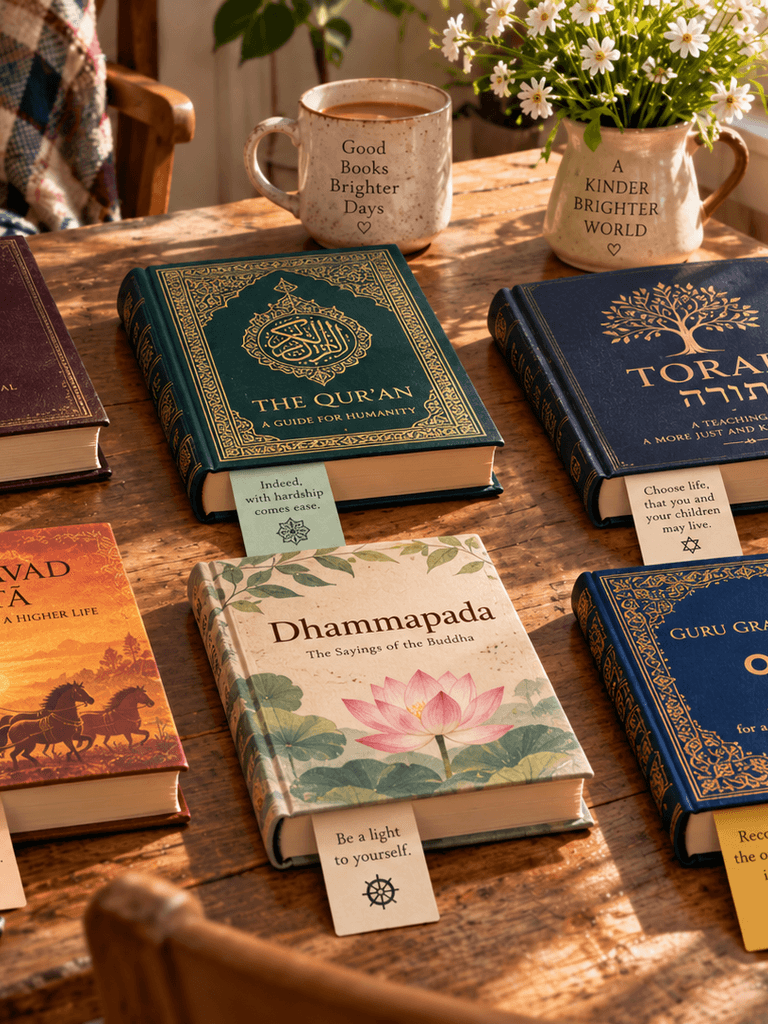
Explore religious teachings on death and the afterlife through named sources on resurrection, rebirth, and liberation, with differences kept in view.