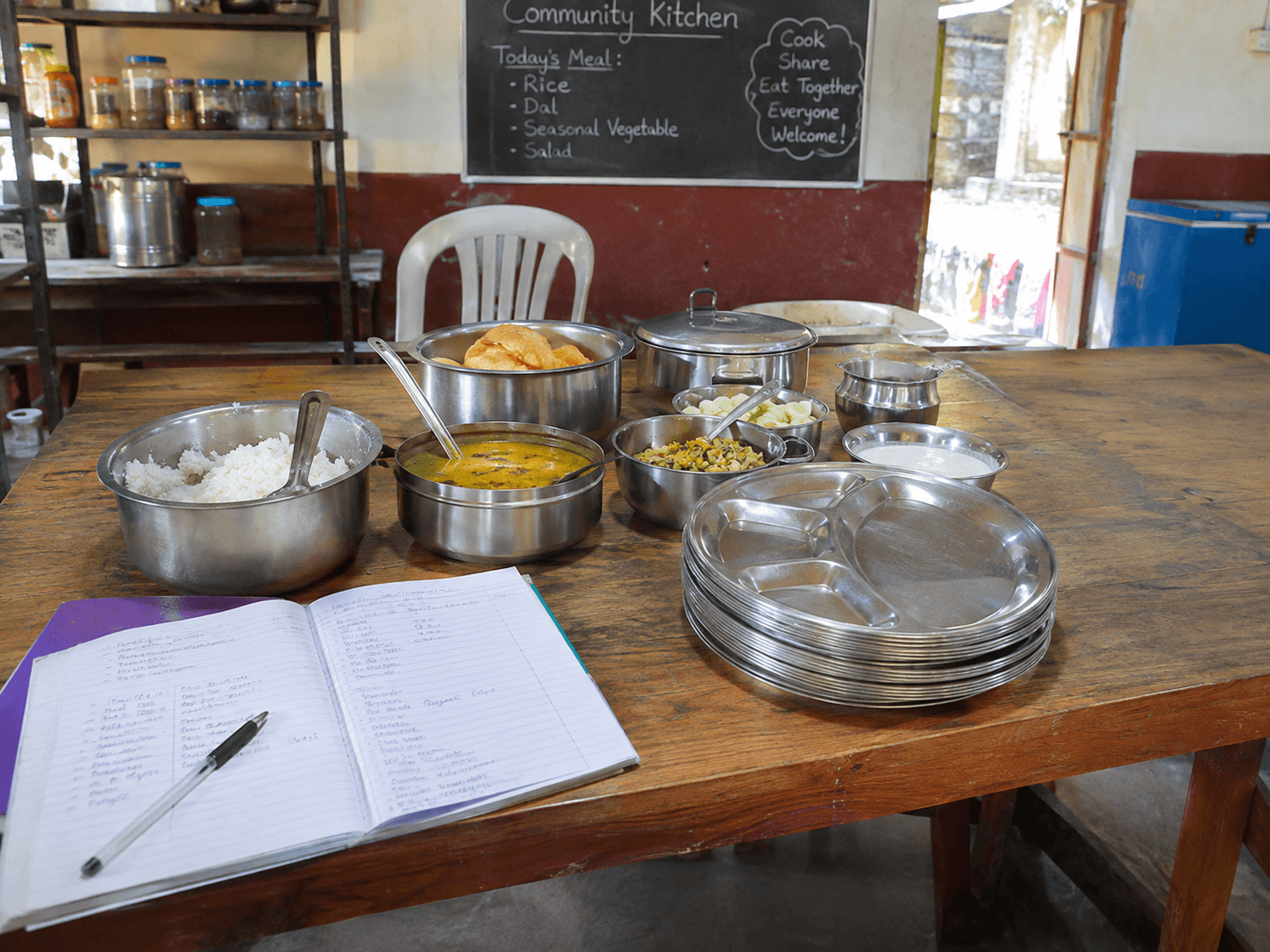
In Sikhism, seva means service, commonly explained as selfless service: serving without making personal reward or recognition the purpose. Its meaning involves devotion to the Guru, humility, and responsibility toward others. Preparing food is one expression; the relationship between the people cooking, serving, and eating also matters.
This guide is for readers who want to move from a short definition to a source-grounded understanding. It follows three passages from the Guru Granth Sahib, then considers langar and a modest way to approach participation.
In brief: Seva joins service with a Sikh religious orientation toward the Guru and the Divine. Scriptural passages connect it with life in the world, freedom from reward-seeking, and sharing one's earnings. Langar gives service a communal form through preparing and sharing food as equals. Humility and equal dignity belong in the account alongside the useful work itself.
Start with the three passages, explore sangat, pangat, and langar, or use the participation exercise.
The Sikh Missionary Society's account of seva emphasizes voluntary service, the welfare of others, and the danger of turning service into self-importance. It also describes service through the body, mind, and material resources. These categories make room for different capacities: physical work is one contribution among several.
Haumai, often explained through ego or self-centeredness, helps identify the difficulty. A useful act can become an occasion to place oneself above another person. The religious question includes the orientation of the person serving, as well as what gets done.
Translating seva as “charity” therefore leaves questions unanswered. Who has the power to define another person's needs? Does giving reinforce the giver's superior position? What connects the activity with the Guru's teaching? Sikh explanations place such relationships within the meaning of service.
“Selfless” can also be misunderstood. In the reading developed here, attention moves away from making oneself the center. That does not entitle an organizer to demand unlimited labor or disregard someone's dignity. The practical boundaries below are our editorial guidance for respectful participation, rather than a translation of a scriptural rule.
The Guru Granth Sahib is Sikh scripture and is revered by Sikhs as the Guru. Its hymns and compositions need to be read in context. An ang is its standard reference unit, commonly rendered as page; PDF page numbers may differ.
For the English readings below, we use Sant Singh Khalsa's translation, alongside the Gurmukhi displayed by SriGranth. The English explanations are paraphrases. Keep the translator's name with your notes; an English rendering is an interpretation of the text.
Guru Nanak's hymn in Siree Raag, beginning on ang 25, includes this line on ang 26: ਵਿਚਿ ਦੁਨੀਆ ਸੇਵ ਕਮਾਈਐ — commonly transliterated vich dunia sev kamaiai. Khalsa renders its instruction as doing seva in the world; the following line connects this with a place in the Divine court.
The preceding imagery matters. The hymn speaks of a lamp, understanding truth, and the Guru's bani, or utterance. Its account of service belongs within that devotional setting. Removing those elements would make the line easier to fit into a general volunteering slogan, while losing part of what it says.
Our reading question is straightforward: how does an ordinary activity become an expression of what a person is learning from the Guru? The hymn invites attention to life in the world without making that life religiously self-sufficient.
In Guru Arjan's Sukhmani, ang 286 includes ਸੇਵਾ ਕਰਤ ਹੋਇ ਨਿਹਕਾਮੀ — seva karat hoi nihkami. Khalsa connects service without reward-seeking with attaining the Divine. The surrounding passage describes a servant oriented toward the Guru, remembering the Divine Name and relinquishing self-display.
This setting makes the translation “selfless service” more intelligible. The emphasis concerns desire and devotion, with a religious end in view. It does not describe a bargain in which a person accumulates volunteer hours to purchase spiritual success.
For reflection, distinguish a welcome consequence from the purpose of an act. Someone may enjoy companionship while helping in a kitchen. That differs from helping chiefly to win admiration. The distinction is our example of a question prompted by the passage; the text does not supply a psychological test for judging someone else's motives.
A salok of Guru Nanak on ang 1245 includes ਘਾਲਿ ਖਾਇ ਕਿਛੁ ਹਥਹੁ ਦੇਇ — ghal khai kichh hathhu dei. In Khalsa's rendering, a person works for their livelihood and gives some of what they have; the next line recognizes such a person as knowing the path.
The earlier lines criticize religious pretension and a teacher who seeks support through the status of being a guru. The ending turns attention toward work and sharing. Read together, the lines challenge an account of religious authority that is detached from how one lives.
This passage supports a connection between livelihood and generosity. It does not specify a donation percentage here. Nor should its polemical setting be turned into a judgment that people unable to earn a wage lack dignity. Decisions about disability, poverty, and support require more than extracting this closing couplet.
Use our guide to comparing sacred-text translations to record where a second edition changes the emphasis. Keep the passage, translation choice, and your application in separate notes.
Three related terms help locate seva in shared Sikh life:
|
Term |
Meaning in this setting |
|---|---|
|
Sangat |
The congregation or company gathering for religious life. |
|
Pangat |
People seated together in a row to share food without distinctions of rank. |
|
Langar |
The communal kitchen and meal, sustained through contributions and service. |
The Punjabi University's Encyclopaedia of Sikhism explains pangat as sharing food from a common kitchen across distinctions including caste and social status. The Sikh Coalition's explanation of langar connects communal cooking, serving, eating, and sharing with equality. It specifies sitting on the ground for people who are able to do so.
That qualification matters for an accessible account. Equal dignity cannot sensibly depend on everyone having the same physical capacity. Ask the local community about appropriate seating and other access needs.
The SGPC's Sikh Rehat Maryada, article XXI, page 49, connects langar with training in voluntary service and overcoming high/low and untouchability distinctions. This is an institutional code of conduct, a different kind of source from a scriptural hymn.
In an academic article, Kanwarjeet Singh, Jane Southcott, and Damien Lyons describe the relationship between congregation, service, and voluntary offerings. They then draw an analogy with doctoral supervision; keep that educational application distinct from the Sikh institution it draws upon.
The Sikh Human Rights Group highlights a further point: food is received as the Guru's provision, rather than as a favor that places a particular donor above the diner. This expresses an ideal for the relationship. A person receiving food should not have to perform gratitude to an individual benefactor to be treated with respect.
An account of seva becomes incomplete when it praises helpful individuals but leaves hierarchy unexamined. Who is welcomed? Who is heard? Who repeatedly receives the least visible work?
Sociologist Surinder S. Jodhka's study of Sikh religion and caste, especially sections 1–2, distinguishes the Gurus' opposition to caste hierarchy from caste's continuing presence among Sikhs. He examines material and social relationships as well as religious principles. Langar's egalitarian purpose is therefore not evidence that discrimination has disappeared from every community.
Holding that distinction makes room for both respect and accountability. A tradition's teaching can provide grounds for questioning a practice that falls short of it. Describing an ideal accurately does not require claiming that every institution already fulfills it.
The Sikh Human Rights Group also describes service through environmental work, practical administration, and community activity beyond a gurdwara. Seva can enter questions of collective welfare through forms less immediately visible than handing someone a meal. This does not make every political activity seva, or settle disagreements about the best response to injustice.
A useful modern question follows: does the service leave the people involved with more room to speak and participate? Humility should make a volunteer receptive to correction. It should also make organizers receptive when someone names an unfair burden or asks for a different arrangement.
This is an optional editorial exercise for a low-stakes activity. It is not a prescribed Sikh discipline, a test of sincerity, or a substitute for learning from a Sikh community.
Begin by reading one of the three passages above. Write its ang, attributed Guru, translator, and one sentence about its immediate setting. Then choose a small contribution you can realistically offer.
If you hope to help at a gurdwara, contact an organizer first. Ask what is needed, whether visitors can help with that task, and what local guidance you should follow. Follow the community's instructions about respectful dress, head covering, shoes, and kitchen hygiene. Ask about access arrangements rather than assuming you must copy another person's posture or work.
Use this brief participation record:
For example, an organizer might ask for help stacking clean plates. You could agree to a short period, learn the method, and ask where to put anything you are unsure about. The modest scale is useful: it leaves space to listen instead of arriving with a project that nobody requested.
Keep participant boundaries explicit. Receiving langar is not payment for volunteering. Ask before taking photographs, and accept a refusal. Decline work beyond your training or physical capacity; you may stop or ask for another role. Nobody needs to accept humiliation, coercion, or unsafe conditions to prove that their service is sincere.
Afterward, return to your passage note. Record what you observed separately from what you infer about Sikh teaching. One visit cannot represent every gurdwara, and helping once does not make a visitor an authority on seva.
Seva and sewa are common English spellings of the same term. Differences of spelling alone do not identify distinct practices. To understand a particular use, ask about its source and setting: service in a hymn, work within a congregation, and a contemporary organization's activity may require different kinds of explanation.
No. Sikh institutional accounts describe contributions through physical work, mental or devotional activity, and material resources. Langar makes seva especially visible, but the Sikh Human Rights Group also describes administration and environmental work. The activity's purpose and relationships matter alongside what is donated or how much work is completed.
Langar is open across religious backgrounds; the Sikh Coalition describes it as a practice of equality and communal responsibility. Visitors can ask a local organizer about helping and follow the community's guidance. Being welcome at the meal does not create an obligation to volunteer, donate, or make a religious commitment.
An activity such as feeding people can invite comparison, but the religious explanation needs its own sources. This article reads seva through the Guru, devotion, livelihood, and communal equality. Similar actions or a shared word do not establish that different traditions understand service, authority, or spiritual ends in the same way.
Seva becomes clearer when service, devotion, and equal dignity are considered together. Choose one passage, record its setting, and bring a specific question to someone qualified to explain Sikh teaching. Our method for comparing religions can help preserve that context if you later widen the study.
For Plurilore study, check the Sikhism source overview. The current catalog lists Sant Singh Khalsa's English Guru Granth Sahib translation. That is one translation of one canonical work, with a different scope from historical literature, Sikh codes of conduct, community guidance, or Gurmukhi scholarship. Use source-linked study to develop better questions, then continue reading and listening.
Nick works in IT and holds a master's degree in the field. His interests sit where philosophy, spirituality and technology meet. He started Plurilore as a side project shaped by those interests.