The best AI tool for comparative religion depends on how you want to study.
Plurilore is built for questions that lead into sources and continued study. Faith Explorer focuses on mobile and offline reading. Religions.app offers a long list of language and text tools. Abraame concentrates on the Quran, Bible, and Torah. DoctrineLab uses an openly Christian set of criteria for doctrinal comparison.
In brief: Do not choose a tool because it gives the smoothest answer or advertises the largest library. Check whether its citations open, whether translations are named, whether it keeps real differences visible, and whether its price, privacy, and study tools fit what you need.
|
What you need |
Tool to consider first |
Why |
|---|---|---|
|
Questions that lead into deeper study |
Plurilore |
Connects answers with sources, selected-tradition comparison, the Library, Atlas, courses, and notes |
|
Mobile and offline scripture reading |
Faith Explorer |
iOS app with offline access, saved passages, folders, tags, and AI dialogue guides |
|
Original-language and specialist text tools |
Religions.app |
Lists interlinear, translation, etymology, parallel-passage, timeline, map, and other study tools |
|
Quran, Bible, and Torah comparison |
Abraame |
Focuses on three Abrahamic source traditions and names its main source providers |
|
Christian doctrinal comparison |
DoctrineLab |
Organizes texts and scholarship through an explicit Christ-centered approach |
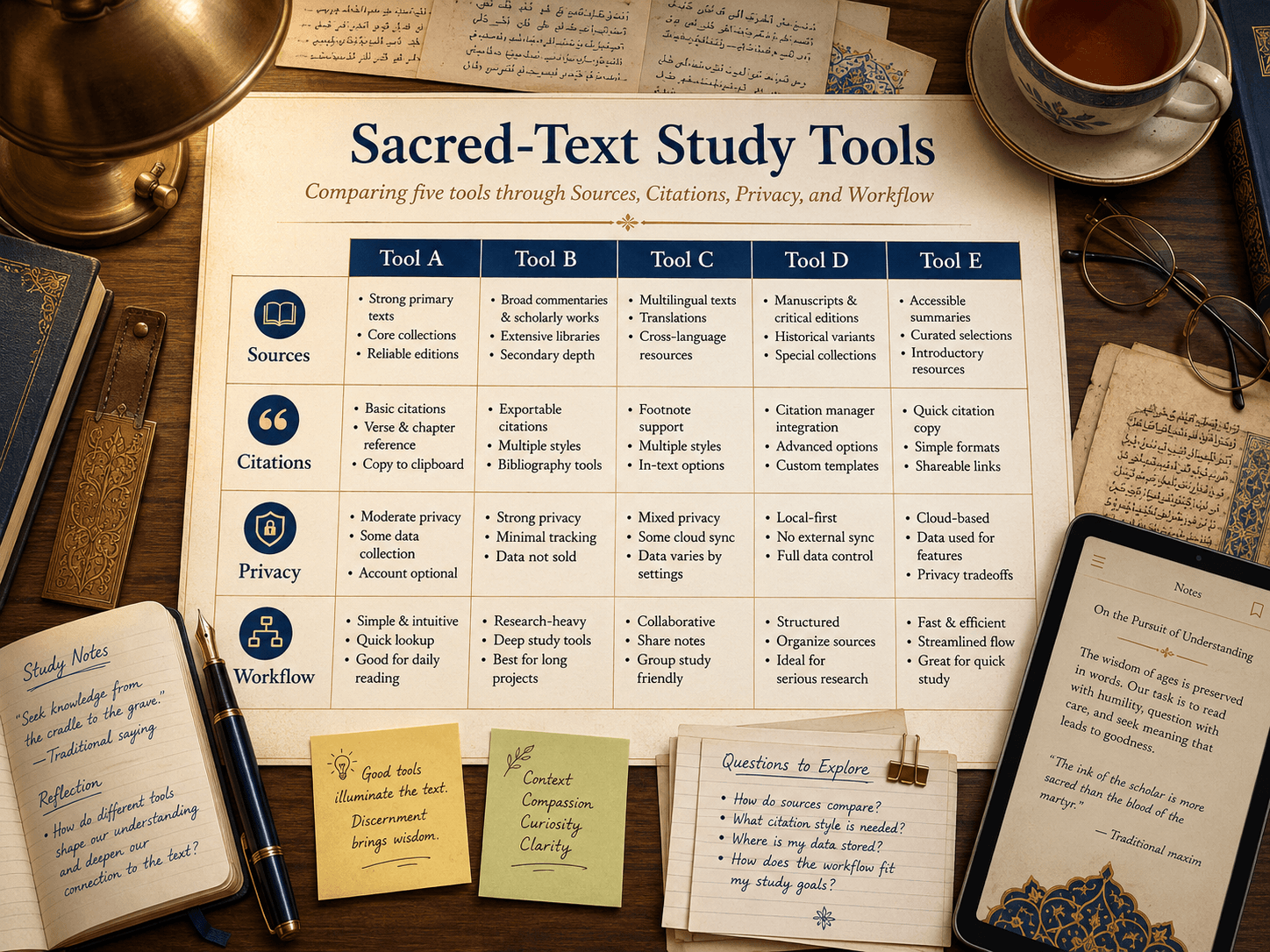
These are starting points based on the products' current pages. They are not accuracy awards. The same hands-on questions and citation checks should be used for every product before the list is published as a final recommendation.
A tool had to meet four basic conditions:
The guide looks at the things a reader is likely to notice after the first impressive AI answer:
The approach follows our guide to comparing religions without flattening their differences: understand each tool on its own terms, then ask the same fair questions of all of them.
Fluent writing is not enough. An AI can sound certain while linking the wrong passage, missing the surrounding context, or treating two traditions as though they use the same ideas.
Before trusting a tool, try these simple checks:
No tool can settle a religious or theological question by itself. The goal is to find software that helps you study and verify, not software that asks to be trusted as an authority.
|
Product |
Library described by the company |
Best-known strength |
Price shown on August 6, 2026 |
|---|---|---|---|
|
Plurilore |
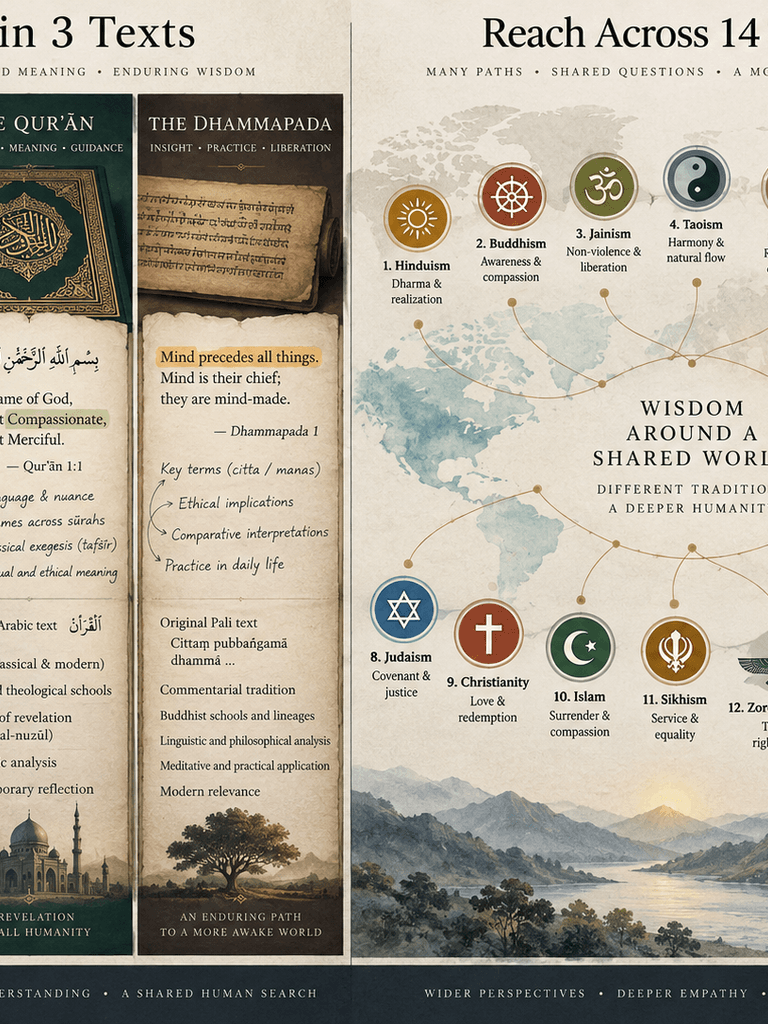
194,000+ passages, 4,500+ reader documents, 14 traditions |
Questions, source links, comparison, Atlas, guided study, and local notes |
Free; configurable Scholar from $10/month |
|
Faith Explorer |
144,122 verses, 17 texts, 9 religions |
iOS and offline library with nine AI dialogue guides |
Free; App Store lists in-app purchases |
|
Religions.app |
82,000+ verses, 24 traditions |
Large collection of language, comparison, and study tools |
Free; 7monthlyor7monthlyor60 annually |
|
Abraame |
Quran, Bible, and Torah |
Three Abrahamic perspectives with named source providers |
Limited daily free use; paid price not shown |
|
DoctrineLab |
Six canons and seven traditions in its current description |
Layered doctrinal study using fixed criteria |
Price not confirmed |
Do not read the largest number as the largest or best library. One product may count verses, another passages, and another chapters, commentaries, or database entries. The exact text and translation you need matter more.
Plurilore is for readers who want a question to become a longer study rather than end with one AI response.
A reader can ask about one tradition or compare selected traditions, see the sources used in an answer, open those sources in the Library, explore connected ideas in the Atlas, and continue with courses or notes.
The main tools include:
Plurilore describes its answers as source-grounded but also says that AI can make mistakes. Readers should open important citations rather than treating the answer as final.
A chat is not kept as a permanent server-side conversation after the reader leaves the page. Notes stay on the current device, while other account information is explained in the privacy policy.
The pricing page lists a free Seeker plan with 10 monthly credits, a configurable Scholar membership from $10 per month for 100 credits, and non-expiring extra credits at $0.20 each. Scholar allowances range from 100 to 10,000 credits per month; annual billing costs ten monthly payments.
Plurilore publishes this guide. That makes fairness especially important. Its citations, answers, limits, and saved-work tools should be tested in exactly the same way as every competitor.
Faith Explorer describes itself as an interfaith scripture library in your pocket. Its website lists 144,122 verses, 17 texts, nine religions, and nine AI dialogue guides.
Faith Explorer is the clearest mobile and offline choice in this group. Its App Store page describes an iPhone and iPad app with offline reading, search, cross-religion comparison, saved passages, notes, folders, tags, and learning paths.
The named AI guides also give it a more personal style than a standard research assistant.
Faith Explorer's privacy policy says no personal account is required, saved material remains on the device, and religious questions are not stored permanently. The free app is supported by advertising and may use device identifiers for ads when the user agrees.
The website says both “iOS & Android” and “Android Coming Soon.” Its text counts are also difficult to compare with other libraries. For example, it describes the Bhagavad Gita as 9,814 verses and the Tao Te Ching as 10 verses without explaining how those numbers were produced.
Those inconsistencies call for clarification and testing. They do not prove that the product itself is inaccurate.
For a closer decision, read Faith Explorer vs Plurilore.
Religions.app says it includes more than 82,000 verses across 24 traditions. It stands out for the number and variety of study tools it lists.
Its feature pages include:
The sources page names several editions and translations. It also distinguishes reproduced scripture from generated commentary and AI answers, which is a useful boundary.
Religions.app currently advertises $7 per month or $60 per year. Its pricing page shows a free tier and a Pro plan with 60 AI questions per month.
The homepage says “30+ research tools,” while the pricing page says “90+ premium study tools.” These numbers may count different things, but the difference is not clearly explained. The pages also describe free access in slightly different ways.
Test which tools are actually available at the account level you plan to use.
Abraame focuses on one clear task: comparing Quran, Bible, and Torah sources around the same question.
A narrower focus can be an advantage. Abraame is for readers who want Jewish, Christian, and Islamic perspectives rather than a larger world-religions library.
Its sources page names Quran.ai for Quran text and tafsir, Bible API and Christian commentary for biblical material, and Sefaria for Jewish sources. The product also advertises English, French, Hebrew, and Arabic interfaces, notes, conversation history, and PDF export.
Abraame says limited daily use is free and broader use requires a subscription, but we did not find a public price in the information checked. Its source links, translations, privacy, three-column answers, and exports still need hands-on testing.
Do not mark it down merely because it covers fewer traditions. For a Quran–Bible–Torah question, that narrower focus may be exactly the point.
DoctrineLab is aimed at structured theological research rather than general interfaith exploration.
Its pages separate primary texts, historical setting, later interpretation, and modern scholarship. It also emphasizes disagreement, historical development, and research exports.
DoctrineLab uses criteria that include “Sufficiency of Christ,” “Normative Revelation,” and “Historical Grounding.” Those are not neutral categories shared by every religion. They come from a Christian theological concern.
That does not make the tool useless. It makes it specialized. DoctrineLab may fit a reader who deliberately wants that Christian framework, but it should not be presented as a viewpoint-free judge of every tradition.
Its working tools, accounts, price, privacy, citation links, and exports still need to be tested.
SacredIndex describes planned search, comparison, translation, and AI features, but it currently invites people to join an early-access list. Until the working product can be tested, it is not a current recommendation.
SacredLib offers public sacred-text and analysis pages. We could not yet confirm enough about its sources, account experience, privacy, or current product direction to rank it. It remains on the list for future testing.
A Bible, Quran, or other single-tradition assistant may be excellent for its intended readers. It simply answers a different need from a broad comparative-religion tool. Include one only when that narrower focus is relevant to the question.
Start with the study you actually want to complete:
The deciding question is not “Which product has the most AI?” It is “Which product helps me check the answer and continue learning?”
There is no single winner for everyone. Plurilore is built for questions and continued study; Faith Explorer for mobile and offline reading; Religions.app for specialist language and text tools; Abraame for Quran, Bible, and Torah comparison; and DoctrineLab for a clearly Christian form of doctrinal study.
A general chatbot can suggest starting points, but a fluent answer can still use the wrong source or hide important differences. Ask for named texts and translations, open important citations, and check more than one interpretation. A specialist tool may make this easier, but it does not remove the need to verify.
Faith Explorer is the clearest offline option based on its website and iOS listing. Check which texts, notes, search tools, and AI features work without a connection. “Offline access” may apply to downloaded reading while generated answers still need the internet.
Religions.app publishes the largest tradition count in this shortlist at 24. Plurilore reports 14, and Faith Explorer reports nine. Those numbers do not show how deeply each tradition is covered. Check the exact texts, editions, and translations you need.
Treat them as links to check, not proof by themselves. Open the citation, make sure the passage exists, identify the translation, read the surrounding text, and ask whether it really supports the AI's claim.
The best AI tool for comparative religion is the one that covers the sources you need, keeps real differences visible, and helps you move beyond the first answer.
Start with the shortlist, then test one real study question. If you want a question-led path into sources, comparison, the Atlas, and notes, you can try Plurilore. If another tool fits your platform, language, or theological purpose better, choose it—and keep checking the sources.
Find Faith Explorer alternatives for web research, source verification, original languages, Abrahamic comparison, privacy, notes, and structured study.