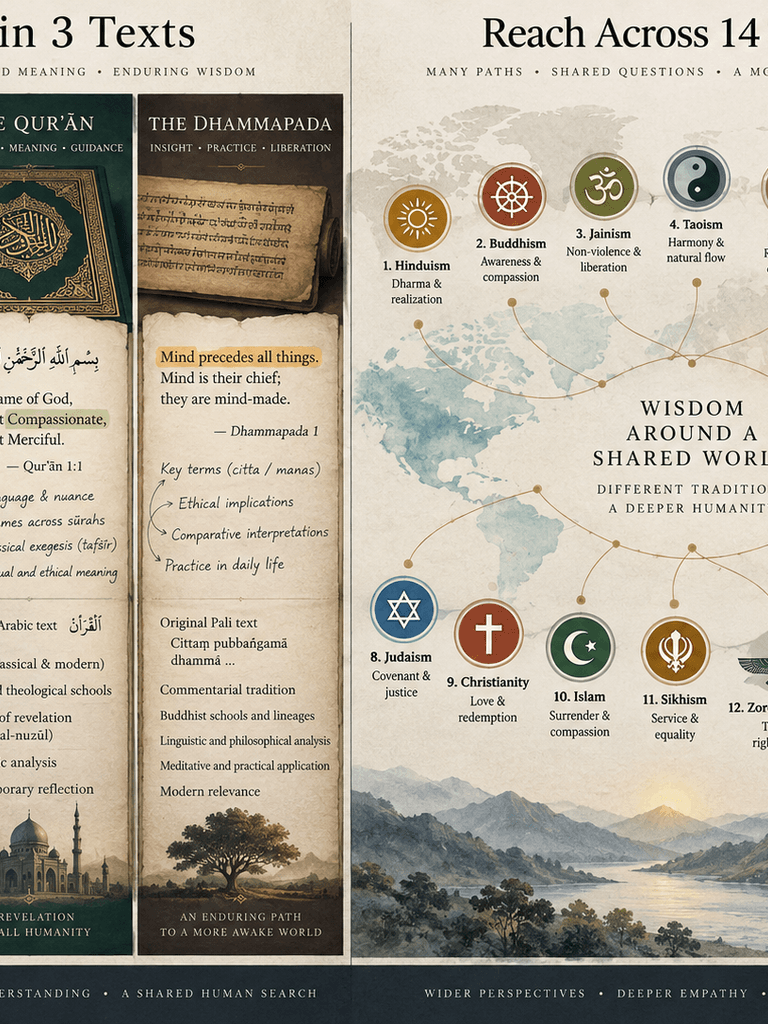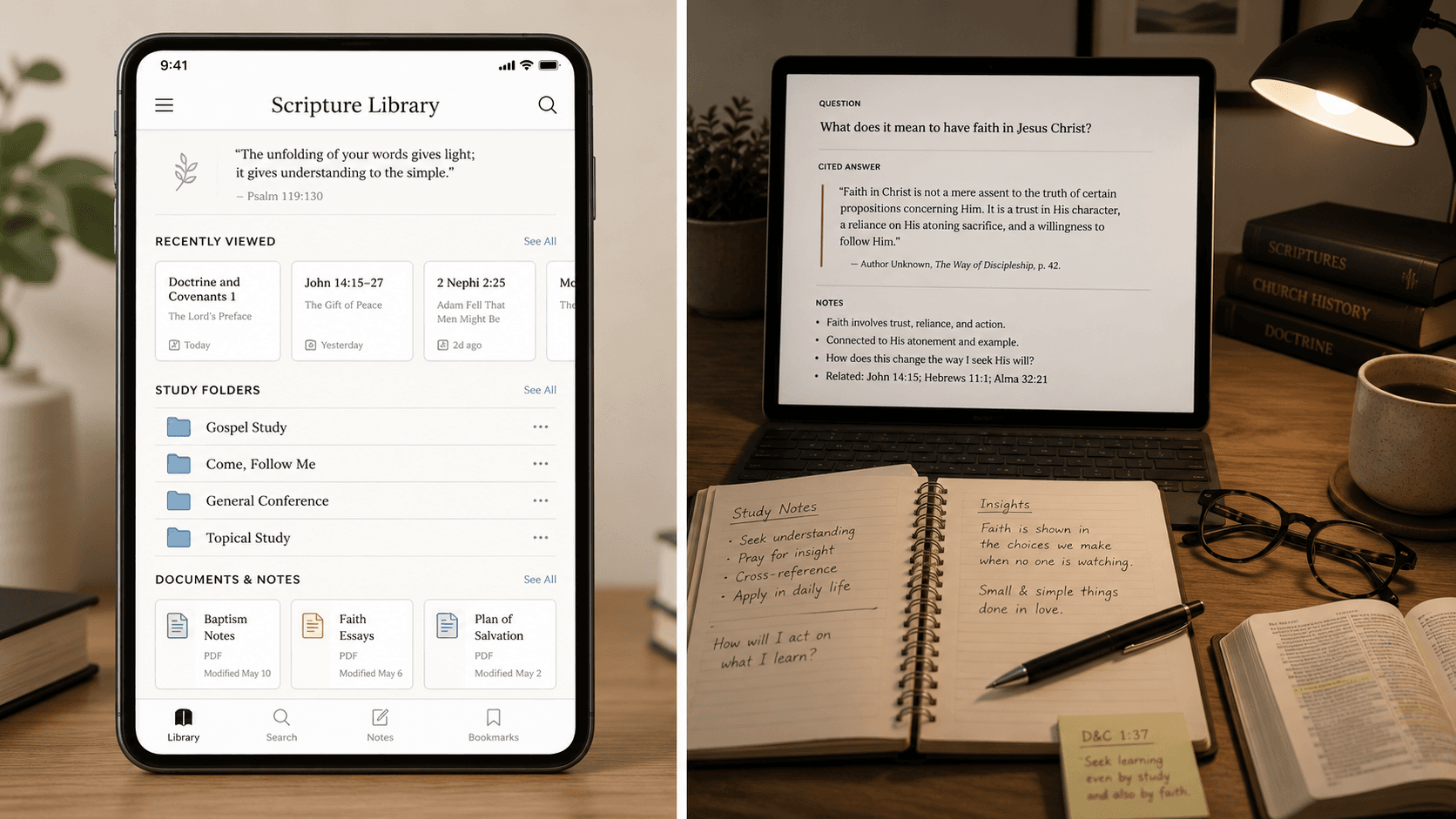
Faith Explorer and Plurilore both help people explore sacred texts, but they suit different ways of studying.
Faith Explorer is mainly a mobile scripture library. It emphasizes offline reading, saved passages, and conversations with AI guides. Plurilore is a web workspace for people who want to begin with a question, follow sources, compare traditions, explore related ideas, and keep notes.
In brief: Choose Faith Explorer if you want an iPhone or iPad scripture library that you can use offline. Choose Plurilore if you want a browser-based space for asking questions, checking sources, comparing traditions, and continuing into deeper study.
Disclosure: Plurilore publishes this comparison. No competitor paid to be included. We checked the products' websites, pricing, App Store, and privacy pages on August 6, 2026. The article will be updated with hands-on findings before the refreshed version is published.
Faith Explorer is the simpler choice for mobile reading. Its website and App Store page focus on an iOS app, offline access, daily readings, search, folders, tags, and nine AI dialogue guides. Its privacy policy says you can use the core app without a personal account and that saved material stays on the device.
Plurilore is the stronger choice when your study begins with a question. You can ask about one tradition or compare several, inspect the sources used in an answer, continue reading in the Library, explore related ideas in the Atlas, follow guided study, and save selected material in local notes.
Neither tool is a religious authority. Both can help you find and organize material, but important claims should still be checked against the text, its translation, its context, and qualified scholarship or teachers.
|
If you care most about… |
Faith Explorer |
Plurilore |
|---|---|---|
|
Where you study |
iPhone and iPad app; Android status is unclear |
Web browser |
|
Offline reading |
A central feature |
Not a central promise |
|
Starting point |
Browse or search a scripture library |
Ask a question and follow the sources |
|
Comparing traditions |
Side-by-side passages and AI dialogue |
Questions across all or selected traditions |
|
Guided study |
Learning paths are listed in the App Store |
Courses, lessons, quizzes, progress, and tutor support |
|
Saving material |
Verses, notes, folders, and tags |
Scratchpad, local notes, categories, tags, import, and export |
|
Knowledge map |
Not presented as a main feature |
Atlas of topics, traditions, and source connections |
|
Account model |
No personal account required for the core app |
Account used for the full workspace |
|
Advertising |
Free app is supported by advertising |
No advertising in the current product model |
|
Price shown publicly |
Free, with in-app purchases listed |
Free; configurable Scholar from $10 per month |
|
Best for |
Portable reading and offline reference |
Question-led research and continued study |
The numbers shown by the two products are not directly comparable. Faith Explorer counts “verses.” Plurilore counts “passages” and “reader documents.” A chapter, verse, commentary, or database entry can be divided differently from one library to another.
Faith Explorer's clearest advantage is portability. Its App Store listing describes an iPhone and iPad app with offline access.
That matters if you study while commuting, travelling, attending a group, or spending time without a reliable connection. The app also keeps reading and organization together: saved verses, notes, folders, tags, daily material, and your place in a text.
For someone who mainly wants to open a sacred text, read, and save a passage, this may feel more immediate than a larger research workspace.
Faith Explorer says it includes 144,122 verses from 17 sacred texts across nine religions, along with nine AI dialogue guides.
Those figures need a little care. They come from Faith Explorer's own pages, and the way some texts are counted is unclear. Still, they give a useful picture of the kind of library the app is trying to offer.
Faith Explorer presents named AI guides from different traditions. Some readers may enjoy that more personal, conversational style.
Plurilore takes a different approach. Its assistant is meant to help readers find and examine sources rather than speak as a simulated religious representative.
Plurilore is not simply another place to browse texts. A reader can:
That approach works well for questions such as:
Our guides to suffering across major traditions and Christian, Buddhist, and Stoic views of suffering show why a good comparison needs more than a collection of similar quotations.
The Atlas connects traditions, texts, topics, and supporting passages. It can be useful when you know the theme you want to explore but not the exact search term.
Faith Explorer does not currently present a similar knowledge map as one of its main features.
Plurilore describes its answers as source-grounded while also warning that AI can make mistakes. The assistant is a study aid, not a priest, pastor, imam, rabbi, guru, monk, therapist, or final interpreter.
That boundary does not make every answer correct. It makes the intended role of the tool clearer.
Faith Explorer and Plurilore describe the size of their libraries differently, so the larger number does not automatically mean the better library.
Faith Explorer lists 144,122 verses and gives counts for individual collections. Some are hard to interpret. Its website currently describes the Bhagavad Gita as 9,814 verses and the Tao Te Ching as 10 verses without explaining how those units were created. Its App Store description also mentions Babylonian Talmud material that is not clearly matched to the list on its website.
Plurilore reports 194,769 passages in 4,541 reader documents across 14 traditions. That does not mean every sacred text, translation, school, or community is included.
For either product, ask a more useful set of questions:
A smaller library with the right edition can be more useful than a larger one with unclear coverage.
A citation is helpful only if it leads to the right source.
When testing either product, open five citations from several answers. Check:
Also notice what kind of source you are reading. A sacred text, later commentary, modern scholar, and AI explanation do not carry the same kind of authority.
Plurilore is designed to connect answers with retrieved material and Library pages. Faith Explorer says its answers use academic-quality sources and citations. Both promises should be tested in the product rather than accepted from a feature page alone.
Faith Explorer's privacy policy says no personal account is required, saved verses and preferences stay on the device, and religious questions are not stored permanently. It also says the free app shows advertising and may use device identifiers for advertising when the user agrees.
Plurilore uses an account for its full workspace. A chat is not kept as a permanent server-side conversation after you leave the page. Notes are saved on the current device, where they can be organized and exported. Other account information is explained in Plurilore's privacy policy.
In practical terms:
Local storage gives you control, but it can also be lost if you clear browser or app data. Export anything you want to keep before changing devices or deleting an app.
Faith Explorer presents the app as free, while the App Store lists in-app purchases. Its website does not show enough detail for a precise comparison of paid features, so check the current purchase screen inside the app.
Plurilore's pricing page currently lists:
Prices and limits can change. Check the live purchase screen before subscribing to either product.
Choose Faith Explorer if:
Choose Plurilore if:
If one feature will decide the choice—Android access, a particular translation, offline search, exports, privacy, or an AI limit—test that feature before paying.
Faith Explorer's website gives two different answers as of August 6, 2026. One section says “iOS & Android,” while the download section links only to Apple's App Store and says “Android Coming Soon.” iOS is confirmed. Check for an official Google Play listing before relying on Android support.
Faith Explorer is the clearer choice because its website and App Store listing both promote offline access. Plurilore is a web workspace and does not promise offline use as a main feature. Check which Faith Explorer texts and tools work without a connection before depending on it for a course or trip.
Plurilore is better suited to a study that begins with a question and continues through sources, selected-tradition comparison, the Atlas, guided study, and notes. Faith Explorer is better suited to portable scripture reading. In either tool, check important passages and interpretations outside the AI answer.
No. These tools can help find texts, organize material, and suggest questions. They cannot replace language knowledge, historical scholarship, lived religious communities, or qualified teachers. Treat AI answers as a place to begin, not the final word.
Faith Explorer works like a portable interfaith library: browse, save, organize, and read offline.
Plurilore works like a connected study desk: ask, follow sources, compare, explore, save, and continue learning.
Choose the habit you will actually keep. If you want a question-led study space, try Plurilore. If offline mobile reading matters most, check Faith Explorer's current App Store version and text list.
Find Faith Explorer alternatives for web research, source verification, original languages, Abrahamic comparison, privacy, notes, and structured study.