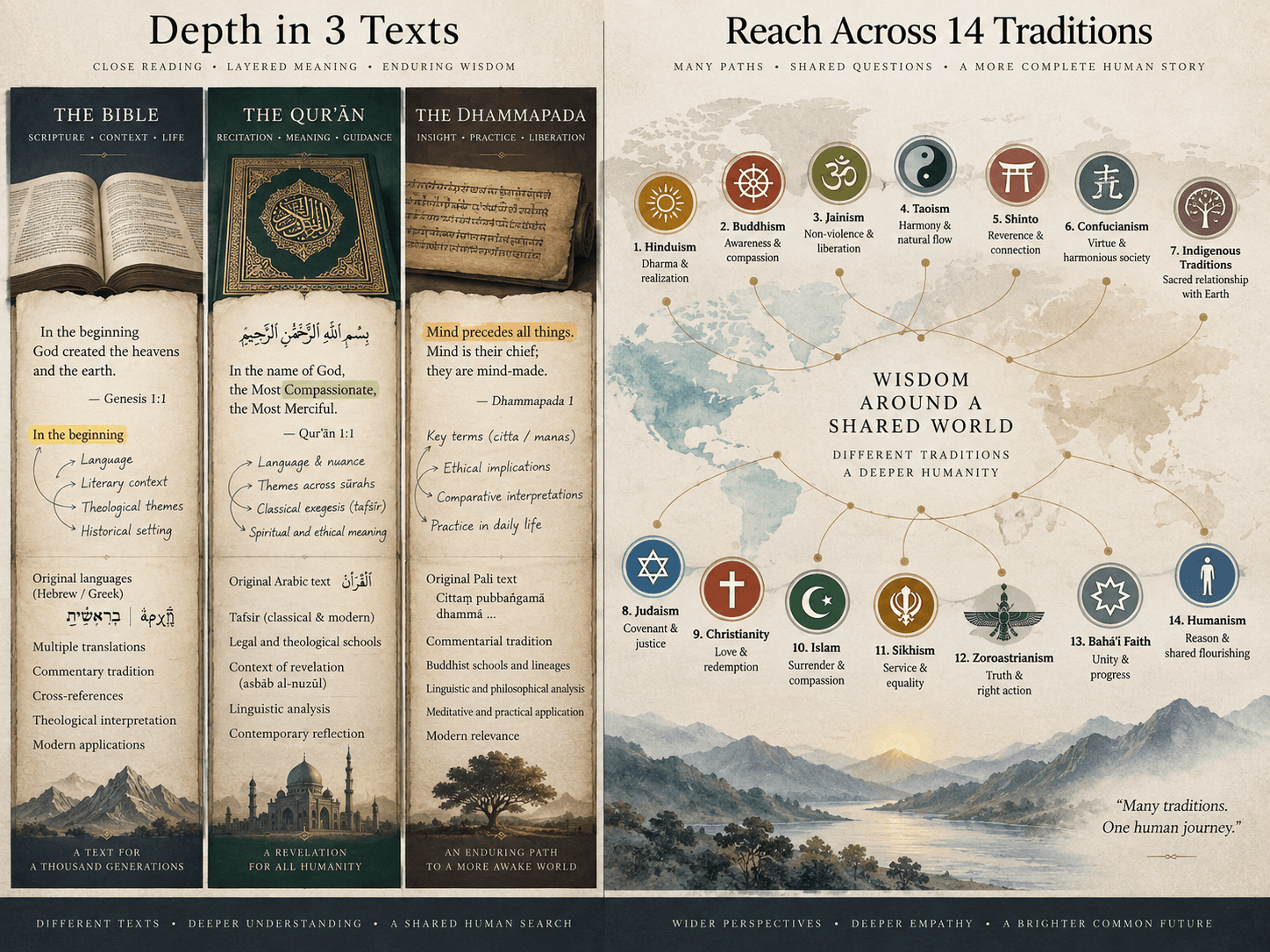
Abraame is a web tool that answers a question by setting the Quran, the Bible, and the Torah beside one another, with named commentary on each side. Plurilore is a web study space that answers questions across fourteen traditions and carries the answer on into sources, comparison, an Atlas of related ideas, Practice, and notes.
The choice between them is not really about which product is better. It is about whether your question stays inside those three scriptures.
In brief: Choose Abraame if your question lives inside the Quran, the Bible, and the Torah and you want named commentary layers on each side. Choose Plurilore if the question crosses beyond those three scriptures, or if you want one answer to lead into sources, comparison, an Atlas, and repeated study. Both companies' public pages were read on September 7, 2026.
Disclosure: Plurilore publishes this comparison. No competitor paid to be included. Abraame's homepage, sources page, pricing page, privacy policy, and terms were read on September 7, 2026, and Plurilore's own pricing was rechecked the same day. Neither product has been through hands-on account testing, a citation audit, or a paid test here, so everything below describes what each company publishes about itself rather than how either tool behaves in use.
Abraame is the better starting point when your question already lives inside the Abrahamic three. Its homepage describes a single job: "Ask a question, receive three perspectives. Quran, Bible & Torah side by side with verified sources." It names its translations and its commentators, and it runs in four interface languages.
Plurilore is the better starting point when the question does not stop there. It covers fourteen traditions, and it is built so that one question leads into the sources behind the answer, a comparison whose participants you choose, an Atlas of connected ideas, and notes you keep.
This is a question of fit, not a ranking. A narrower library can be the better library, and for a Quran, Bible, and Torah question the narrower tool may simply be the right one.
If you have not narrowed the field to two products yet, see where Abraame sits among the other AI sacred-text tools.
The table below sets the two products against what actually differs between them, using each company's own public pages.
|
If you care most about… |
Abraame |
Plurilore |
|---|---|---|
|
Scope |
Quran, Bible, and Torah, with Jewish, Christian, and Islamic commentary |
14 traditions, 217,000+ Library passages |
|
Where the texts come from |
Retrieved from Sefaria, bible-api.com, and a Quran server |
Searched inside a corpus Plurilore has imported and versioned |
|
Commentary layers |
Named tafsir editions, Talmud and midrash through Sefaria, patristic writers, and the Catechism |
Retrieved passages open into the Library; editions are not listed source by source publicly |
|
Interface languages |
French, English, Hebrew, and Arabic |
English |
|
What one credit buys |
About 5,000 tokens of text processed, per its pricing page |
One standard answer; three on the Pro model; one per selected tradition in a cross-reference |
|
Entry paid price |
€4.99 per month |
$10 per month |
|
What is kept after you leave |
Account-linked conversations and notes you can delete, removed after 36 months of inactivity |
Chat is not kept as permanent server-side history; notes stay on the current device |
Every cell describes what a company publishes about itself, not a tested result. The two scope figures also count different units at different scopes, so they are a description of coverage rather than a score against each other.
Begin with your question rather than with the count.
If you want to know how the Quran, the Gospels, and the Torah speak about repentance, or what each of the three says about the same figure, three columns is the right shape for the work. Reaching for a tool that also holds Buddhist or Sikh material buys you nothing you will use.
If the question reaches outside those three, no amount of depth inside them will help. That is the whole decision, and it is worth settling before you look at a price.
Two cautions about the three-column layout itself. The first is that placing three traditions in three columns is a design choice, not a finding. Judaism, Christianity, and Islam are not three versions of one teaching, and a tidy row of columns can make agreement look easier to reach than the sources allow. Comparison holds up better when it starts by naming the exact text, edition, and reading community before comparing them.
The second is that the columns overlap awkwardly. A Torah column and a Bible column contain some of the same books, and Jewish and Christian readings of those shared books are not the same reading. It is worth understanding why “the Bible” is not one column before treating any two of the three as a matched pair.
This is the difference a reader can feel, and neither company's marketing leads with it.
Abraame's sources page describes drawing on three outside services: Sefaria.org for Jewish material, bible-api.com for biblical text, and a Quran server at mcp.quran.ai. Plurilore searches a library it has imported into its own database and versions with each build.
Three practical consequences follow.
Who chooses the edition. Abraame inherits whatever editions those services carry. Its biblical material is listed as the King James Version, Louis Segond, and the Vulgate, which are long-established public-domain editions rather than recent scholarly translations. If your work depends on a modern critical translation, check that first.
Whether the same question returns the same passages next month. An upstream library that grows or reorganises can change what comes back. An imported corpus is fixed until the next build, which is steadier for repeat work and older between builds.
What happens when something outside changes. A tool that reaches out to another service at the moment you ask depends on that service being there and unchanged. A tool that searches its own copy carries the cost of keeping that copy current instead.
Neither pattern is the better one. They fail in different directions, and you should pick the failure you mind less.
This is where a three-text tool can genuinely go further than a fourteen-tradition one, and it is the strongest thing Abraame has to show.
Its sources page names what most tools in this market leave vague. On the Jewish side, through Sefaria: the Masoretic Tanakh, Talmud Bavli, Midrash, Rashi, Ramban, Mishneh Torah, and the Zohar, alongside Mishna, Ibn Ezra, Sforno, Rabbeinu Bahya, Shulchan Arukh, Bereshit Rabba, Tanhuma, and Mekhilta. On the Islamic side: the Hafs 'an 'Asim text, the Abdel Haleem and Hamidullah translations, and tafsir, the tradition of Quranic commentary, from Tabari, Ibn Kathir, Jalalayn, Qurtubi, Sa'di, and Muyassar, with surah, juz, hizb, mushaf page, and asbab al-nuzul, the occasions of revelation. On the Christian side: Origen, Augustine, Jerome, John Chrysostom, Gregory of Nyssa, the Septuagint, and the Catechism of the Catholic Church.
Its homepage adds that deeper analysis covers "Compared tafsirs, juristic schools on Quran side. Gematria, Atbash, PaRDeS on Torah side."
Those last terms deserve plain explanation rather than a raised eyebrow. Juristic schools are the established schools of Islamic law, which reach different rulings from the same verses. PaRDeS is the classical fourfold framework of Jewish reading: peshat, the plain sense; remez, allusion; derash, homiletic interpretation; sod, the mystical layer. Gematria and Atbash are long-established Jewish interpretive methods that work with the numerical values of Hebrew letters and with letter substitution. A reader trained in any of these will want a tool that knows they exist, and few do.
One caution. These layers are not three versions of a single genre. A tafsir, a page of Talmud with its commentators, and a homily by Chrysostom do different work inside their own traditions, and a product that stacks them in parallel columns has not made them equivalent.
Plurilore works differently. Retrieved passages appear in a sources panel and open into the Library, but Plurilore's public pages do not currently list editions and commentators to this level of detail. On what each company publishes today, Abraame tells you more clearly which edition you are about to read.
Two of Abraame's own public documents describe its citations in different registers, and both are worth reading before you pay.
Its sources page opens with a strong claim: "Abraame never invents a citation: every verse and commentary shown comes from an identified, publicly accessible canonical base."
The same page closes with a section headed "Acknowledged limits": "No database covers a millennia-old tradition exhaustively. Sefaria keeps growing, MCP Quran evolves, bible-api.com has its own editorial choices. We update sources continuously and flag known gaps."
Its terms are more cautious still: "AI models may produce errors, hallucinations, approximate citations, or misinterpretations. You must verify sources against original editions."
All three are the company's own words, and the terms are the more careful document, as terms usually are. Nothing here suggests bad faith. The point is only that the cautious sentence exists, and that the way to settle it is to open citations inside an account and see what resolves.
A second pair sits the same way. The homepage says "No sign-up required. Ask your first comparative question now," while the privacy policy describes a service built around accounts. Both can be true at once if a first question is a trial and saved work needs an account. Check what a signed-out visit gives you before planning around it.
Plurilore's position is the one stated across its own guides: a citation makes checking easier and does not prove the model read the passage correctly. Neither product's citations have been audited here, and this page makes no claim that one product's references hold up better than the other's.
Both products sell credits. A credit is not the same unit in the two products, which is the single most misleading thing about comparing their price lists.
Abraame's pricing page shows a free tier at €0 with 15 credits a month and a cap of three a day, then Discover at €4.99 a month for 400 credits, Student at €9.99 for 1,200, and Scholar at €19.99 for 3,500. Annual billing is advertised at about 17% less, top-up packs run from €2.99 to €19.99, and every tier carries its own daily cap. The page defines the unit in a footnote: "1 credit = ~5,000 tokens."
Plurilore's pricing page lists a free Seeker plan with 5 credits each month, and a Scholar membership from $10 a month for 100 credits, configurable up to 10,000, with extra credits at $0.20 each. A Plurilore credit is one standard answer, three on the Pro model, and one per selected tradition when you compare several at once.
So one product's credit measures how much text was processed and the other's counts answers delivered. €4.99 for 400 credits and $10 for 100 credits cannot be divided against each other, and the two prices are in different currencies, which this page does not convert.
In headline terms, Abraame's entry paid tier is the cheaper one: €4.99 against $10. What that money buys is the open question, because a comparison answer covering three traditions with commentary may consume more than one credit.
The only honest version of this comparison is how many real questions you get for your money, measured in each account with your own question. Run it in both free tiers first and watch the allowance move.
Abraame's refund policy page describes a 30-day refund window and cancellation at any time, effective at the end of the billing period. Its terms add that credits are non-refundable once consumed.
These are two genuinely different models, and the better one depends on what you want to be true of your own study.
Abraame's privacy policy, last updated April 27, 2026, describes an account-based service. It lists name, email, hashed password, and avatar, along with a study profile of stream, level, and language, technical data such as IP address and usage logs, conversation data, and payment data handled by Stripe. Conversations and notes are kept "as long as you use the service," an inactive account is deleted after 36 months, and a reader can delete history from their profile at any time. It names Stripe, Supabase, Lovable Cloud, OpenAI, Anthropic, Google, and Daily.co as processors, says data may be handled outside the EU, EEA, and UK under standard contractual clauses, and routes access, deletion, and portability requests to [email protected] with a one-month response.
Two things there are worth confirming rather than assuming. The stream values the policy names are Jewish study streams, which tells you about a settings field and nothing about how any answer is balanced, something no one has tested. And Abraame's methodology page mentions European hosting while the privacy policy allows processing outside Europe under standard contractual clauses. Both statements can hold at once, but if where your data sits matters to you, ask before subscribing.
Plurilore uses an account for the full product. A chat is not kept as a permanent server-side conversation once you leave the page, and notes stay on the current device rather than on Plurilore's servers, which means exporting and backing them up is your job rather than the company's. The rest of the account handling is set out in Plurilore's privacy policy.
Neither model wins outright. One gives you a history you can return to, and asks you to trust a company to hold it. The other holds less, and asks more of you.
Abraame advertises four native interface languages: French, English, Hebrew, and Arabic. It describes itself as a Progressive Web App that installs from Safari or Chrome, with offline access to recent conversations, rather than a native app in either store. If you study or teach in Hebrew, Arabic, or French, that is a real advantage and not a small one.
Its terms name the operator as "Airking DWC-LLC, an entity established in Dubai, United Arab Emirates," and the company publishes little else about itself. Its homepage says the product is built "primarily on Claude (Anthropic)," while its terms name OpenAI, Anthropic, and Google, so read that as a current preference rather than a fixed commitment.
Plurilore is published in English and runs in the browser. It publishes this comparison, which is why the disclosure sits at the top of the page rather than the bottom.
On what each company publishes today, Abraame is ahead in five areas.
These are substantive advantages. What is still missing on both sides is evidence from inside an account: whether the citations resolve, whether the three columns hold comparable depth, and how quickly a real question spends an allowance.
Plurilore is ahead where the question stops fitting in three columns.
Plurilore's limits are real too. It is a browser workspace rather than an installable app, the free plan is small at 5 credits a month, notes live on one device, and its public pages do not name editions the way Abraame's do.
Choose Abraame if:
Choose Plurilore if:
Before paying for either, run the same real question through both free tiers. In Abraame, open a Sefaria reference from an answer and confirm it resolves, then ask the same question again a week later and see whether the same passages come back. In Plurilore, run one cross-tradition question and watch the credit count fall by one for each tradition you selected. In both, save something, export it, and find the delete control.
Yes, in part. Its pricing page shows a free tier at €0 with 15 credits a month and a cap of three credits a day, with no card required, and paid plans starting at €4.99 a month. Because the page defines a credit as roughly 5,000 tokens, the free allowance is a budget for text processed rather than a set number of questions. The only way to know what it covers is to spend some of it on your own question.
No. Its pages describe the three Abrahamic scriptures with Jewish, Christian, and Islamic commentary, and nothing outside them. It also advertises a single-tradition study mode, which is a reasonable way to work: the study still starts with reading one scripture's vocabulary on its own terms first.
Abraame, on what the two companies publish. It names six tafsir editions, Jewish commentators and legal and midrashic works reached through Sefaria, and a patristic list plus the Catechism, where Plurilore's pages describe coverage without naming editions at that level. That compares published descriptions, not tested answers, so confirm the commentator you need before subscribing.
Yes. A cross-reference question runs across the traditions you select, so a strictly Abrahamic comparison is a normal way to use it. The cost model follows the selection: one credit per tradition chosen, three per tradition on the Pro model, which is worth knowing before you compare three at once.
No, and Abraame's own terms say so plainly: its answers "are provided for educational purposes only and never constitute rabbinical, halakhic, theological, legal, medical, or professional advice." Plurilore takes the same position. Both are ways to find and check texts, and a binding religious question belongs with a qualified person in your own community.
Abraame does one thing, names its sources while doing it, and does it in four languages. Plurilore covers fourteen traditions and connects one question to the sources, the comparison, the Atlas, and what you do next.
If your work stays with the Quran, the Bible, and the Torah, and commentary depth is what you are short of, Abraame is the more direct answer and the cheaper starting price is real.
If the question has already moved past those three scriptures, try Plurilore. And if Abraame turns out to fit your reading better, choose it, then open the citations and keep reading past the answer.
Find Faith Explorer alternatives for web research, source verification, original languages, Abrahamic comparison, privacy, notes, and structured study.