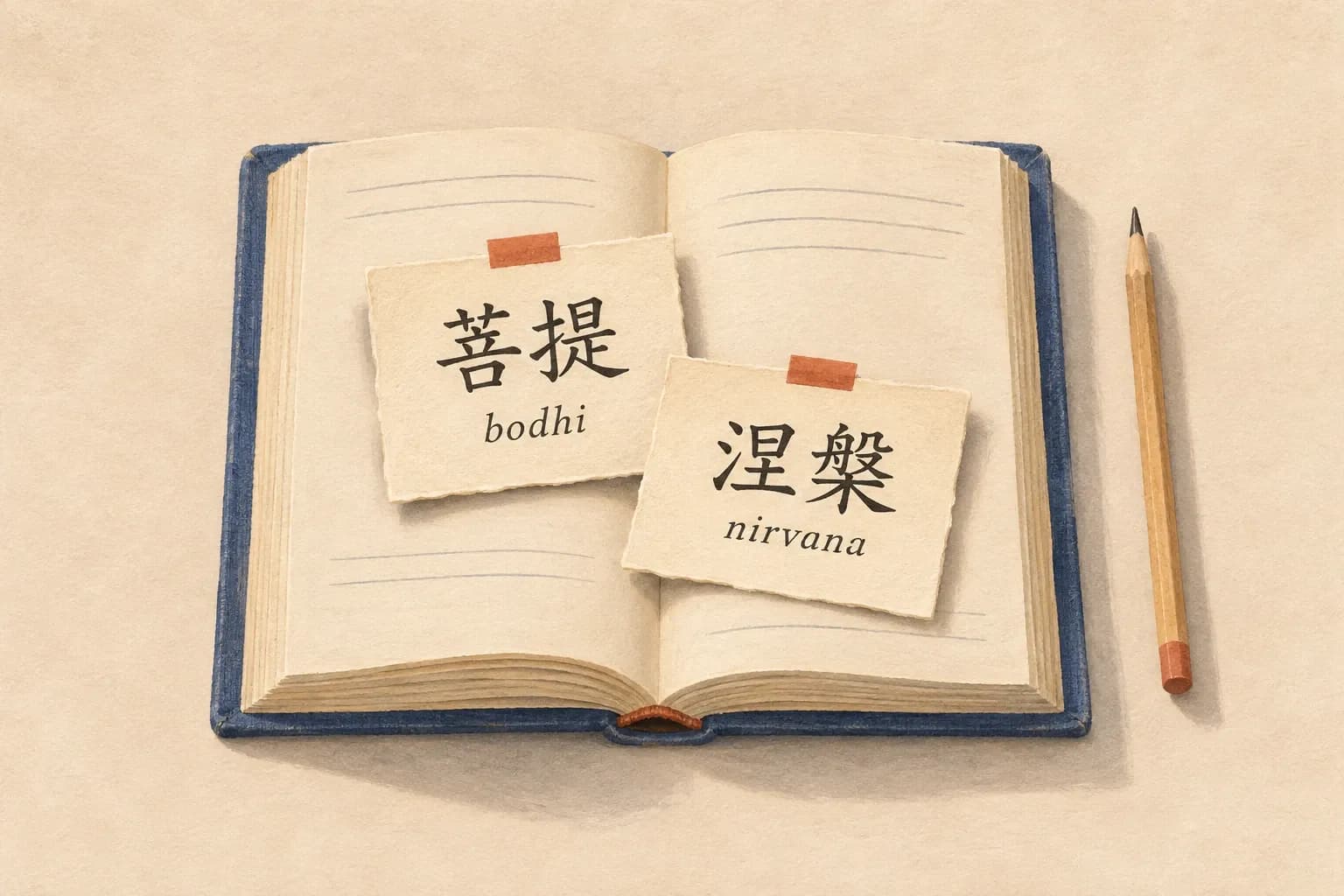
A reader encounters “awakening” in two books and assumes that both describe the same experience. The inference is understandable: familiar words help us enter unfamiliar traditions. But an English expression can also conceal decisions made along the way. Was the source word translated for its meaning, preserved for its sound, or explained through a particular school’s teaching? Before comparing religious goals, it helps to notice what a translation has already asked us to accept.
Chinese Buddhist texts offer a useful place to practice this attention. They preserve both sound-based forms and explanations of meaning. Reading those forms in sentences can make comparison more precise without claiming that Chinese wording gives transparent access to an untouched original.
菩提, pronounced puti in modern Mandarin, represents the Indic term bodhi through sound. 覺, associated with waking or awareness, helps explain its meaning. These are different operations: one carries a term across languages, while the other offers a way of understanding it. The modern pronunciation is not a reconstruction of the sounds used by an ancient translator.
Soothill and Hodous’s 1937 dictionary records this relationship, but its age matters. Charles Muller’s preface to the digital edition warns against treating its terminology and explanations as an adequate primary research tool. A searchable old dictionary is useful; accessibility does not make it current scholarship.
For a modern cross-check, Muller’s Digital Dictionary of Buddhism entry on 菩提, reproduced on Tsadra’s Bodhicitta resource, likewise identifies a transliteration and includes wisdom and awakening among its meanings. It also recognizes contextual overlap with nirvana. That qualification matters: these words are neither interchangeable everywhere nor separated by one rigid rule. [1–2]
The short Chinese Heart Sutra attributed to Xuanzang, T251, places these expressions close together:
究竟涅槃。三世諸佛依般若波羅蜜多故,得阿耨多羅三藐三菩提。
Working rendering prepared for this article, not a quotation from a published English translation:
“[They] reach ultimate nirvana. The buddhas of the three times, relying on the perfection of wisdom, attain unsurpassed complete awakening.”
The bracketed subject is supplied from the preceding passage about bodhisattvas. The first expression uses 涅槃, a sound-based form for nirvana; the second contains a longer sound-based expression conventionally explained as unsurpassed complete awakening.
The reading point is modest. The text relates both expressions to the perfection of wisdom, but gives them different wording and grammatical positions. Translating both simply as “enlightenment” would make that visible difference harder to inspect. This does not prove that the goals are unrelated, nor settle how a commentator should explain them. It shows why a reader should examine the sentence before replacing its terms with a shared English label. [3]
Chapter 7 of Kumarajiva’s Vimalakirti Sutra, T475, complicates another apparently straightforward word: “attain.” Shariputra asks the goddess when she will attain unsurpassed awakening. Her answer challenges the premise of something being acquired:
菩提無住處,是故無有得者。
Working rendering prepared for this article:
“Awakening has no abiding place; therefore there is no one who attains it.”
The exchange continues with Shariputra’s own attainment. He replies:
無所得故而得。
Working rendering prepared for this article:
“It is attained because there is nothing attained.”
These lines belong to a literary and doctrinal dialogue, not a dictionary definition. My reading is that the exchange unsettles an image of a fixed person acquiring awakening as a possession. It should not be turned into a free-standing claim that Buddhist practice is pointless, or that the text rejects every conventional use of attainment language. The question, speaker and response are part of the evidence. [4]
For readers moving between traditions, a small record is more useful than a universal glossary. Write down the text and version, the source expression, the translator’s English choice and the surrounding sentence. Then distinguish three things: what the wording says, what a reference work explains, and what you infer. An inference may be worth making, but readers should be able to see where it begins.
It also helps to ask what a proposed comparison concerns. Are two passages describing knowledge, release from suffering, a path of practice, or the language used to describe a goal? Mark Siderits’s scholarly overview “Buddha,” revised in 2023, connects the title “awakened” with discovering and teaching the path to nirvana. That connection supplies context, not permission to erase every distinction between the terms. [5]
The same discipline applies beyond Buddhism. Begin with the other tradition’s own text, vocabulary and interpretive setting. Shared English can suggest a question, but it cannot answer that question by itself. Conversely, different vocabulary does not establish that meaningful comparison is impossible. Both resemblance and difference need an explanation tied to passages.
“Awakening” can remain a useful English choice. Its usefulness increases when the reader can follow it back to a particular expression, sentence and version. The purpose of these notes is not to replace one convenient word with a supposedly perfect one. It is to keep translation visible enough that comparison becomes an inquiry rather than a shortcut.
[1] William Edward Soothill and Lewis Hodous, A Dictionary of Chinese Buddhist Terms (1937), entry 菩提; Charles Muller's “Preface to the Digital Edition,” especially its cautions about age and terminology: https://mahajana.net/texts/soothill-hodous.html
[2] Charles Muller, Digital Dictionary of Buddhism, entry 菩提, as reproduced in Tsadra Foundation’s Bodhicitta resource, “Key Terms/Bodhi,” dictionary section. This is the accessible reproduction consulted, not a claim to have inspected a subscription edition: https://bodhicitta.tsadra.org/index.php/Key_Terms/Bodhi
[3] 般若波羅蜜多心經, attributed to Xuanzang, Taisho no. 251 (T251). Canonical reference: https://cbetaonline.dila.edu.tw/zh/T0251 Accessible reproduction of the CBETA text used to check the passage: https://tripitaka.zensoul.org/T/T0251/1
[4] 維摩詰所說經, translated into Chinese by Kumarajiva, Taisho no. 475 (T475), chapter 7, 觀眾生品: https://zh.wikisource.org/zh-hant/維摩詰所說經/07
[5] Mark Siderits, “Buddha,” Stanford Encyclopedia of Philosophy, substantive revision March 6, 2023; section 1, archived Fall 2024 edition: https://plato.stanford.edu/archives/fall2024/entries/buddha/
The English renderings of the Chinese excerpts were prepared for this contribution; they are not quotations from published English translators. The interpretations are offered as readings of these identified Chinese versions, not as reconstructions of an original Indic text or definitions binding on all Buddhist traditions.
Huideng Chanyu (慧灯禅语) is a Chinese-language website presenting Buddhist texts and cultural material, with attention to sources, translation and context.